Refugees

Inside the gruesome world of the ‘human safari’

“People don’t actually do that, right?” my publisher asked nervously. “No one actually goes on a human safari, do they?” Eight years ago, I didn’t know for sure. There had certainly been rumors for years that wealthy foreigners were traveling to conflict zones to kill civilians at random. Gradually I had concluded that some people were indeed heading off to complete their bucket list of horrors. In my novel To The Lions, I placed the “human safari” in a fictional refugee camp in southern Libya. Concrete proof, however, was almost impossible to find. Several times during my years as an investigative journalist, I heard stories about nightmarish things going on in places where law and order had collapsed.

The sorry farce of Afrikaner ‘refugees’ fleeing ‘white genocide’

The worst victims of South Africa's African National Congress are not white Afrikaners, even if they are a vulnerable group. The worst victims are poor black people, the majority of South Africans, who have been deliberately impoverished by the super-wealthy ANC elite. These blacks live in stinking squalor with 42 percent unemployment, with water and sanitation failing, terrorized by violent crime and stricken by malnutrition. If any South Africans should be welcomed into the US as refugees, it is they. So it was a sorry farce when 49 Afrikaner “refugees” were greeted as heroes by senior US officials at Dulles Airport in Washington Monday. Trump is talking nonsense about “white genocide” in South Africa.

Afrikaners

Why Japan won’t repeat the West’s mistakes on immigration

Japan has become another piece of fodder for the West’s culture wars. After a recent visit with his family, talk-show host Jimmy Kimmel praised the country for its clean toilets and lack of litter, only to be lambasted by right-wing pundits such as Ben Shapiro, who accused the comedian of having leftist beliefs that are completely at odds with what makes Japanese society so safe and orderly. Namely, Shapiro argued, Japan is a closed-off nation, unpersuaded by arguments to allow mass migration, and its homogeneity and “unique culture,” along with a strict legal system, help sustain this “package deal.” During the height of the Syrian refugee crisis nearly a decade ago, amid intense international criticism, Japan refused to accept asylum seekers from the Middle East.

Japan

How refugees saved a town in upstate New York

Utica was once home to the American Nightmare. In the 1960s, the upstate New York city was a vibrant manufacturing hub, home to 100,000 people. Then the great unwinding began. General Electric pulled out in the early 1990s, and shortly after that the Air Force base closed. Entire streets burned as fleeing residents tried to claim insurance payouts. Families moved out as gangs from New York City moved in. Walking through the rubble in 1999, the mayor joked to an interviewer he had been having a nightmare of his own: “I dreamed I was the mayor of the city of Utica.

refugees

How many refugees can Eastern Europe take?

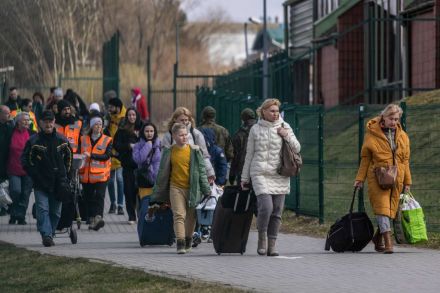
Hundreds of thousands of Ukrainian refugees have already streamed into Slovakia, Hungary and the Czech Republic. Head north to Poland, and the numbers go from the unprecedented to the jaw-dropping: two and a half million refugees have entered the country with a total population of 38 million since the war in Ukraine began. In the Czech Republic, where I live, official estimates put the current number of refugees at over 300,000, a figure expected to rise to between 500,000 and 600,000 in the coming months. In a country of less than eleven million, that’s five percent of the population. In Poland, a proportion closer to ten percent is possible. At the moment, most of the Czech Republic’s refugees are concentrated in Prague.

Souvlaki with graffiti

I’m drawn to sketchiness but even by my sketchy-drawn standards, the state of Athens is deflating. The cradle of Western civilization now appears to be the graffiti capital of the Western world. The luridly colored scrawls are everywhere; Greek grannies air their carpets over balconies marred by multicolored tags and swirls. The Parthenon temple still looks mighty grand atop the ancient Acropolis citadel, but down in the modern city a lot of people look hard-up and downtrodden: lined faces, permanent frowns, hastened aging, disheveled clothes. Wandering through central Athens, I passed two shuttered shops set back from the street. About twenty homeless people lounged in the alcove, amicably passing round substances to smoke and ingest.

Athens

Where Europe ends and the war begins

On a nondescript bridge in the northeastern Hungarian town of Záhony, the European Union ends and the war begins. Even amid the turmoil in Ukraine, the local border crossing is strangely quiescent. The flood of cars from the early days of the war has slowed to a trickle, and big eighteen-wheelers continue to cross over from Hungary into Ukraine. There are only two signs that something is amiss: a small notice on the door of the nearby Penny Market asking customers to help Ukrainian refugees, and a massive billboard of Hungarian prime minister Viktor Orbán’s stern face, promising voters that he will keep Hungary safe and peaceful.

viktor orban eu hungary

Ken Cuccinelli: Afghans flown to US ‘not being vetted’

Former deputy secretary of Homeland Security Ken Cuccinelli said Thursday that the United States has flown in thousands of Afghan nationals that have not been properly vetted in the aftermath of the military withdrawal of Afghanistan. According to data published by the Washington Post, 23,876 'at risk' Afghans have already arrived in the US out of the more than 120,000 individuals that were evacuated from the Kabul airport. Cuccinelli explained during an interview on WMAL's O'Connor & Company that these individuals are being 'paroled in' to the US because there has not been enough time to conduct a thorough security screening and confer them legal status. 'They're not being vetted. They're being what's called "paroled" in,' Cuccinelli said.

ken cuccinelli

Stephen Miller: here comes the Afghan refugee crisis

The rapid takeover of Afghanistan by the Taliban has potentially dire consequences for Afghan women and children. The Islamist group was able to commandeer sophisticated US weaponry and other military equipment during our poorly-planned troop withdrawal. And so Americans have been primed to cheer the arrival of planes carrying thousands of Afghan refugees, who we are told would otherwise be executed by the Taliban, into the United States. But what are the long-term consequences of rapid refugee resettlement? Could this present a risk to national security? How will this effect Americans economically or culturally?

Former White House Senior Advisor Stephen Miller (Getty Images)

Pita Shack flashback

Friday afternoon in the Pita Shack diner in the northern suburbs of Austin, Texas and I was surrounded by Iraqis. There was even a picture of a sweet-looking Marsh Arab girl in her papyrus boat hanging on the wall. It was all unexpected but strangely familiar, stirring memories of Delta-30’s turret-scanning the junction of Red 11 in downtown Al Amarah back in 2004. During the first Gulf War in 1991, the Maysan province around Al Amarah was the site of local uprisings against Saddam Hussein. In retaliation he drained the region’s marshes to deprive the local Marsh Arabs of the waters on which their livelihoods and 6,000-year-old culture depended.

pita shack