Putin

Putin is devouring his children

From our UK edition

Like the Greek titan Cronos devouring his own children, Vladimir Putin seems determined to turn against those he was once closest to – out of fear, anger and hubris. In the process, he is only further weakening his regime. The former deputy head of the infamous Federal Security Service (FSB), colonel general Sergei Beseda, has been moved from house arrest to the investigations wing of the equally infamous Lefortovo prison. Designed to break inmates’ wills, guards escorting prisoners through its corridors use clickers to announce their presence. This allows other prisoners to be placed face to the wall in niches along the way so that they don’t get to see who else is in there.

The three stumbling blocks to a Ukraine peace deal

From our UK edition

A month in, and the war in Ukraine looks very different to how anyone expected. On the first day of the invasion, western intelligence sources believed that Kyiv would fall to Russian forces within 72 hours, underestimating the Ukrainians’ ability to defend their territory and overestimating the Russian military’s capabilities. Among Vladimir Putin’s many errors was his underestimation of western unity. He did not predict the severity of the sanctions against Russia or that his act of aggression would snap Europe (most notably Germany) out of its complacency over defence spending. In some ways, Putin, by going for a full-on invasion, made it easier for the West to adopt a unified position.

Don’t let Russia end the old world order

While most Americans believe that the Russian invasion of Ukraine is morally wrong, there is in some corners a pervasive sense of annoyance with the conflict. The real enemy, some say, is China, and they believe that America should not focus on the last vestiges of 20th-century conflicts at the expense of losing focus on those of the 21st. They see NATO and the rest of the Cold War infrastructure as representative of a dying world. Instead of propping up this order, they argue, America should be hard at work building a new order to take on China. The goal of a new American-led, anti-China world order is a necessary one. The currently existing old order is ill-fitted to combat China, which indeed will be America’s main 21st-century enemy.

A state of virtual war

My husband came into the living room the other day as I was sitting on the couch, scrolling on my computer — doomscrolling to be more accurate. “What are you doing?” he asked. “Are you watching... war?” We laughed at the absurdity of the comment but he wasn’t wrong. That’s exactly what we had been doing for days. Watching war on social media. Needless to say, it was a challenge to focus on this piece. As the conflict escalated rapidly in Ukraine, I couldn’t tear myself away from the drama as it unfolded on Twitter. Putin seemed backed into a corner, desperate and using many of the same barbaric tactics he used in Syria. Bombing hospitals. Bombing kindergartens. Killing civilians.

war

Inside Putin’s mind: the lessons of Chechnya

From our UK edition

As far as Vladimir Putin is concerned, ‘we are nobody, while he who chance has enabled to clamber to the top of the pile is today Tsar and God’. So said Anna Politkovskaya, the eminent Russian journalist, in her book Putin’s Russia. She continued: ‘In Russia we have had leaders with this outlook before. It led to tragedy, to bloodshed on a huge scale, to civil wars. I want no more of that.’ She wrote those prophetic words almost two decades ago. A reporter for the Russian newspaper Novaya Gazeta, Politkovskaya came to prominence during the second Chechen war. Her accounts of that conflict, which officially lasted from 1999 to 2000, revealed Putin’s war against separatist rebels in the Caucasus as a hideous, corrupt sham.

Turkey’s dilemma: whose side is Erdogan on?

From our UK edition

Istanbul Vladimir Putin’s ill-conceived blitzkrieg in Ukraine has failed thanks, first and foremost, to the guts of Ukrainian soldiers and civilians. British and US-supplied anti-tank weapons have played a crucial role, too. But it’s Ukraine’s Turkish--made TB2 Bayraktar drones that have been the war’s most unexpectedly effective weapon. Unexpected not just because of their battlefield killing power but because the father-in-law of the TB2’s inventor and manufacturer is Recep Tayyip Erdogan – the only European leader to have once described himself as a friend of Vladimir Putin. Erdogan, with a foot in the East and West, has emerged as the war’s key power-broker – and his loyalty is being actively courted by both Moscow and Washington.

Why I drove a lorry to Poland

From our UK edition

‘Why the hell did you hire a lorry without a spare tyre?’ asked Rizvana. Fair question. Luckily we had just pulled into a service station near Leipzig when the front tyre blew. The bang was so loud that the cashier rushed outside fearing an explosion. We waited for five hours in the biting wind. German technical prowess came to our rescue. The mechanic arrived with hydraulic lifts, the correct replacement tyre and near-perfect English. Some onlookers gathered as three of us jumped on his torque wrench to loosen the nuts. Our mission was not going to plan. Rizvana Poole is a Labour councillor in my town of Chipping Norton and she’s the reason we drove to Warsaw in a lorry filled with supplies for Ukrainian refugees.

How much is Europe (still) paying Putin for oil?

From our UK edition

When sanctions were imposed on Russia there was a big exception: Europe was still buying and paying for oil – leading to a bizarre situation. The West was doing everything it could to help Ukraine while still sending Putin hundreds of millions of dollars a day. But how much was that revenue worth to the Kremlin? As sanctions began to hit Russia, the price of Brent crude (the oil benchmark) soared to $130 a barrel, the highest since the 2008 financial crisis: an increase of over 90 per cent. It’s fallen since then but today it's still sitting between $107 and $115 dollars a barrel – well above where it had been weeks ago. But are these price rises making money for the Kremlin?

Francis Fukuyama on Ukraine, liberalism and identity politics

From our UK edition

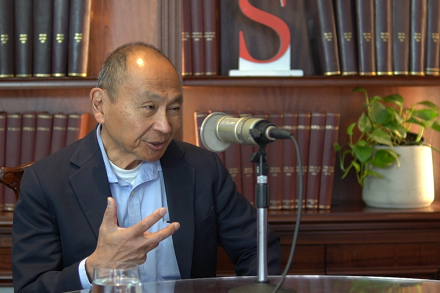
This week, Sam Leith spoke to Francis Fukuyama – the author of 'The End of History and the Last Man' and the newly released 'Liberalism and its Discontents' on the latest episode of The Book Club. You can watch their conversation below, listen to it here or read this transcript. The conversation has been edited for length and clarity. https://www.youtube.com/watch?v=btOHGuzdDVY   Sam Leith: Liberal is a word that means something very different in Tennessee than it does in Muswell Hill. What exactly are the parameters of what you call classical liberalism? Francis Fukuyama: It does have a very different meaning in the United States than it does in Europe. My definition of it is closer to the European one.

It doesn’t matter if Putin is mad

From our UK edition

Mike Tyson put it simply: ‘Everyone has a plan until they get punched in the mouth’. And Vladimir Putin has just experienced a blistering one-two: fierce resistance on the battlefield, trashing his plans for blitzkrieg, followed by the rabbit punch of international sanctions that will soon rock the whole of Russian society. ‘Putinism’ is not an ideology that can command intellectual or spiritual loyalty if it doesn’t deliver. It is not an ‘ism’ like Marxism. It is simply a Mephistophelean deal with the Russian people: if I can have double-glazing and a half-decent smartphone, you can have yachts and palaces. That deal is now off the table.

Russia has never been a part of the West

From our UK edition

In 1697 Tsar Peter the Great set out on a great journey across western Europe, seeking the support of European monarchs in his confrontation with the Ottoman Empire. Unsuccessful in securing alliances, he returned instead laden with ideas acquired in his travels through Britain and Holland, which he promptly put into action in modernising Russia. The most visible symbol of this new nation was Saint Petersburg, the intended new capital of his empire. By 1858, an English visitor to the city described it as ‘one of the handsomest cities in Europe’, with a street of residences ‘so large that 50 extend over an English mile.

The right’s illiberal moment is over

In all my years covering right-wing politics, I’ve met an odd cast of characters: ethnonationalists, archeofuturists, transhumanists, sedevacantists, Austrofascists, neo-reactionaries, incels, identitarians, Proud Boys, Groypers, even Jeb Bush. Yet I’ve never met a Putinist. Not a one. Before we go any further, I want to be clear on this point: Putinists don’t exist outside the former Soviet Union. How could they? Putin himself is a pure nationalist. He embraces the whole ball of contradictions that is Russia. He’s equal parts tsarist and Leninist. Whatever hodgepodge ideology you want to call Putinism, it can’t be applied to the United States. You may as well try golfing with a shovel. Now, I’m sure you’ve encountered a Putin fanboy on the internet.

assassin
putin

Did the realists underestimate Putin?

Liberal internationalists, neoconservatives and NeverTrumpers are having the time of their lives these days, ridiculing anyone on the political right who has ever said a good thing about Vladimir Putin. Those “Putin groupies” as a Wall Street Journal columnist described them, include former Italian prime minister Silvio Berlusconi, far-right French presidential candidate Marine Le Pen, Hungarian prime minister Viktor Orbán and, of course, Trump himself. Trump described Putin as a “genius” and said he was a better president than Barack Obama — and he isn’t the only American president to compliment the Russian leader. President George W. Bush said about Putin, “I looked the man in the eye. I found him to be very straightforward and trustworthy.

The strange ideology that could be driving Putin

Vladimir Putin’s motives in attacking Ukraine have become the subject of many deep and searching speculations. Is he seeking a personal legacy by attempting to reassemble the parts of the Soviet Union that fell asunder? Is he pursuing Russian national security by making sure Ukraine never becomes the frontline of NATO? Is he gleefully taking advantage of a weak and incompetent US president? Is he vindicating the glorious history of the KGB? These theories are not mutually exclusive, and there are many more possibilities. I want to enter the discussion from my nearly pristine ignorance of Russian geopolitical designs.

eurasianism

Why do Russian tennis stars need to condemn Putin?

From our UK edition

Nigel Huddleston is Under-Secretary of State for Sport, Tourism, Heritage and Civil Society, hardly the biggest job in government. Yet he seems a little inebriated on what little authority he has – at least if his latest remarks to the Department for the Digital, Culture, Media and Sport committee are anything to go by. Huddleston has taken on board the mood of the moment. He appreciates that sport must make a stand against Vlad the Invader and the invasion of Ukraine, and which sensible person would disagree? But boycotting Russia from major competitions and clamping down on dodgy oligarch football owners isn’t sufficient, apparently. Huddleston wants more.

The fatal miscalculation that led to war in Ukraine

From our UK edition

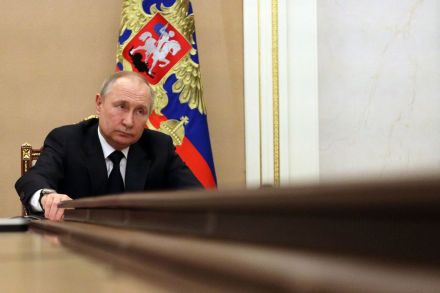
The war against Ukraine – or the ‘special military operation’ as it is compulsorily known in Moscow – has lasted over a fortnight. For weeks Putin maintained a bristling encampment of forces in western Russia, southern Belarus and Crimea. He hoped this would provoke the collapse of the ‘neo-Nazi’ Ukrainian government and its comedian-president. When this failed to occur, he invaded. Photographs show Putin sitting at the end of a long table keeping his distance from his leading associates, such as the booming-voiced foreign minister Sergei Lavrov and khaki-clad defence minister Sergei Shoigu. Gone are the days of Kremlin camaraderie: Putin now expects and gets the maximum display of deference from his followers.

What if Putin hasn’t miscalculated – but the West has?

From our UK edition

Conventional wisdom dictates that Vladimir Putin has ‘miscalculated’ in his invasion of Ukraine. His blitzkrieg has been poorly executed. He has reinvigorated the Nato alliance and the EU and triggered heavy sanctions. And he has lost the ‘information war’ to Volodymyr Zelensky, the TV comedian turned global hero. But what if the West has ‘miscalculated’ in reading Putin’s intentions? What if the West’s sanctions, along with intensified military aid to Ukraine and a courageous local resistance, encourage Putin to double down? What if he decides to use a weapon of last resort, a nuclear, chemical or biological weapon, even at the risk of World War 3?

My one-way ticket out of Moscow

From our UK edition

Things fall apart. Moscow friends call to say that I have to urgently send my 19-year-old son out of Russia. He is travelling on his Russian passport and a new law says that he is obliged to register for the military draft. Nikita is on a gap year working at a Moscow theatre and he begs not to be sent away. I dismiss the warnings. A day later, a friend’s nanny shows up at our door and hands me an inch-thick packet of high-denomination euros to take out of the country for her employer. The money’s owner is already en route to Israel on a private jet. I overrule my son and open up Skyscanner. Europe, the US and Canada have closed their airspace to Russian planes and the Kremlin has reciprocated. Istanbul is the only European destination still accepting flights from Moscow.

Why does everything ‘embolden’ Putin?

From our UK edition

The most emboldened man on earth must be Vladimir Putin. Everything seems to embolden him. Treating Russia as a pariah state could embolden him, wrote someone in the Telegraph, but Barack Obama’s previous attempts to engage with him had just emboldened him, wrote someone else. Liz Truss on a visit to Kiev last month, insisted the West should strengthen relations with Ukraine. ‘If we hang back, that would only embolden the bullies,’ she said. Nato’s humiliation in Afghanistan helped embolden Putin, wrote Colonel Richard Kemp; sanctions hitting the population can embolden him too, wrote Tobias Ellwood. As Julian or Sandy, on the BBC Light Programme in the early 1960s, might have remarked of Kenneth Horne: ‘Oooh, innee bold?