Putin

I stand with Diane Abbott

From our UK edition

Not for the first time in her political career, Diane Abbott is getting a lot of flak online. She’s being trolled, heckled and denounced as an enemy of the United Kingdom. Only this time Ms Abbott is being hauled over the coals not for saying something silly, but for saying something sensible. Something true. Something fundamentally correct. Namely, that Nato bears a great deal of responsibility for the current crisis in Ukraine. Browsing the Abbott-bashing headlines you could be forgiven for thinking she had upped sticks, flown to Moscow, and sworn lifelong allegiance to Vladimir Putin. ‘Diane Abbott backs Russia!’, says the Express.

What really happens if Russia invades Ukraine?

From our UK edition

Russia will pay an enormous price if it invades Ukraine, whether it goes for the whole country or only the eastern region around Donbas. Vladimir Putin has already assembled well over 100,000 troops near Ukraine’s borders, moved in tanks, heavy artillery and aircraft, and brought in the medics and blood supplies needed to deal with casualties. Western governments have evacuated all but essential diplomatic personnel and told their citizens to get out now. Still, no one knows what Putin has decided, or even if he has decided. Visits to Moscow by senior western politicians have yielded little information and no diplomatic solution. The message seems to be that Putin remains uninterested in a compromise.

Ukraine’s plight paints a bleak vision of Europe’s future

From our UK edition

It is tempting to view Vladimir Putin as a Cold War relic: a former KGB officer who hasn’t got over the fall of the Soviet Union, which he called the ‘greatest geopolitical catastrophe of the century.’ But, as I say in the Times today, what is happening on Ukraine’s border isn’t a throwback to the Cold War. Rather, it is a preview of Europe’s future. Since Nato’s creation, European security has rested on America’s involvement. But Europe is now a secondary concern for the US; Asia and competition with China is the most important challenge facing Washington now. The horribly messy US withdrawal from Afghanistan was justified on the basis that it would free up resources to focus on China.

Why Putin wins

From our UK edition

Does Vladimir Putin intend to invade Ukraine? Or are his troop manoeuvres just a game — another test of the West’s resolve? If the former, he will win: British troops (and citizens) have been told to leave Ukraine in the event of conflict and no one doubts that the estimated 130,000 Russian forces could succeed in their objective. So the first major land war in Europe since World War II would end in an easy victory for Russia.  “My guess is he will move in,” Joe Biden said last week, as if he were a casual observer. Families of US diplomats in Ukraine have been ordered to leave the country But even if it's a bluff, Putin can count the past few weeks a success.

Viktor Orbán or: How I Learned to Stop Worrying and Love Putin

From our UK edition

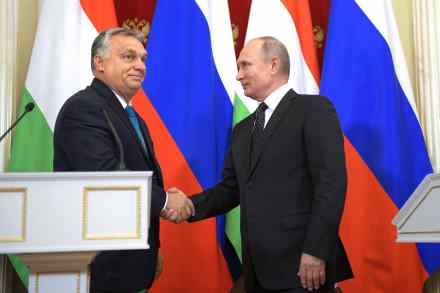
Viktor Orbán first came to prominence when in 1989 he declared on live TV that Hungary must put an end to the ‘Russian occupation’. On the first day of February this year, he held his thirteenth meeting with Vladimir Putin. What’s changed? Like much of his generation, Orbán initially believed that the fall of communism would mean a ‘return to Europe’ — with not only western democracy but also a western standard of living. Yet after a brief and unpleasant stint studying in Oxford, the student politician discovered that Britain’s future elites were ignorant and decadent.

Read: Tucker Carlson on Ukraine, ethno-nationalism and M&Ms

From our UK edition

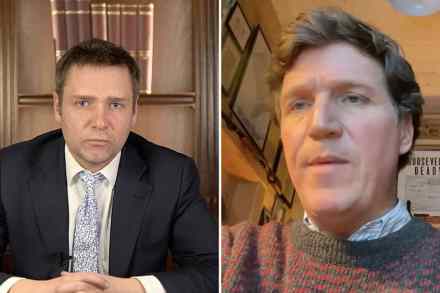
This week, Tucker Carlson spoke to Freddy Gray on the latest episode of Spectator TV. You can watch their conversation here, or read it below: Freddy Gray: It’s a great honour to be joined by Tucker Carlson, who is the host of Tucker Carlson Tonight, which is a show on Fox News, but it’s also available in the UK or through the Fox News app. We’re going to continue to be talking about Ukraine. And Tucker, I think it's fair to say you've encountered quite a lot of criticism in recent days because as far as I can figure out, you are the only mainstream host who is sceptical of the idea that President Biden needs to interfere militarily if Vladimir Putin invades Ukraine. And for that, you have been called a Russian spy and a Russian asset.

No one should celebrate the decline of America

From our UK edition

Where is America? Like an old friend who hasn’t been in touch for years, you wonder if its silence is lost interest or if it just got too busy. America used to be everywhere, the dominant voice in world affairs, a desirable friend and a much-feared enemy. It intervened (and, yes, interfered) whenever it felt its interests or values were threatened. Often its involvement was unwanted and sometimes it didn’t improve matters, but there was a reliable solidity to it, a sturdiness born of military might, prosperity and national self-belief. It could be admired or reviled, but it had to be reckoned with. America shies away from it all now. Observe how Joe Biden alternates between stark warnings and unintelligible ramblings on the prospect of a ground war in Europe.

Letter from Odessa: life on the front line of a new Cold War

From our UK edition

‘God Save the Queen’ trended on Ukrainian social media over the weekend. ‘As a Brit in Kiev I have never felt so popular,’ one expat tweeted. Four hundred miles to the south, however, on the once grand, now shabby streets of Odessa, the enthusiasms of the Twittersphere seem remote. There is little optimism that Britain, or indeed any other western country, can do much to halt the tidal wave that locals fear Russia is about to release on them. At first blush, life might look normal. On the main pedestrian street, Deribasovskaya, horsemen offer children rides on ponies with pink saddles. But in the city’s cafés, markets and large open squares, there is gnawing fear and growing unease. ‘How can we plan for tomorrow?

Haunted: the spectre of revolution is stalking Putin

From our UK edition

A spectre is haunting the former Soviet Union — the spectre of people power. Every time it appears, Vladimir Putin leads an unholy alliance of all the reactionary autocrats of the former Soviet space to try to exorcise it. Last week, Putin sent 3,000 Russian paratroopers to Kazakhstan at the request of its president to crush a sudden revolution that left at least 160 protestors and 12 security officers dead. For the time being, it looks like Putin’s timely intervention — as well as an internet shutdown that paralysed protestors’ ability to coordinate — has successfully quelled the flames.

No, Putin isn’t trying to bring the Soviet Union back

From our UK edition

On Christmas Day 1991, in his last act as president, Mikhail Gorbachev signed away the existence of the Union of Soviet Socialist Republics. A 74-year experiment that began with the ‘Great October Revolution’ of 1917 (although the USSR was formally constituted in 1922) was over. Or was it? Thirty years on, Stalin regularly tops the Levada Centre’s survey of ‘the most outstanding personality in history’, while half of Muscovites favour the return to Lubyanka Square of the statue of ‘Iron Felix’ Dzerzhinsky, founder of the Bolshevik political police. Russian troops are massing on Ukraine’s borders. Moscow demands that Nato should stay out of the countries of the former USSR. The control of the media and public conversation tightens.

The battle for Ukraine has already been lost

From our UK edition

Forget the 'commitment' of the US Secretary of State Antony Blinken to Ukraine’s sovereignty, the EU’s 'firm and decisive' support, and Liz Truss's vow to 'stand firm' with Ukraine. The hard truth is that the West has already lost, or rather abandoned, Ukraine. Even if it is not overrun by Russian tanks this winter, the Kremlin has a free hand to destabilise, threaten, and undercut Ukraine – including by intensifying the conflict in Ukraine’s east. After all, that war, initiated by Vladimir Putin, has been ongoing since 2014. And for all the tough rhetoric, countless sanctions, and the two bargains struck in Minsk, Russia continues to occupy Crimea and treat Donbas as its own territory.

Lukashenko and Putin are exploiting Europe’s migration muddle

From our UK edition

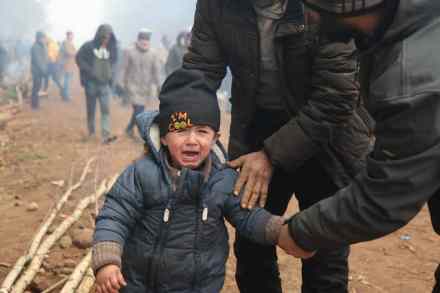
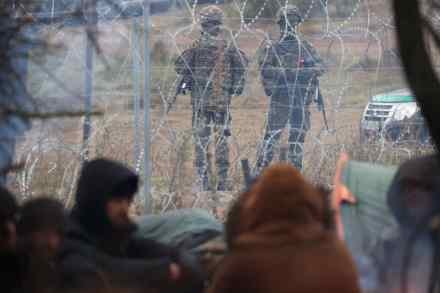
At the border of Belarus and Poland, camps of migrants wait for a chance to cross the border into the EU. Groups attempt to break down the razor wire fences standing in their way, Some 15,000 Polish soldiers stand ready to stop them. Belarusian soldiers urge them on and offer assistance. The Belarusian state shuttles more migrants towards the border by the day, hands out wire-cutters, and prevents them from turning back. Some 30,000 migrants have attempted to cross into Poland since August. That number is swelling by the day, with Belarus now running dozens of flights every week ferrying further desperate people to Europe’s eastern border.

How Turkey is fuelling the Belarus-Poland migrant crisis

From our UK edition

In the cold, damp forest lining the border between Poland and Belarus, thousands of refugees flown over from the Middle East have waiting to cross into the EU for days. Belarusian riot police are shoving them away from their gates and towards Poland, where only more forces await. The Belarusian dictator Alexander Lukashenko has recently been in conflict with the EU, which has imposed sanctions on his regime after last year’s contested elections which many believe to have been rigged. Lukashenko is pushing refugees towards Poland to be pawns in a fight, with the backing of Putin. The refugees find themselves between a rock and a hard place: in front of them, a Polish government who looks good appearing tough against migration and Lukashenko.

There is no Russia-China axis

From our UK edition

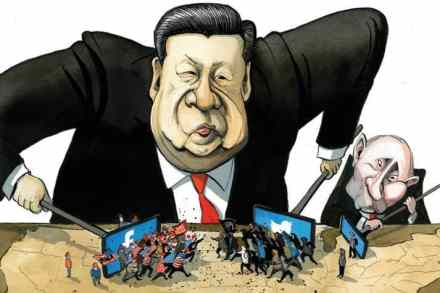
You should be careful what you wish for, because you might just get it, so the old cliché goes. In diplomacy at the moment, it seems you should be careful of the threats you prepare for, because you may end up producing them. There is a growing trend in the West towards treating Russia and China as some single, threatening ‘Dragonbear’ (a reference to the two countries' national animals). This underrates the very real tensions between Moscow and Beijing, but risks pushing them even closer together. The most recent case in point was Nato secretary-general Jens Stoltenberg’s interview in the Financial Times, in which he criticised ‘this whole idea that we either look Russia, or to China… because it goes together.

Is Russia ready for life after Putin?

From our UK edition

When Russians headed to the polls last week, the Duma election results were never in doubt: Putin’s United Russia party won two-thirds of the seats, while the rest went to the tame ‘systemic opposition’. But even if the outcome wasn't a surprise, the manner of Putin's victory should ring alarm bells about what happens in Russia when he eventually departs. The Kremlin ‘won’ the Duma elections insofar as United Russia received the number of seats it wanted. It did this on just 50 per cent of the vote, down on previous elections, with widespread violations, and at the cost of what little credibility the electoral process still enjoyed. In regimes like Russia, elections are not for the people, but for the autocrats.

How Russia lurched from vaccine victory to Covid crisis

From our UK edition

Russia made headlines last August when it triumphantly unveiled its pioneering coronavirus vaccine, Sputnik V. But now, nearly a year on, it has a more dubious claim to fame – as the anti-vax capital of the world. For months now, sparkling clean pop-up clinics offering jabs to the public, with no appointment needed, have been open for business in shopping centres and food halls across the country. With three domestic formulas approved and millions of vials in reserve, there is no shortage of doses for anyone who wants one. And yet, Russians just aren't signing up.  New data from research giant Morning Consult, based on 75,000 weekly interviews with people across the globe, has found the nation has the highest level of vaccine scepticism of anywhere surveyed.

Why the Biden-Putin summit wasn’t a waste of time

From our UK edition

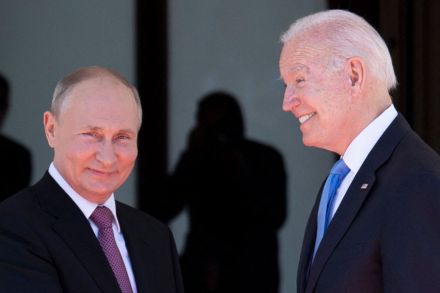
The meeting between U.S. president Joe Biden and Russian president Vladimir Putin in Geneva started cordially enough. A quick handshake, toothy smiles for the cameras, and some standard words of diplomacy. 'I would like to thank you for the initiative to meet today,' a slouching Putin told an attentive Biden. 'Still, U.S.-Russian relations have accumulated a lot of issues that require a meeting at the highest level, and I hope that our meeting will be productive.' Putin's words were something of an understatement. U.S.-Russia relations are scraping the bottom of the barrel and may very well be at their lowest point since the early 1980s, when Washington and Moscow were turning Europe into a parking lot for intermediate-range missiles.

Russian memoirs are prone to a particular form of angst

From our UK edition

Perhaps the secret to understanding Russian history lies in its grammar: it lacks a pluperfect tense. In Latin, English and German the pluperfect describes actions completely completed at a definite point in the past... Early Russian had such a tense, but it was erased. This grammatical lack costs its speakers dear. Russian history never becomes history. Like a stubborn page in a new book, it refuses to turn over. Thus wrote the Soviet dissident and writer Igor Pomerantsev, my father, during his exile in London in the 1980s. When I returned to Russia in the 2000s I had the sense that beneath the Potemkin democratic veneer, Putin’s Russia was actually a case of history repeating, and retrod my parents’ route back to England.

Why Lukashenko keeps getting away with it

From our UK edition

The diversion of a Ryanair flight bound for Lithuania from Athens and the arrest of passenger Roman Protasevich – an influential Belarusian blogger critical of the country’s dictatorial regime – is the latest tyrannical action to lead to expressions of grave concern and tempered outrage from the West. However, the fact that the passenger aircraft was forced to land by a Belarusian fighter jet on the pretence that the plane was carrying explosives is, arguably, a step up on the ladder of severity. Police brutality and the unlawful detention of opposition activists are quick to cause Western condemnation, but those still solely concern domestic matters – the interception of a European plane in transmit between two EU member states is unprecedented.

Alexei Navalny’s big gamble

From our UK edition

Alexei Navalny seems to undergoing a metamorphosis. Yesterday, we saw him attending another trial by video, looking gaunt after 24 days of hunger strike. But if anything, the more attenuated his frame, the more his moral certainty shone through it. An appeals hearing for a separate charge of insulting a Second World War veteran gave him a rare opportunity to speak to the outside world. Characteristically, he made a joke of his condition to his wife, Yulia, saying he now looked like ‘a creepy skeleton.’ However, this was a moment’s light-hearted intimacy in a bravura performance primarily directed towards both the Kremlin and the wider Russian population.