Poverty

Fuel Poverty and the Winter Fuel Allowance

From our UK edition

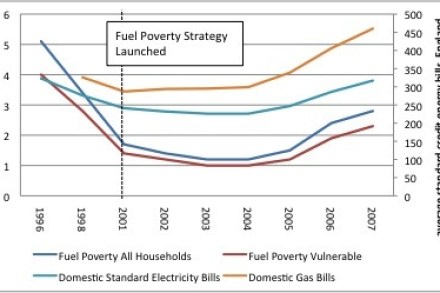
The Winter Fuel Allowance was an emotive part of the election campaign, with Labour accusing the Tories of planning to scrap it and David Cameron promising not to. At no point during that debate was it asked whether the WFA was a good way to spend money. Our report earlier this year, Cold Comfort, examined in some detail the demographics of fuel poverty, as well as questioning the logic behind the government’s target. If you take the fuel poverty measure (those spending more than 10% of income on energy) as read, the last government failed utterly to achieve anything on it – as the graph below shows. They introduced the target when fuel poverty was declining sharply and were surprised when it bottomed out and started rising again.

The war on poverty opens a second front

From our UK edition

I detest the use of the word ‘Czar’. Everything has a Czar – potato regulation, multi-story car parks and Twitter being my favourite three. But the war on poverty needs to be fought by free-thinking absolutists. The appointment of Frank Field to conduct an independent review into poverty and life chances confirms David Cameron’s, and the coalition’s, non-partisan commitment to social mobility and betterment.   Field presents his analysis in a succinct piece in the Telegraph.  He writes: ‘Over recent decades, the Left and centre-Left’s answer to poverty and inequality has been to spend more money, to redistribute from richer to poorer.

The IDS agenda could help to end the benefits trap

From our UK edition

Yesterday, it was Michael Gove's schools agenda. Today, it's the other main reason to get behind the coalition: IDS's plans for fixing the welfare system. The Secretary of State for Work and Pensions has given a speech outlining them this morning. You can read it here, and I'd certainly encourage you to do so. There are plenty of welcome ideas in there, but none more so than IDS's emphasis on removing disincentives to work from the tax and benefit system. We at Coffee House have banged on about his "dynamic" approach, developed at the Centre for Social Justice, for some time now - and with due cause.

What to do with all that knowledge on welfare

From our UK edition

Is Frank Field back? The Labour MP has spent much of his life talking about the poor. Judging by reports today, he might be offered a job chairing a commission on child poverty. This is good news but, as Mr Field has already said, there is not much point in him debating the finer points of poverty definitions. He would need to be given remit to suggest policy. What should those suggestions be? First, he should argue that we need to be a lot less self-indulgent about how we think about child poverty. It may be great to think of ourselves as tackling a major social ill, but the past government’s approach was not nearly as successful as it or its supporters liked to think.

Low dishonest dealings

From our UK edition

The strange, unsettled decades between the wars form the backdrop of much of D. J. Taylor’s recent work, including his novel, Ask Alice, and his social history, Bright Young Things. At the Chime of a City Clock is set in 1931, with a financial crisis rumbling in the background. The strange, unsettled decades between the wars form the backdrop of much of D. J. Taylor’s recent work, including his novel, Ask Alice, and his social history, Bright Young Things. At the Chime of a City Clock is set in 1931, with a financial crisis rumbling in the background. James Ross, a struggling writer, tries to keep his landlady at bay with the meagre income he earns as a door-to-door carpet-cleaner salesman.

Overseas aid could be a Tory winner in Con-Lib fights

From our UK edition

As the Conservatives start looking at areas where the Liberal Democrats are weak, or where differences can be drawn between the parties, they are honing in on international development. In the Independent on Sunday, David Cameron and anti-poverty star Jeffrey Sachs lay out the party's plans if they win power. It includes a commitment to spending 0.7 of GDP on overseas aid, an emphasis "on greater transparency, ensuring the money reaches the people who need it most" and "action on women" as a conduit to development. The op-ed is clearly inspired by the work of Tory aid spokesman, Andrew Mitchell, who has written a piece for ConservativeHome this evening.

Why we shouldn’t confuse poverty with inequality

From our UK edition

The power of ideas is vastly underrated in British politics. It has become fashionable to dismiss them as "ideology" and declare oneself in favour of "what works".  But the idea of what works is, of course, driven by concepts. As Keynes put it: "Practical men, who believe themselves to be quite exempt from any intellectual influence, are usually the slave of some defunct economist."   I write this because ConHome has just run a piece by Max Wind-Cowie saying, "Equality should not be a dirty word for the Conservatives". I do admire the way Demos, seeing Labour on the way out, is trying to inject as much of its agenda as possible into the Conservative party. But "equality" is, alas, a trap.

Tim Montgomerie’s broad church

From our UK edition

The FT Magazine has a cover boy today: Tim Montgomerie. It’s about how “a small group of Christian Conservatives are rewriting party doctrine,” and has positioned Tim in such a way that there appears to be a halo behind his head with his eyes heavenwards. Something tells me this was not the picture Tim was expecting. The front cover tease sounds like one of these conspiracy theories you get in America: the capture of a political party by a small band of idealogues etc etc. Read on, and the piece is fair and instructive: it tells the important – but hardly controversial – part of a key aspect of Conservative development. It starts in 1990, when Tim founded Conservative Christian Fellowship, on principles which went on to guide his career.

“Saboteur” or realist?

From our UK edition

Lord Lawson is Andrew Neil’s guest on this week’s BBC Straight Talk and, among other topics, the former chancellor rebuffs Ed Miliband’s accusation of climate change heresy. Lawson said: “I hope that all parties…take a good hard look at this, we don’t want a sort of Stalinist monolithic line in everything.  But I do think, because of the damage that will be done to the economy, that is why, and for very little good, if any, that is why we have got to take a good hard look at the fact that we can’t get a global agreement on this anyway, as will be seen in Copenhagen…So, I think you have got to go back to the drawing board and have a fresh approach.

The choice facing the Tories

From our UK edition

If you'd like a step-by-step preview of Labour's next election campaign, then do read Alastair Campbell's latest blog post.  All of Brown's attacks from PMQs are in there, and then some: "tax cuts for the rich"; a lack of "policy heavy lifting" on Cameron's part; the Tories "haven't really changed", etc. etc.  The spinmeister has been in closer contact with Downing Street recently, and it shows.  It's all gone a bit bar-brawling. The Tories now face a choice between, broadly speaking, three different responses: i) Ignore Campbell.

Tightening immigration should constitute part of compassionate Conservatism

From our UK edition

The mainstream parties’ collective silence on immigration has, undoubtedly, contributed to the BNP’s growing popularity. Nicholas Soames and Frank Field have penned such an argument in today’s Telegraph. David Cameron’s modernisation of the Conservative Party came at the expense of even mentioning immigration. Yesterday’s mind-boggling population projection should curtail the era of uncontrolled immigration: Britain cannot sustain such human and social pressure in the age of austerity. The Tory leadership might view this reality with trepidation. They should not. Limiting immigration would alleviate poverty; it equates exactly with the Tories’ broad one nation philosophy.

Why marriage should be recognised in the tax system

From our UK edition

Cameron has been fairly bold in entering the debate on marriage, because we don't like do that debate in Britain. Not really - it's private, and we Brits don't like debating private things. Anything which helps marriage can easily be paraphrased as "deploying fiscal incentives to force something which should largely be a private decision". And not by the left, but by our very own Pete Hoskin in the below post. Now, we are a heterodox bunch of baristas here at CoffeeHouse and we do disagree - so here is why I think Pete is wrong. I'd like to have a go offering some of the "convincing answers" he's looking for. Right now, millions of couples are better off apart under the perverted incentives of the welfare state. The Tories would remove this anomaly.