Poverty

No rights without responsibility

From our UK edition

The most recent official statistics show that 5.4 million adults and 1.9 million children live in the UK’s 3.9 million workless households. Through the Universal Credit, the coalition is taking a radical approach to tackle this, but it won’t be enough. The government’s own analysis estimates that it will move 300,000 households into work. But this will leave 3.6 million households behind, dependent on benefits and likely to pass worklessness onto the next generation. There are also timing worries. Unemployment and, in particular, youth unemployment are high on the political agenda (new statistics on NEETs will come out next week), but the Universal Credit will not be fully implemented for another seven years.

The battle over universal benefits continues on the local front

From our UK edition

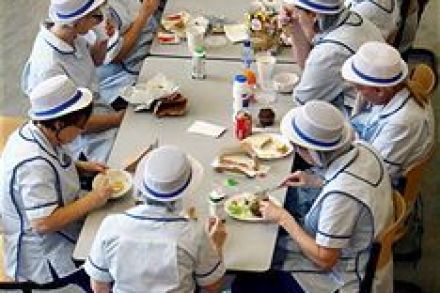
Here's a question for you: should free school meals (FSM) be given to all pupils, regardless of their parents' income? I ask because this is precisely what the Labour-led council of Southwark is proposing for its primary schools. As the Evening Standard reports, the councilmen’s thinking is that by giving "healthy" FSMs to every pupil, every day, they might help "reduce childhood obesity." Oh, and the measure will cost some £4 million a year. Even if we put aside the question of whether the local praetorians should — or even could — tackle obesity on behalf of middle-class parents, this is still needling stuff.

Grammar schools aren’t an answer to the social mobility problem

From our UK edition

With all the talk about social mobility, it was inevitable that those who believe grammar schools were the doorway to opportunity would wade into the debate. The most prominent of these interventions came yesterday from David Davis, who said: “The hard data shows that the post-war improvement in social mobility, and its subsequent decline, coincided exactly with the arrival, and then the destruction, of the grammar school system. This is the clearest example of the unintended consequence of a purportedly egalitarian policy we have seen in modern times.” The “hard data” Davis refers to is this 2005 study by Jo Blanden, Paul Gregg and Stephen Machin for the LSE and the Sutton Trust.

Your five-point guide to the coalition’s social mobility report

From our UK edition

The government's new report into social mobility is, it tells us, all about "opening doors" and "breaking barriers" — but it's probably taxing attention spans too. 89 pages of text and graphs, offset by the same pea soup shade of green that's used for all these coalition documents. To save you from wading through it all, here's our quick five-point summary: 1) The same story… Much of the report, as James suggested earlier, is familiar territory. After all, the coalition's two most developed policy areas — welfare and education — are precisely designed to improve opportunities for the least well-off; so here they are again, restated and slightly reframed.

Miliband’s two big risks

From our UK edition

Who would have thought it? Miliband's short speech in Nottingham today went largely unheralded, and doesn't seem to be getting a whole lot of attention now — and yet it tells us more about his approach to Opposition than almost anything he has said previously. Fact is, the Labour leader is taking two risks that may be either bold or foolhardy, depending on your point of view. These risks could come to define his Labour party. The first is splashed right across the entire speech. Miliband dwells on three "challenges" that the country will face over the coming decade: the "cost of living crisis"; declining prospects for the next generation; and the erosion of the "Merrie Englande" that David Aaronovitch wrote about this week.

Brits want to give money abroad – but not necessarily via the government

From our UK edition

"A well-targeted aid budget is essential if Britain is to punch above its weight on the world stage." That's how Tim Montgomerie finishes his neat defence (£) of British aid policy for the Times today. But, putting aside the matter of whether it's wise to give aid to, say, India at a time of spending restraint back home, Tim's claim rather inspires a question: is our aid budget well-targeted? And the answer, it seems to me, is encoded in Ian Birrell's punchy piece for the Evening Standard. Ian's overall point is similar to that made by economists such as Dambisa Moyo, whose work we have mentioned on Coffee House before now: that international aid is failing, on a grand scale, to do anything about the poverty it's meant to alleviate. Worse, it even has counterproductive effects.

Aid to India to be replaced with pro-growth help

From our UK edition

How to manage Britain's aid to India? The fast-rising country has a space programme, costing nearly the same as Britain gives in annual aid. To many people, that is reason enough to cut all aid. Yet, at the same time, India is one of the world's poorest countries. 456 million people live on less than $1.25 per day. Annual income per person is only $1,180, compared to $3,650 in China and $41,370 in the UK. That means there are 20 percent more poor people in India than in sub-Saharan Africa. But India receives only $1.50 in aid per person, compared to $28 for Sub-Saharan Africa. A good example of India's plight is Bihar province, which has population the size of Germany’s.

Clash of the wonks

From our UK edition

Last night the Southbank Centre hosted its second “Think Tank Clash”.  As last year, it was a sell out event, and saw representatives of six of the country’s top think tanks take each other on in three debates.  These debates were ably and wittily compared by writer John O’Farrell and the winners determined by audience vote.  The winners of each “clash” then competed in a three-way discussion to determine the overall top tank. Round 1: “Revenge” – Res Publica v Demos Res Publica founder and director Phillip Blond commenced by making the case for breaking up the banks. He argued that the current system does not distribute capital, but rather concentrates it, thereby “strangling real business”.

Much more than a networking event

From our UK edition

What's the point of Davos? This is a question seldom addressed in the reports filed from the five-day "World Economic Forum" which ended on Sunday. Many speeches are made, many issues debated, but it is not a place where decisions are taken. It is not a G20. Manifestos are not launched there. It exists to serve a very particular function: every year for a short period of time it becomes the temporary capital of the globalised world. Top business and political leaders, distinguished academics and journalists - all committed to improving the state of the world - flock there to meet each other, swap ideas and then go home. This year, I went along for my first visit - and I promised to file my own report for CoffeeHouse on what I made of it.

The pressing need to redefine poverty

From our UK edition

What is ‘poverty’? It might sound a basic question but, when we hear about x percent of people ‘living in poverty’, what does that actually mean? The policy review conducted by Frank Field last year offered a number of insights into the issues of life chances and their determinants. But it failed to address that fundamental question: what is poverty? Until we know what we are measuring, it is impossible to attempt to tackle it. Poverty continues to preoccupy us. According to the British Social Attitude Survey, the majority view is that there is “quite a lot” of poverty in Britain today, and many expect it to increase over the next ten years.

Frank Field’s report highlights the coalitions within the coalition

From our UK edition

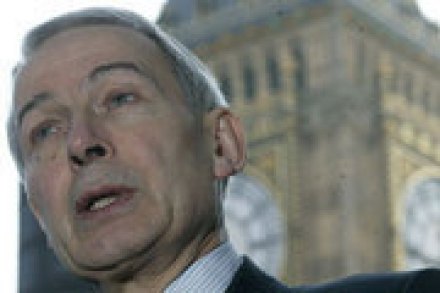
Frank Field's review of child poverty policy covers a daunting expanse of ground. From breast-feeding to the little society ("the younger sister of the Big Society"), it's stuffed with more ideas than reviews that are twice the size – and will take some time to digest properly. But, in a way, that's precisely the point. Field's central argument is that New Labour took an overly simplistic view of poverty. For Brown & Co. it was all about funnelling cash handouts to poor families, often to lift them from just under an arbitrary poverty line to just above it. For Field, it is more about improving opportunities across the board, with a particular focus on children aged 0 to 5.

Flight’s loose tongue

From our UK edition

Has Howard Flight just done a Keith Joseph? The latter’s run for Tory leader ended when he made a speech about poor people breeding.  As David said earlier, plain speaking can have its problems. But Flight’s danger is in being mistranslated. He sought to make a simple point: that many working families can't afford to expand their families, while the state provides a substantial cash incentive for those on benefits to do so. But his use of the word “breeding” sounds like he’s into eugenics, and the language – talking about the poor – sounds dodgier still. Given his struggle with foot-in-mouth disease, it’s surprising that Cameron ennobled him.  But still, his quote is a far cry from what Joseph said in Edgbaston.

Breaking dependency

From our UK edition

IDS has played the party politics of welfare reform adeptly. He has built a coalition beyond the government, convinced of the need for urgency and dynamic reform. Even Labour is on side, only criticising when valid and necessary. It has not proposed a comprehensive alternative because it is protecting its record in government - sensing, correctly, that it is vulnerable to its history. Douglas Alexander rallies to New Labour’s defence in the Independent on Sunday. Labour’s record on welfare was not uniformly baleful: Purnell, Hutton and Murphy did important work, on which IDS has drawn. But Alexander overlooks some inconvenient truths.

To the victor the spoils

From our UK edition

The government must be doing something right with its aid policy: several NGOs absolutely hate it. Talking to the Guardian, Patrick Watt, Director of Save the Children and sleeping disciple of the Moral Compass of Kirkcaldy, has criticised the government’s decision to direct aid funding to conflict resolution. He says: ‘What is the real driver of aid allocation? Is it poverty, is it need and the ability to use money effectively or is it the agenda of the National Security Council? We do need to have a balanced approach to aid allocation that reflects the principles of the 2002 International Development Act which stipulates that all aid should be for poverty reduction.’ Put simply, Watt doesn’t get it.

The morning after the day before

From our UK edition

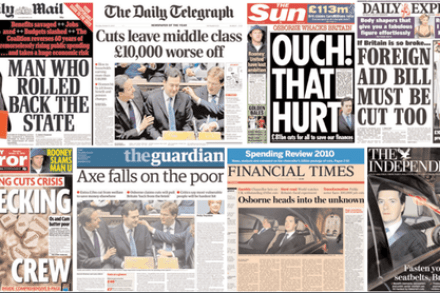
The last time the doomsayers were proved so wrong was when the Hadron Collider didn’t blow us all up. Osborne’s cuts have come and life, the universe and everything continue insouciantly. In fact, the cuts were nowhere near as deep as many expected. As the graphic above proves (courtesy of ConHome), the press reaction is cordial, which was the best the Osborne could hope for. The Times (£) and the Guardian express concern about fairness, based on decile graphs that suggest the poor will receive less direct income from the state; and the Telegraph grumbles about the ‘squeezed middle’.

Spectator Exclusive: Britain’s welfare ghettos

From our UK edition

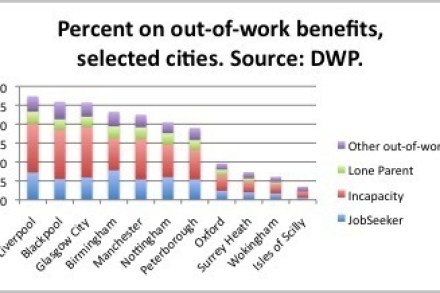
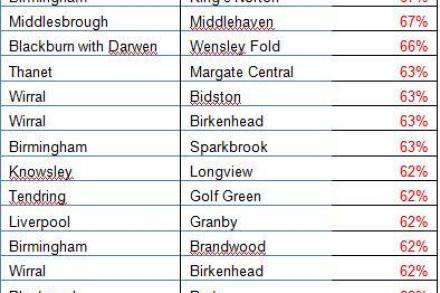
Today we are releasing a brand new picture of the nation’s welfare ghettos. Our research gives a disheartening insight into the extent of dependency in England and Wales. The top line: things are getting worse. This is much more detailed and useful information that the statistics often bandied about by politicians. It is well known, for example, that nearly 2 million people have been claiming out-of-work benefits for more than five years. But what does that look like?

A tale of two statesmen and a wary industry

From our UK edition

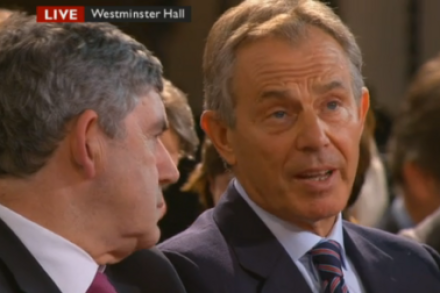
The only readable part of Tony Blair’s Lawrentian romp of a memoir, is the epilogue. He explains why the state must be trimmed in the future and how globalisation is affecting global polities, and all expressed with languid charm and an air of self-deprecation which he has acquired on the road to riches. No wonder he’s the toast of Washington, the UN and Beijing – he’s the model of the Modern English Gentleman, a real pukka sahib. Gordon Brown, meanwhile, has travelled to the UN to attend a meeting on tackling poverty. After a decade of enduring Bono at his most self-righteous, poverty is not yet history. Aid agencies and campaigners, wary of aid fatigue, are asking what went wrong. It seems that humanity could not realise its expectations.

Field caught between reality and fantasy

From our UK edition

Frank Field's been thinking. He will make his report on poverty next week and he hints at its contents in an extensive interview with the Times (£). He is convinced that there is more to social mobility than money and he has some brilliantly simple ideas to alleviate poverty. He advocates creating four or five terms in the school year to shorten the long summer holiday, which he argues disadvantages the poor. 'They have less help at home so they lose out even more in long holidays. They drop behind, they are not being read to or tutored or talked to in the same way as many middle-class children. They have often fallen behind by the beginning of the next school year.The school year is also out of kilter with mums working.

Brown’s plan for the future

From our UK edition

Mr Blair’s former breathless lover will form the fully staffed Gordon and Sarah Brown Foundation, paid for by lucrative speaking engagements, which the Spectator revealed some weeks ago. He has accepted three pro-bono appointments - joining Queen Rania of Jordan’s Global Campaign for Education, working on a new programme to bring the internet to Africa and joining the board of Tim Berners Lee's World Wide Web Foundation. He will also continue to write on the plight of the world’s poor. Presumably, he won’t now be seeking a spot at the Shadow Cabinet table. Like Blair, Brown’s ambitions are global. I can’t criticise Brown for any of this – they are all worthy causes close to Brown’s heart.

A ‘regressive’ budget?

From our UK edition

The IFS has given the coalition’s opponents powder for their muskets, only it’s a little damp. The IFS’ analysis is drawn exclusively from straight tax and spend figures; it does not account for the future financial benefits brought by structural public service reform – so Gove’s and IDS’ reforms, both of which aim to alleviate poverty, have not been evaluated.  Matthew Sinclair explains why this means the IFS has exaggerated the severity of Osborne’s Budget: ‘Suppose you invented a policy, some kind of economic miracle, which doubled the incomes of the poorest ten per cent of families without the Government spending a pound.  That would reduce benefit spending.