Parliament

Why no one will win on 7 May 2015

From our UK edition

On 19 June 1815, after the battle of Waterloo, the Duke of Wellington declared that ‘nothing except a battle lost can be half so melancholy as a battle won’. Two hundred years later, David Cameron or Ed Miliband might feel the same way as they sit in Downing Street. Any elation over victory will be quickly overshadowed by the thought of troubles to come — in all likelihood insurmountable troubles for either man. Everyone has known for years when this election will take place, with the result that the campaign starting gun has been fired even earlier than usual. Cameron is busy prophesying economic chaos if Labour wins; Miliband is warning that the NHS won’t survive in its current form if the Tories get back in.
Why Russell Brand isn’t wrong to fear entering Parliament

From our UK edition

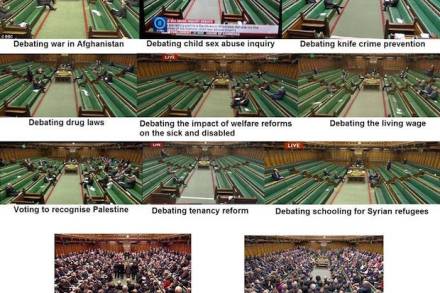
Oh look, Russell Brand doesn’t want to stand for Parliament even though he moans about it! You can watch the clip of the man who was introduced as a ‘comedian and campaigner’ on Question Time last night saying he would ‘be scared I’d become one of them’ here. Now, it’s easy to mock this ‘comedian and campaigner’ for not following through with his ‘campaigning’ and doing something about the issues he cares so deeply about by going into politics, or at least bothering to understand it (he also moaned about pictures of poor attendances in Parliament when MPs are talking about issues that people care about and high attendances when talking about their pay. On which note, here’s something that might interest you, Russell).

What’s behind the Boris Johnson show?

From our UK edition

Coming in from the pouring rain, I make my way to the office on the eighth floor of City Hall. With its curving windows, many books and bust of Pericles tucked away in a corner, it reminds me both of a classroom and the cockpit of a spacecraft. Its occupant is waiting for me, looking a little crumpled but less dishevelled than I had expected. He greets me very pleasantly but this is what I’m thinking. Here is the most famous person I have ever interviewed. In his own way, he is almost as iconic as the Queen or Churchill, the nodding dog in those insurance commercials. He is Boris, one of a tiny handful of politicians/celebrities instantly known by their first name.

The menace of memes: how pictures can paint a thousand lies

From our UK edition

It’s very fashionable these days to be despondent about the quality of our politicians. They’re all lazy liars who look only to their interests and neglect their duties to their constituents because they’d rather be grunting and snorting around a trough before sticking their snouts in it. And while the expenses scandal, resignations and court cases show that a lot of anti-politics sentiment has been provoked by the politicians themselves, it’s worth remembering that not every accusation levelled at Westminster is fair. Over the past couple of years, a trend for internet memes about politicians has grown.

The Spectator at war: Standing on ceremony

From our UK edition

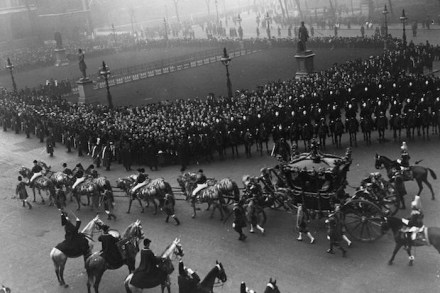
From The Spectator, 7 November 1914: On Wednesday next the King will open Parliament in state, the only alteration in the prescribed ceremonial being the temporary disuse of the glass coach. This alteration is due to a cause which, it is interesting to note, is reflected in every large household in the kingdom. So many members of the King's servants have gone to the front as soldiers that it is difficult to find a sufficient number of the men trained to the ceremonial work. Otherwise, and most properly, the state will be full state. We are sure that the country as a whole will most heartily endorse the King's decision.

Hello trees, hello sky, hello armoured riot police

From our UK edition

What a beautiful day, I thought, as I nodded to the porter in the bowler hat and stepped out of the Westminster hotel into October sun and wind, with a dramatic, fast-forwarding sky overhead, and the dry crackle of leaves underfoot. Lovely London. Solid, masculine, powerful, exciting London. Beautiful London. Outside Westminster Abbey the pavements were thronged with tourists pointing their cameras and smartphones at anything and everything, from the traffic cops to the decorative spikes on the railings. Pret à Manger was packed with riot police in full battledress queueing nicely for their mid-morning caffeine fix. I crossed over the road into Parliament Square and passed a statue of what looked like a black troll.

An NHS stale-mate and squirms for John Bercow, in today’s PMQs

From our UK edition

Today’s PMQs was an NHS stale-mate. David Cameron went after Labour on the NHS in Wales, demanding that Labour agree to an OECD inquiry into the NHS there, while Ed Miliband claimed ‘you can’t trust this Prime Minister on the NHS’ - a more personal attack than his usual charge that you can’t trust the Tories with the NHS. The exchanges didn’t tell us anything new. Though, it is striking - and rather baffling - how willing Miliband is to effectively turn himself into a spokesman for the Welsh government on the NHS there. Cameron’s most interesting answer came in response to a question from Peter Bone on EU immigration to Britain.

Spectator letters: St Augustine and Louise Mensch, war votes and flannel

From our UK edition

Faith and flexibility Sir: What a contrast in your two articles on religion last week: one liberal atheist parent (Claire Stevens) concerned about her son’s turn to conservative Islam, and one conservative Catholic (Louise Mensch) determined that her children understand her unbending fidelity to the tradition.  Ms Mensch’s problem is endemic throughout the western church, Catholic and Protestant alike: greater confidence in human sinfulness than in God’s forgiveness. Mrs Stevens’s problem is the opposite: a lack of confidence in her atheism. Brought up to believe in nothing, one is prone to believe in anything.

What Aristotle would have made of Brooks Newmark’s selfies

From our UK edition

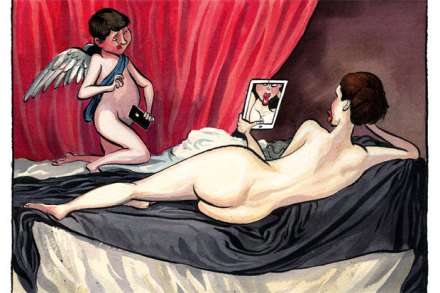
News that the soon-to-be-ex-Tory MP Brooks Newmark has sent pictures of his genitals to a second (presumed female) contact has centred yawningly around ‘rights’, ‘exploitation’, ‘power’ and so on. Aristotle can take us back to basics. The ancients did not do ‘rights’ anyway: they did the law. If there was no law against what you were doing, go ahead. But that did not mean that your action was therefore praiseworthy. How, then, should a man, especially one in the public eye, judge his actions? Aristotle suggested there were four main criteria: whether the actions in question were legal, advantageous, honourable and appropriately motivated. That Newmark’s action was ‘legal’ is undeniable.

Must MPs always vote before we go to war?

From our UK edition

Jesse Norman was permitted three minutes for his speech to the Commons in last Friday’s debate. But the contribution from the Conservative MP for Hereford & South Herefordshire was one of the more important backbench interventions — and no less important for being wide of the debate’s focus. The House was being invited to support British intervention against the Islamic State. Mr Norman’s speech was about whether the invitation was even appropriate. As he put it, ‘A convention has started to develop that, except in an emergency, major foreign policy interventions must be pre-approved by a vote in Parliament.’ The MP thought this unwise. I disagree. Or half-disagree. But ­Norman’s case was powerful, and I shall give you the gist.

If Islamic State is to be defeated, it must be attacked in both Syria and Iraq

From our UK edition

listen to ‘David Cameron's statement on Isis and Iraq’ on audioBoom Parliament will today vote for the motion authorising air strikes by the RAF against Islamic State in Iraq. The motion with its promise of a further vote before any action is taken in Syria and a commitment not to put troops on the ground has been designed to pass as easily as possible. Understandably, no one in Downing Street wants to risk a repeat of last year’s Syria vote. But the reasons why the motion will pass are also the reason why it is not fit for purpose. Islamic State has succeeded in rendering the border between Syria and Iraq meaningless, it operates on both sides of it. But British planes will only hit Islamic State on one side of this line.

Charles III is made for numbskulls by numbskulls

From our UK edition

Suppose Charles were to reign as a meddlesome, self-pitying, indecisive plonker. It’s a thought. It’s now a play, too, by Mike Bartlett. In his opening scene he bumps off Lilibet, bungs her in a box and assembles the family at Buck House to discuss ‘what next?’ Bartlett imagines them as stuck-up divs. William’s a self-righteous sourpuss. Kate’s a smug minx. Camilla’s a hectoring gadfly. Harry’s a weepy drunk. Charles is a colossally narcissistic nuisance. They’re too dim to understand the constitution so Camilla has to explain that a new reign commences with the death of the previous monarch and not at the coronation. (This is for the benefit of the audience, who are assumed to have the same poultry-level IQ as the Windsors.

Britain abandons foreign policy. And abandons debates about foreign policy too.

From our UK edition

Cynics have long suspected that Britain's foreign policy is as independent as its nuclear deterrent. Cynics have a point. Perhaps, as some suggest, it's time to concede the game's a bogey and cease even pretending to pretend this remains a country of at least some modest importance and influence. Except, if we choose to, we do retain some influence, even some importance. Nevertheless, we certainly do not have an Iraq policy at present. Nor do we really have an ISIS policy. The Foreign Secretary is long on what we're not doing and very short on what we are. Of course this reflects past misadventures. Not just those pertaining to Iraq but others too, including last year's parliamentary determination to avoid having a Syria policy too. So, yes, Prudence runs foreign policy these days.

Mark Simmonds was just saying what a lot of MPs think

From our UK edition

I feel some sympathy for Mark Simmonds, the Conservative MP who’s resigned as a minister and is stepping down at the end of this Parliament because he can’t support his family. His announcement has been greeted with scorn and derision by the chattering classes — how dare he complain that an MP’s salary isn’t enough to live on? — even though most of them are earning far more than him. Any politician who utters a murmur of dissent about the terms and conditions of his or her employment is an instant pariah. In fact, if you can be bothered to read beyond the headlines, Simmonds’s complaint seems pretty reasonable.

It costs £34,000 to become an MP. No wonder they expect higher pay

From our UK edition

Mark Simmonds has been in politics long enough to know not to expect much sympathy from his constituents. He resigned as a Foreign Office minister this week because his £89,435 ministerial salary was not enough — at least, not enough for him to keep a family home in London. Many of those who live and work in the capital may sympathise with this struggle, but hearts will not be bleeding in his constituency, Boston and Skegness, where the average wage is £17,400. So he is not seeking re-election, and will leave politics next year. Simmonds was one of the lucky ones. He managed to find enough money to make it into parliament in the first place, which many would-be MPs cannot.

Westminster plays recall tennis

From our UK edition

Now that David Cameron has returned from his Portuguese fish-shopping exploits, the game of recall tennis that Westminster has been playing for the past few days has stepped up a few notches. Now it's not just Philip Hammond, Michael Fallon and other Cabinet members leaving COBR meetings who can be asked whether or not they think Parliament should return from recess to debate the situation in Iraq, but the Prime Minister himself. It's running like this: another Tory MP writes to the Prime Minister to say there should be a recall, or a senior party figure from the Lib Dems or Labour says there should be one.

‘These people want a holocaust’: pressure grows on PM for recall over Iraq

From our UK edition

Downing Street remains resolute that there will not be a recall of Parliament over the situation in Iraq. But Conor Burns, a Tory backbencher who resigned as a ministerial aide over Lords reform, has just joined calls for a recall by writing to David Cameron warning that helping to evacuate the religious minorities at risk is not enough. His letter, seen first by Coffee House, is pretty strong stuff. Burns tells Cameron that 'these people want a holocaust of everyone who does not share their brutal ideology. It simply cannot be enough to try and evacuate those [ISIS] want to kill and then leave them, as the Pentagon admitted last night, undiminished to continue their terror' and that 'there is more that we could be exploring to deal with the problem's source'.

Forget warnings and labels. Make problem drinkers pay for their excess

From our UK edition

It was news to me that there exists an All Party Commons Committee on Alcohol Misuse, but when you think about it, the notion makes complete sense; for evidence, all they need do is nip down the nearest corridor to talk to colleagues hanging out in any of the several bars in parliament. The members of the committee have now suggested that bottles of alcohol should carry health warnings. It’s all a bit American, isn’t it? Over there, they treat alcohol as part of the substance abuse spectrum, with crack cocaine a bit of the way down from gin. I suppose it does no harm to point out that drinking to excess can play havoc with your liver, and the existing exhortations on spirits — Please Enjoy This Bottle Responsibly — are, I’d say, next to useless.

Video: Should Parliament be recalled over Iraq and ISIS?

From our UK edition

Neither Obama nor Cameron seem ready to return from their holidays to debate how best to respond to the events in Iraq. However, in our look at the week ahead, Isabel Hardman argues that the debate shouldn't just be taking place in newspapers, but also in the House of Commons. Could we see a recall of Parliament, asks Fraser Nelson, or is Cameron simply too scared after last year's disastrous debate over Syria? Douglas Murray suggests that however much we may care about the events in Iraq, the only country that can do anything about it is America.

The three parent technique is genetic modification. Will parliament confront this?

From our UK edition

If I were choosing a third parent for a baby, you know, I’d be inclined to choose one of the Williams sisters — the top-notch tennis players. If you want to create a baby with really classy metabolism — and metabolic function is just what the third parent provides — you may as well make it good. But what you can’t do, in creating a baby that’s able to process energy efficiently, is pretend that this is anything other than genetic modification. Yet the Department of Health, in effectively approving the three parent baby technique (actually, it’s always going to be two mothers plus one father), has redefined its categories in its proposals to allow mitochondrial DNA transfer. The proposals were published this week.