Pakistan

Adam Curtis’s Bitter Lake, review: a Carry On Up the Khyber view of Afghanistan

From our UK edition

We all need stories 'to help us make sense of the complexity of reality', intones the sensible sounding voice of Adam Curtis at the start of his new documentary about Afghanistan, Bitter Lake. But stories told by 'those in power' are 'increasingly unconvincing and hollow'. What a relief then that Curtis has raided the archives of BBC News on our behalf for footage of the west’s 13 year engagement in Afghanistan to construct his own more than two hour long story. His conclusion: the crisis in Afghanistan is all the fault of the witless Americans! The problem all began on a US warship parked in the Suez Canal in 1945 (cue newsreel). It was there that President Franklin D. Roosevelt met with King Abdul Aziz of Saudi Arabia and agreed to buy all of his oil.

I don’t want to live under Islamic blasphemy law. That doesn’t make me racist

From our UK edition

I have spent most of the last fortnight debating Islam and blasphemy and wanted to take the opportunity to put down a few unwritten thoughts. In the immediate aftermath of the Paris atrocities most of the people who thought the journalists and cartoonists in some sense ‘had it coming to them’ kept their heads down.  I encountered a few who did not, including Asghar Bukhari from the MPAC (Muslim Public Affairs Committee).  In the aftermath of the atrocity Asghar was immediately eager to smear the cartoonists and editors of Charlie Hebdo as racists.

This is how you can fight the Taleban

From our UK edition

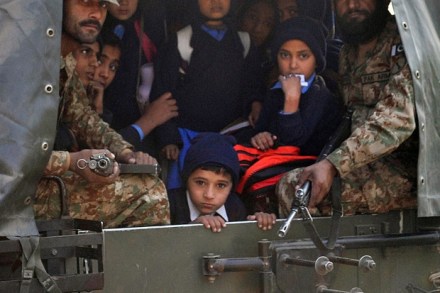
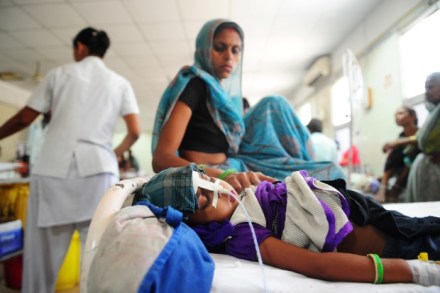
The murder of over a hundred children by the Taleban in Peshawar left people furious but also frustrated. What can we do to stop the Taleban? Troops are leaving Afghanistan, combat mission over; we've no stomach for army casualties and drone strikes too often backfire. Every innocent farmer killed by a drone galvanises local support for the Taleban. There's a Pashto saying which gets to the point: 'Be afraid of those who do not fear death.' If we're not prepared to risk much, and we're not, it's near impossible to defeat an enemy prepared to risk everything. So, should we despair, shop for Christmas presents, forget about the Peshawar dead? No.

From Sydney to Peshawar – Islamic extremists are civilisation’s common enemy

From our UK edition

Yesterday it was Sydney. Today it is Peshawar. Yesterday a coffee shop. Today a school. Yesterday a lone gunman. Today a gang of them. If anybody wondered about the global and diffuse nature of the challenge that Islamic fundamentalism poses, the last 24 hours have given another demonstration of the problem. Yet what is amazing, after all these years, is how unconcerned many people remain with working out what is going on. How could the Taliban have chosen to attack a school in Peshawar? Why did Boko Haram steal the Nigerian schoolgirls? Why did the Sydney attacker fly that flag? Why do Isis fly theirs?  The Western world in particular seems to be made up of not only exceptionally slow, but actually reluctant, learners.

International cricket must return to Pakistan (and my team went first)

From our UK edition

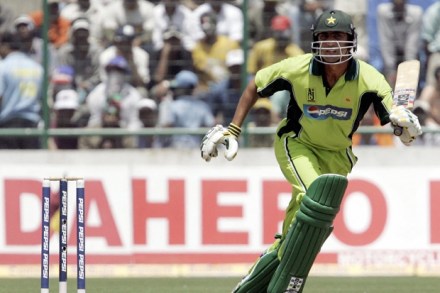
In a tiny courtyard just off the teeming alleys of Lahore’s old town, a young Pakistani boy in a gleaming white shalwar kameez picks up his Adidas cricket bat and proceeds to clout to all corners the plastic ball his pal is chucking down. Behind him on the wall the outline of three stumps is drawn, and the word Out! chalked there, more in hope you feel. In the corner a little schoolroom has emptied out and excited young boys and girls, books in hand, look on, giggling happily. Is this the new Imran? Almost certainly not, but we are in one of the holy places of Pakistan cricket, and in this troubled but vibrant country, only cricket comes close to Islam as a unifying passion.

General Kayani leaves a gulf at the head of the Pakistan army – and Pakistan

From our UK edition

Pakistan’s Army chief general, Ashfaq Kayani, has announced that he will retire on 29 November. In doing so, he put an end to the rumours running from D.C. to Delhi about the stability of the region. It is no secret that talk of Afghan settlement and a negotiated pause to the war is contingent on the Pakistan army. Over the last six years as army chief, and previously as ISI Chief and Director-General of Military Operations, General Kayani has been one of the foremost figures in the Afghan War. Western defence chiefs - particularly General Sir David Richards and General Stanley McChrystal - forged extremely close relationships with Kayani. They understood that the region's stability depends on this quiet, chain-smoking general.

There is no such thing as ‘immigrants’ – only Poles, Yanks, Somalis…

From our UK edition

There was much glee about yesterday’s publication of a report into the economic impact of immigration, which concluded eastern Europeans had provided a net benefit of £4.4 billion to the UK economy. There was far less mention of the fact that immigrants from outside Europe in the same period cost the taxpayers £118 billion. But as Christopher Caldwell observed in Reflections on the Revolution in Europe, the immigration debate is not about economics, for ‘the social, spiritual, and political effects of immigration are huge and enduring, while the economic effects are puny and transitory. If, like certain Europeans, you are infuriated by polyglot markets and street signs written in Polish, Urdu, and Arabic, sacrificing 0.

There’s one obvious question about immigration, but nobody is asking it

From our UK edition

If you were to close your eyes at any debate on immigration, you might reasonably picture the participants standing back-to-back, shouting and gesticulating to opposite corners of the room. On such occasions, there’s typically only one point on which everyone actually agrees: that very highly skilled migrants – doctors, engineers, scientists – are welcome here in Britain. Oddly, though, nobody ever seems follow up with the obvious question: what about the countries these migrants leave behind? Look at the four nations from which we take most foreign doctors – India, Pakistan, South Africa and Nigeria. Is it not unfair to deprive them of their brightest medical minds?

Kate Chisholm on what makes the BBC World Service so special

From our UK edition

‘Don’t take it for granted,’ she warned. ‘It’s one of the few places where you can hear diverse voices, different points of view; where you can understand that the world is infinitely complex.’ Alana Valentine, an Australian writer, was talking about the BBC World Service with such passion it was inspiring. You might think she would say this, wouldn’t she. After all, Valentine was giving her acceptance speech having just won first prize in the World Service’s International Radio Playwriting Competition for her radio drama The Ravens. Yet what she said was striking because you could tell she really meant it. These were not just platitudes.

‘Religion of peace’ to execute Christian woman for ‘blasphemy’ in Pakistan

From our UK edition

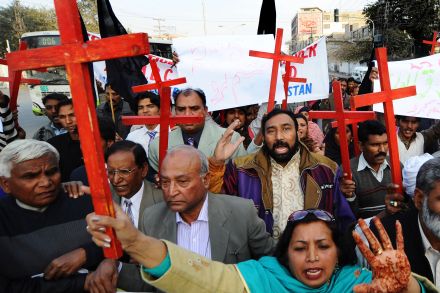
Not long to go now before a middle-aged Christian woman, Asia Bibi, is hanged in Pakistan for allegedly having said something disparaging about the prophet Mohammed, peace and blessings be upon him etc. Exactly what it was she said about old Mo’ isn’t entirely clear. Something a bit snippy, I would guess. She’d been arguing with some Muslim women who objected to Mrs Bibi using their communal drinking cup - because as a Christian she is, of course, unclean. Two politicians who tried to help her were assassinated. When the convicted killer appeared in court, al-Jazeera reports, he was 'showered with rose petals and praise'. Mrs Bibi meanwhile has just lost her appeal, presumably much to old Mo’s quiet satisfaction.

Happy ‘anti-slavery day’ to Clapham Christians, et al

From our UK edition

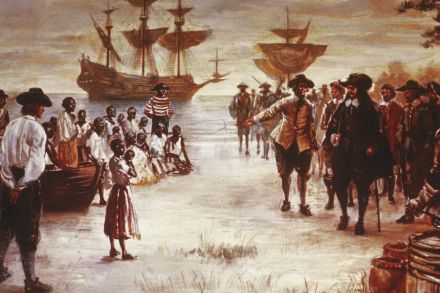
October 18 is 'anti human-trafficking' day by 2007 Act of European Parliament; along with 'anti-slavery day' by 2010 Act of UK Parliament. So there's that, for the 29.8 million people worldwide estimated to live in forced servitude. Over at SlaveryFootprint.org, your correspondent learns that I personally make use of 37 slaves in my London routine, mostly through my consumer electronics and my larger-than-average appetite. The survey, laden with factoids about the coerced labour behind shrimp cocktail and mascara, is macro-analysis at its mushiest - and a far more worthwhile use of 15 minutes online than all the 'carbon-footprint' calculators put together.

Does Jonathan Powell really want to negotiate with the Islamic State?

From our UK edition

I think I’ve finally worked out the time-honoured Jonathan Powell formula for promoting a new book: take which-ever group constitutes the most bloodthirsty terrorist organisation of the day — in this case IS, the warped Islamist force currently enslaving and beheading its way across Iraq and Syria — and create a media fizz by boldly declaring that sooner or later we’re going to have to negotiate with them. Powell’s predicted circumstances in which the ‘talking’ to IS should actually happen, however, are hedged with unrealised conditions. At other moments he will daringly hint that talking is best without any preconditions at all.

Our boys in the Islamic state: Britain’s export jihad

From our UK edition

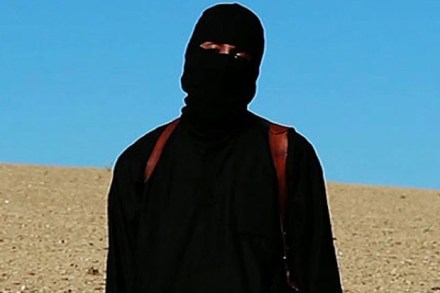
[audioplayer src="http://traffic.libsyn.com/spectator/TheViewFrom22_21_August_2014_v4.mp3" title="Douglas Murray and Shiraz Maher discuss Britain's jihadis"] Listen [/audioplayer]It is the now familiar nightmare image. A kneeling prisoner, and behind him a black-hooded man speaking to camera. The standing man denounces the West and claims that his form of Islam is under attack. He then saws off the head of the hostage. Why did Wednesday morning’s video stand out? Because this time the captive was an American journalist — James Foley — and his murderer is speaking in an unmistakable London accent. The revulsion with which this latest Islamist atrocity has been greeted is of course understandable. But it is also surprising.

Jihadi John – a very British export

From our UK edition

It is the now familiar nightmare image. A kneeling prisoner, and behind him a black-hooded man speaking to camera. The standing man denounces the West and claims that his form of Islam is under attack. He then saws off the head of the hostage.

Nation-builders on a sticky wicket: the farce and heroism of Pakistani cricket

From our UK edition

There is farce in Peter Oborne’s history of cricket in Pakistan. An impossible umpire is abducted by drunken English tourists and imprisoned in their hotel. Political uncertainty leads to the selection of rival captains and players for the same match against New Zealand. An ageing Pakistan cricketer is ruled out of a one-day international after eating a surfeit of spinach. There is tragedy, too. England toured Pakistan in 1968–69, during the strife which ultimately led to the bloody separation of West and East Pakistan (modern day Bangladesh). The players landed in Karachi, in West Pakistan, which was under a curfew. The tension was such that they were billeted in a hotel near the airport, should they need to escape.

Pakistan’s ISI accused of subverting media freedom

From our UK edition

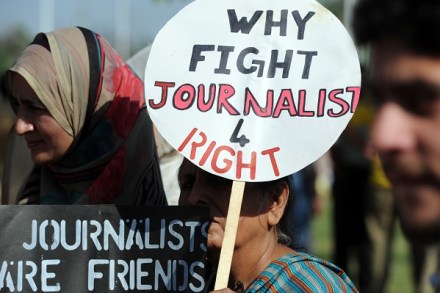
Media freedom is under attack in Pakistan, declared Hamid Mir, one of Pakistan’s most prominent journalists. He had six bullets pumped into him by bike riders in Karachi on 19 April. TV anchor, Raza Rumi, was similarly attacked in Lahore in late March. In May 2011, investigative reporter Saleem Shahzad was murdered following his allegations of links between the Pakistani military and al-Qaeda. These are just three of the many Pakistani journalists who’ve been victims of a wave of threats and violence in recent months and years.

Witness to a stoning

From our UK edition

Attending public executions, whether beheadings or stonings, is not my predilection, yet one does come across them in the course of life in Arabia and Pakistan. Beheading and stoning are the accepted penalties for a range of presumed offences in much of the Muslim world, and the all-male crowd — especially the old men — push and shove outside Riyadh’s main mosque after Friday morning prayer for a better view of offenders losing their heads by the ceremonial sword. The seeping cadavers and their heads are left on the tarmac pour encourager les autres.

Farzana Iqbal was murdered by Muslims applying ‘sharia’. Why does the BBC not report these facts?

From our UK edition

Farzana Iqbal, aged 25, was stoned to death by members of her family in broad daylight on the steps of a courthouse in Lahore, Pakistan, because she had married a man with whom she was in love. This was an “honour killing” and perpetrators use sharia law to justify their murders. Some 1,000 women are killed in this manner in Pakistan each year and an overwhelming majority of the population seems to be in favour of them. Some 91 per cent of honour killings worldwide are “Muslim on Muslim” crimes. In Pakistan, laws introduced in the 1970s, by Zia-ul-Haq, and based on punishments recommended in the Koran and Sunnah, mean that women have almost no recourse in law and the male members of the family can do with them as they will.

Hope for one of the most turbulent, traumatised regions in the world

From our UK edition

John Keay’s excellent new book on the modern history of South Asia plunges the reader head first into some wildly swirling currents. Here are India, Pakistan, Bangladesh, not to mention Sri Lanka and Nepal, and a supporting cast of mini-states present and past that you may not even have heard of, all tumbling, overlapping, in a state of perpetual contradiction and collision, flowing like a tide of crazed tsunami debris down some great tropical floodplain. This is the world’s biggest population zone, and possibly even the world’s coming economic superpower, in full and violent flow. Midnight’s Descendants is primarily about the partition of India, the moment in 1947 that initially created independent India and a new state called Pakistan.

The Malala phenomenon – as seen from Pakistan

From our UK edition

Mixed emotions stirred here in Pakistan when Malala Yousafzai came within kissing distance of the Nobel Prize. The reaction was reminiscent of how we felt when Sharmeen Chinoy's Saving Face was up for an Oscar: great to be noticed by the world, but how tragic that the path to such recognition was paved with acid burnt faces. The deplorable act of attacking Malala increased the aversion felt for the Taliban among ordinary Pakistanis. But terrorists do not feed on public support; their demented ideology is sustenance enough. Pakistanis wept when Malala was battling for her life, and heaved a sigh of relief when she survived. We are proud that she has thrived. As for her moving to England, it affirms our view that the West has an equal penchant for inflicting and preventing pain.