Nigel farage

The changing face of Nigel Farage

From our UK edition

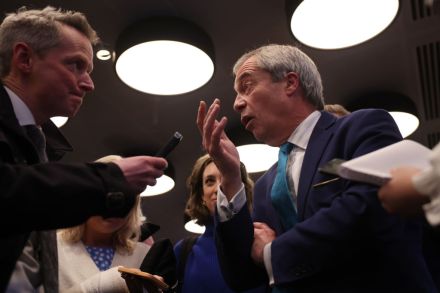
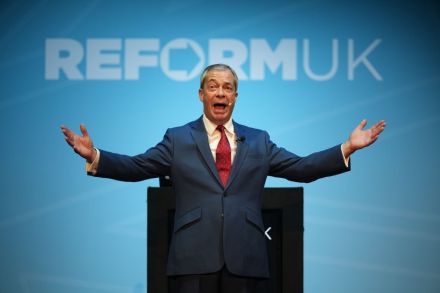
On Monday night, a hundred Reform staff and donors met at a Marylebone pub to toast the local election results. A jubilant Nigel Farage addressed his troops, who ran up a five-figure bill. They had good reason to celebrate. With 30 per cent of the vote, Reform crushed Labour (20 per cent) and the Tories (15 per cent). They won 677 wards, ten councils and a fifth MP in the Runcorn by-election. Certain results were particularly satisfying: in Ed Miliband’s Doncaster North, Reform won more seats than any other party. Three speeches defined Reform’s campaign. First, there was the Birmingham rally at the end of March. Farage arrived on a JCB digger, presenting himself as a ‘Mr Fixit’ for the woes of ‘Broken Britain’.
Do the Tories hate free trade? Plus, Reform hits new polling high

From our UK edition

15 min listen

Lots to talk about today, including new polling which puts Reform on 29 points compared to the Tories on just 17. We’ve also just had the first PMQs since the local elections. But the trade deal announced yesterday between the UK and India is dominating the headlines, with many concerned about some of the concessions made – namely the decision to exempt some short-term Indian workers from national insurance as part of the new agreement. This comes barely a week after the local elections, where immigration has been widely considered the most salient issue.

My apology to Reform

From our UK edition

I have read countless commentaries explaining why we shouldn’t take Reform’s victories last Thursday too seriously. They are all wrong. I have the distinct impression that these were the most significant election results for a good few decades. Up here in the north, everyone I know voted Reform. More importantly, when I used to ask people how they voted, they would beckon me to one side and, through a cupped hand, whisper ‘Reform’. Now they say it out loud and proud. And the apology is because I had doubted Reform’s ability to climb above 30 per cent – the crucial figure. I also doubted that they were serious enough about the Blue Labour/SDP levelling-up stuff. And I doubted their ability to make serious inroads into local government. All of this was wrong too.

Local elections live: is Reform unstoppable?

From our UK edition

15 min listen

The word ‘unprecedented’ is often overused in politics, but these local elections have proved to be just that. The headline is: sweeping success for Reform.  Nigel Farage's 'teal tsunami' comes at the expense of the main parties – turning the two-party consensus on its head. The recriminations for Labour and the Tories have already begun. On the left, a number of MPs have broken cover and urged the government to shift its position on high-salience issues such as winter fuel. On the right, Kemi Badenoch’s leadership is looking increasingly shaky, with Tory MPs and staff warning that a step change is needed. Where do the main parties go from here? And can anyone stop Nigel?

St George’s Day: who is the most patriotic leader?

From our UK edition

15 min listen

Happy St George’s Day! To celebrate, we thought we would discuss who is the most patriotic political leader — and why some struggle to communicate their love of country. Keir Starmer declared in an interview with the Mirror this morning that Labour is ‘the patriotic party’. This follows a more concerted effort from those within the party to become more comfortable with the flag. But is Keir Starmer actually a patriot? How will the ‘battle of the Union Jack’ play out at the local elections? And does Reform have a point to prove when it comes to patriotism? Oscar Edmondson speaks to James Heale and Claire Ainsley, former executive director of policy for the Labour party, now at the Progressive Policy Institute. Produced by Oscar Edmondson.

Does Farage have a path to No. 10?

From our UK edition

My contention was always that Reform UK would struggle to reach 30 per cent in the polls and, while the party is edging upwards, that still seems to be a ceiling. However, the latest MRP poll in the Sun suggests that, for Nigel Farage to become our next Prime Minister, the party need not gain much more support than it is currently attracting. The Sun had Farage on course to win 180 seats, largely by polling at about 30 per cent in some of the red wall constituencies. Labour and the Conservatives were each predicted to gain 165 seats. In such a finely balanced parliament, discussions about a Conservative–Reform deal would become otiose: a Reform–Conservative coalition would almost certainly emerge, regardless of any prior negotiations.

Reform vs Labour: who’ll win the battle for the north?

From our UK edition

When MPs and peers were recalled to parliament for an emergency debate on renationalising British Steel, one man was the talk of the terrace: Nigel Farage. Out by the river, a Labour peer congratulated the Reform leader for ‘leading on everything’. After all, Farage had been in Scunthorpe days earlier calling for steel nationalisation.  Since I started covering British politics for The Spectator ten years and six prime ministers ago, there have been plenty of times when an insurgent party appeared to be on the rise. In 2015, the ascent of Ukip contributed to David Cameron’s decision to call a referendum on EU membership. Then in 2019, the success of the Brexit party in the European elections spurred many Tories into backing Boris Johnson for leader.

Letters: Leave our soldiers alone

From our UK edition

Military farce Sir: Your leading article (‘The age of realism’, 1 March) argues that the government must invest in the UK’s ‘thinned-out infantry ranks’. This is certainly true, but it does pass over, in my view, the more fundamental issue of the broken recruitment system. My own application to join the Royal Air Force was rejected on the basis that my mother is Polish. Given that Poland is an ally, this seems a curious justification for disqualification. I was born and educated in London, my mother having moved to the UK with my English father 30 years ago. Clearly I am not a security threat, but because ‘computer says no’, I will never be able to enlist. It is, then, with amusement and some frustration that I often read of the ‘recruitment crisis’.

Inside Nigel’s gang, my day as a ‘missing person’ & how to save James Bond

From our UK edition

38 min listen

This week: Nigel’s gang – Reform’s plan for power.Look at any opinion survey or poll, and it’s clear that Reform is hard to dismiss, write Katy Balls and James Heale. Yet surprisingly little is known about the main players behind the scenes who make up Nigel Farage’s new gang. There are ‘the lifers’ – Dan Jukes and ‘Posh George’ Cottrell. Then there are the Tory defectors, trained by Richard Murphy, a valued CCHQ veteran, who is described as a ‘secret weapon’. The most curious new additions are the Gen Zers, who include Tucker Carlson’s nephew, Charles Carlson, and Jack Anderton, known as ‘the Matrix’. Katy and James joined the podcast to lift the lid on Nigel Farage’s inner circle.

A trap for the right

From our UK edition

On Thursday 16 August 1739, the young John Wesley met and for an hour argued with the middle-aged Bishop of Bristol, Joseph Butler. It was an ill-tempered encounter. Wesley believed that God communicated directly with individuals, invested his promises and purposes in them personally, and charged them with missions to reveal and explain the divine will. Butler, famous for his rationalism, reacted with cold indignation. ‘Sir,’ he told Wesley, ‘the pretending to extraordinary revelations and gifts of the Holy Ghost is a horrid thing, a very horrid thing.’ The Bishop spoke for England. We do not ‘do’ God – not even the 49 per cent of us who actually believe in God.

Nigel’s gang: Reform’s plan for power

From our UK edition

A year ago, Reform party aides found themselves in a cramped office in Victoria, London, bickering about chairs. ‘There weren’t enough seats to go around,’ recalls a staffer. These days there are no such issues. Leading in the polls and with five MPs in tow, Nigel Farage’s party has moved to Westminster’s Millbank Tower. This 1960s block peering over the Thames is where Tony Blair’s landslide victories were fought for and won; the new tenants are intent on dismantling most of his legacy as they plot a path to 10 Downing Street. Look at any opinion survey and Reform is hard to dismiss. Having won 14 per cent of the vote in last year’s general election, the party consistently leads in the polls.

The engagement vs isolation debate returns

From our UK edition

British foreign policy has always oscillated between isolation and engagement. The division has shaped Conservative thinking over generations. The archetypal icon of engagement is Winston Churchill. In the wake of the Munich Agreement, Churchill made his greatest anti-appeasement appeal: ‘What I find unendurable is the sense of our country falling into the power, into the orbit and influence of Nazi Germany.’ He was for rearmament and, ultimately, for war. Churchill had in his sights the isolationists of the right – those Tories who would not ‘die for Danzig’. Victory in the second world war, the western alliance, Nato, America’s nuclear guarantee, the European Union, communist collapse – all seemed to prove Churchill triumphant and correct.

Can Farage navigate the Trump-Zelensky maze?

From our UK edition

9 min listen

Donald Trump's latest comments on Ukraine and its leader have united the British political spectrum in condemnation – almost. Nigel Farage has tread a careful path given his friendship with the U.S. President, but also the fact that the majority of the British public disagree with Trump's critical attitude towards Ukraine. Can he keep this up? Cindy Yu talks to Katy Balls and James Heale. Produced by Cindy Yu.

Kemi vs Nigel: who would Thatcher have backed?

From our UK edition

15 min listen

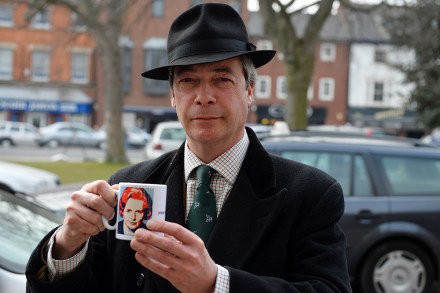
It is 50 years since Margaret Thatcher was elected Conservative leader, and at this week’s shadow cabinet meeting, Lord Forsyth was invited as a guest speaker to mark the occasion. He noted the similarities between 1975 and 2025. Back then, the party was broke, reeling from defeat and facing the fallout from a reorganisation of local government. But, despite threadbare resources, Thatcher managed to rebuild to win power four years later. ‘You have the potential to do the same,’ Forsyth told Kemi Badenoch. However, when asked if a young Thatcher would have been drawn to the right’s insurgent Reform Party, Nigel Farage replied, ‘I don’t think there’s any doubt about it.’ He even claimed that Thatcher had voted UKIP in 1999.

Kemi vs. Nigel: who would Thatcher have backed?

From our UK edition

It is 50 years since Margaret Thatcher was elected Tory leader and at this week’s shadow cabinet meeting, Lord Forsyth was invited as guest speaker to mark the occasion. He noted the similarities between 1975 and 2025. Back then the party was broke, reeling from defeat and facing the fallout from a reorganisation of local government. But, despite threadbare resources, Thatcher managed to rebuild to win power four years later. ‘You have the potential to do the same,’ Forsyth told Kemi Badenoch. Yet there is a crucial difference between then and now: a rival on the right. Nigel Farage’s Reform party is vying with Badenoch to inherit Thatcher’s mantle. Each leader is competing for the same voters, members and donors.

Will there be a Tory/Reform pact?

From our UK edition

19 min listen

While both Nigel Farage and Kemi Badenoch are quick to talk down speculation of a pact between the Tories and Reform, listeners may be surprised to hear that around Westminster such conversations are already taking place. With every new poll, Conservative MPs grow a little more anxious that by the time they go to the polls, they will have little claim to being the main opposition – and so some sort of agreement starts to make sense. That agreement could be anything from a non-aggression pact to bringing the two warring parties of the right under one leader. How likely is it? Oscar Edmondson speaks to Katy Balls and Gawain Towler.

Could a Tory/Reform pact be looming?

From our UK edition

In 1603, James VI managed to do what few thought possible. The self-styled first King of Great Britain succeeded in bringing the ‘auld enemies’ of Scotland and England under one monarch. That union of the crowns is a topic of chatter and inspiration for the British right these days. Admirers of Nigel Farage now talk about the ‘James I model’. The idea is simple: could the two warring tribes of the Conservatives and Reform be brought together under one leader? The next general election may be nearly four years away, but it’s telling that such conversations are already taking place. With every new opinion poll, Conservative MPs grow a little more anxious. The Tories often poll third behind Reform and Labour.

A pleasant respite from the tumult in Cambridge

Cambridge, England Inscribed on the lid of a two-manual harpsichord in Holy Trinity Church at Hildersham in Cambridgeshire is the Latin tag Musica Donum Dei — music is a gift of God. It was a sentiment I could hardly quarrel with as I listened in the little twelfth-century church to a variety of baroque sonatas for violin, recorder, cello and harpsichord. They were expertly performed by the Azur Ensemble, which is comprised of recent graduates of the Royal College of Music. A particular standout was the French harpsichordist Apolline Khou, who has performed widely in Europe and in a solo concert for King Charles III.

Cambridge

Labour is starting to panic about Reform

From our UK edition

‘We’ve had enough of living in two-tier Britain,’ bellows Nigel Farage to cheers from an 800-strong crowd at Chester’s Crowne Plaza Hotel, where he is holding court. ‘There is not a single person on that Labour frontbench who’s ever worked in private business,’ the Reform leader declares. ‘So, is it any wonder they’re making such a Horlicks of it?’ Chester is the sixth stop on Farage’s new year tour, which was initially intended to sound a steady drumbeat in the lead-up to May’s local elections. Since those plans were made, however, Labour has announced a devolution shake-up that could allow various councils to delay their elections by a year. ‘It’s pretty full on,’ Farage says, when we meet on the sidelines of the event.

Is Reform about to overtake Labour? And Tulip Siddiq resigns

From our UK edition

13 min listen

New voting intention polling today puts Reform neck and neck with Labour. The YouGov/Times poll reveals that support for Starmer’s army has plummeted nine points, with just over a quarter of Brits backing the government – while Nigel Farage’s Reform party has seen its support soar by 10 points. Kemi Badenoch’s Tories have lost two points, while the canvassing of 2,279 adults – carried out between 12–13 January – shows the Lib Dems and the Greens both gained one. Perhaps the most damning news, however, is that only half of those who backed Labour in the 2024 election would vote for them next time. Where is Reform drawing these votes from? Is this polling worse for Labour, or the Tories?