Nigel farage

‘We must not be the Tory party 2.0’: Nigel Farage on his plans for power

From our UK edition

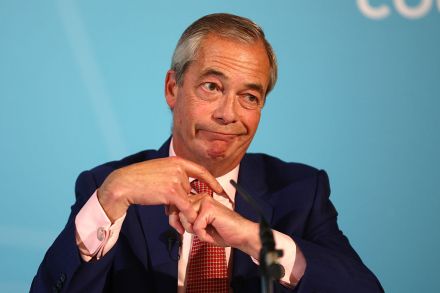
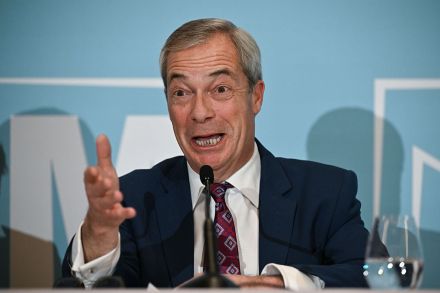
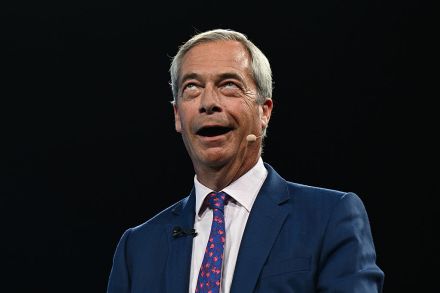
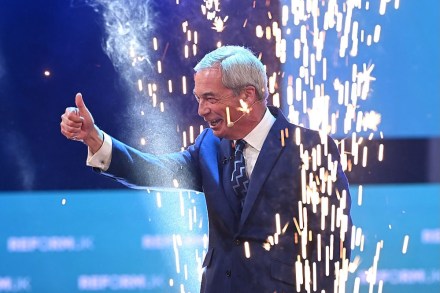
Nigel Farage is signing football shirts when I arrive at Reform’s campaign headquarters in Millbank Tower, the building where New Labour prepared for power before 1997. The black shirts are emblazoned with ‘Farage 10’ in gold. ‘Someone called them Nazi colours,’ the leader complains. ‘This always happens when we do well.’ As favourite to be the next prime minister, Farage is sanguine. ‘They’re a special edition, £350 each.’ How many is he signing? ‘—king hundreds,’ he says, pulling his punches on the profanity. Seven hundred to be precise, a cool £245,000 for party coffers. This is the same week the party registers a £9 million donation from the crypto millionaire Christopher Harborne, the largest single donation in British political history.

Has Reform peaked? – racism allegations & Farage’s toughest week yet

From our UK edition

45 min listen

After a summer in which Nigel Farage seemed to bend the news cycle to his will, Michael and Maddie ask whether the party’s momentum is slipping. Do the allegations dredged up from Farage’s schooldays mark a decisive turning point – or, perversely, strengthen his outsider appeal? And with questions over Reform’s election spending, defections from the Conservatives, and the small matter of finding 500 people to staff a government, is the insurgent right entering its moment of vulnerability? Then: two stories that lay bare a crisis in women’s healthcare. Baroness Amos’s damning interim review of maternity services and the astonishing employment tribunal ruling in the Sandy Peggie case raise the same question – why does the system still fail women at their most vulnerable?

The murky world of political donations

From our UK edition

15 min listen

Reform are in the money. This morning the Electoral Commission has dropped the latest figures on political donations, and Reform are streets ahead. Former Tory donor Christopher Harborne has handed Nigel Farage £9 million, what we believe to be a record amount from a single donor. How much impact will this have on Reform’s chances of electoral success? How much influence do political donors have over how their money is spent? Elsewhere, Reform are conducting a press conference later this afternoon where they will be sticking it to Labour over its decision to postpone more local elections. Without new mayoral elections in four more areas, where are Reform going to spend their new cash? Oscar Edmondson speaks to Tim Shipman and James Heale. Produced by Oscar Edmondson.

Fact check: are the NYT’s experts right about UK immigration?

Yesterday’s release of immigration figures by Britain's Office of National Statistics didn’t make for particularly pleasant reading. While net migration had fallen to around 200,000 in the 12 months to June, much of this was down to an unusually high exodus of people, with 693,000 leaving the country over the same period. Many of those leaving were under the age of 30. That news, however, seemed to prompt something approaching gloating over at the New York Times, which published a piece yesterday headlined: "The British Public Thinks Immigration Is Up. It’s Actually Down, Sharply." To labor the point, the piece was accompanied by a picture of anti-migration protestors in Scotland. The not-so-subtle subtext being: what a bunch of gammon thickos the anti-migration lot are in the UK.

immigration

So what if Nigel Farage was the school bully?

From our UK edition

There may well be, somewhere in this nation of ours, a long-established succession of sensitive, emotionally aware 14-year-olds who can appreciate and denounce the impact of bullying. But, honestly, none of them went to my school.  It doesn’t sound like there were many of this cadre at Dulwich College half a century ago either. At least, not if we believe the recent Guardian ‘scoop’ which claims, thanks to the testimony of Nigel Farage’s fellow pupils (much of which was made public years ago), that the Reform leader was a racist, hate-fuelled youth who taunted anyone of a different faith or ethnicity.

What the UK can learn from Trump’s second term

When John Swinney, the Scottish National Party leader, and former ambassador Peter Mandelson visited Donald Trump in the Oval Office a few months ago, the President showed them three different models for his planned renovation of the East Wing of the White House, which he has demolished to build a new ballroom. “If you’re going to do it,” Scotland’s First Minister suggested, “you might as well go big.” This Wednesday marked one year since Trump’s election victory, and going big captures the essence of his second term – bold and controversial moves, which have impressed even British politicians who thought him reckless in his first term.

Mystic Milei proves ‘austerity’ needn’t be a dirty word

From our UK edition

Javier Milei’s election in 2023 was a repudiation of decades of Peronist turmoil, corruption and inflation. Milei offered shock therapy, delivered with an Austin Powers haircut and chainsaws. This is a man who had worked as a tantric sex coach and claims to speak not just with animals but also with God himself. Eyebrows were raised. Could such a strange man, one who seems to embrace the new occultism outlined in our cover piece, deliver his promised reconstruction of Argentina? Or would voters soon grow tired of the state-slashing mystic? Yet this former frontman of a Rolling Stones tribute band has proved his sceptics wrong.

Britain’s MAGA moment is coming

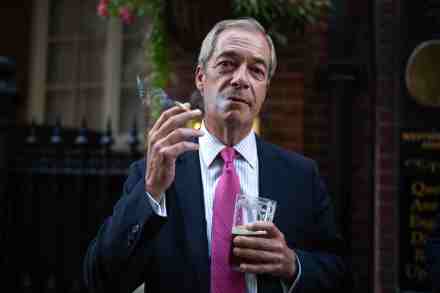
Summer is fun. Winter is serious. Autumn in London feels almost Boolean – the light, the air, the mood, seemed to turn on an equinox dime. The political situation, I heard, had grown even stranger since my last sojourn. “Cool Britannia” is dead. Nothing today is more dated than centrism. And yet the inexorable rules of the unwritten constitution mean no election until 2029. And the great barbarian, Nigel Farage, his weapons a grin and a beer, lies in wait as his numbers rise. Like J.D. Vance and Donald Trump, in an age of immediate media, Farage’s great weapon is that he is human. The same in public and private. Who is Kemi Badenoch in private, or Keir Starmer? Are they even anatomically correct? Someone must know. We never will.

Farage

To win, the Tories should be the party of motorists

From our UK edition

The path to electoral success at the next election is straightforward. Just follow what I call the Channel 5 strategy. Channel 5 is a rare success story in the world of free-to-air broadcasting, a feat attained by following a simple playbook: making programmes the public likes to watch, but which people working in television are mostly too precious to make. Channel 4 got there first. By broadcasting American football, it found a sport which was far more popular with the public than most ‘people in television’ realised. Every NFL game played in London since 2007 saw sold-out crowds at Twickenham or Wembley; when the Pittsburgh Steelers made an appearance in Regent Street, more than 250,000 people turned up.

Portrait of the week: Keir vs Nigel, ID cards and Trump’s peace deal

From our UK edition

Home Sir Keir Starmer, the Prime Minister, addressed delegates at the Labour party conference in Liverpool who had been issued with little flags of the home nations to wave. He said Nigel Farage, the leader of Reform UK, ‘doesn’t like Britain, doesn’t believe in Britain’. He had earlier put forward the difficult argument that Farage’s party was ‘racist’ in its migrant policy while Reform supporters were not racist but ‘frustrated’. Asked seven times whether there would be VAT rises, he repeated that ‘the manifesto stands’. Rachel Reeves, the Chancellor of the Exchequer, promised to keep ‘taxes, inflation and interest rates as low as possible’. Ofgem raised the energy price cap by 2 per cent.

Kemi Badenoch: how I plan to save the Tories

From our UK edition

Kemi Badenoch is in ebullient form. She promises the Conservative party conference, which begins this weekend in Manchester, will be ‘more fun than usual’. But that does not mean the Tory leader plans to sweep on stage like Reform’s Andrea Jenkyns. ‘I won’t be wearing any jumpsuits with sequins on,’ Badenoch says. ‘I won’t be singing “Insomniac”.’ The state of the opinion polls, with the Tories at well below 20 per cent, ought to give her sleepless nights, but she is upbeat. What, I wonder, is her karaoke song? Her three children ‘are the DJs’ in the Badenoch household and ‘all they sing are Taylor Swift songs’. I push my luck and suggest she could try ‘I Will Survive’, Gloria Gaynor’s anthem for defiant women let down by useless men.

What’s really behind Reform’s rise

From our UK edition

It is the question dominating bars and fringe debates this party conference season: what exactly is driving Reform UK’s popularity? Various explanations are proffered: the collapse of the two-party system, fickle voter tastes, the rise of populism across the West. But these are symptoms of a much greater shift: the new information age, unleashed by the internet. In a nation whose politics have long been characterised by venerable institutions, Reform, born in 2020, can claim to be Britain’s first successful e-party. Like most apparent overnight successes, Reform has in fact been years in the making. For much of the 2000s, Nigel Farage struggled to get anywhere with his Eurosceptic messaging.

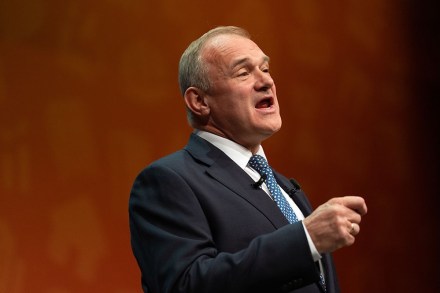
Ed Davey pitches himself as the anti-Farage

From our UK edition

11 min listen

The Liberal Democrat party conference in Bournemouth has concluded with a speech from leader Sir Ed Davey. While the current crop of Liberal Democrats are the most successful third-party in 100 years, they have faced questions about why they aren't cutting through more while Reform is. It's something Davey is aware of and – hoping to exploit how divisive the leader of Reform is – he sought to pitch himself as the anti-Farage. Will it work? Plus, more bad news for the Chancellor. Labour had pledged to aim for the highest growth in the G7. New figures from the OECD did upgrade their global growth forecast, including for Britain, but projected that the UK would see the highest inflation across the G7. How bad is this for Rachel Reeves?

Weimar Britain, the war on science & are you a competitive reader?

From our UK edition

36 min listen

First: a warning from history Politics moving increasingly from the corridors of power into the streets, economic insecurity exacerbating tensions and the centre of politics failing to hold; these are just some of the echoes from Weimar Germany that the Spectator’s editor Michael Gove sees when looking at present-day Britain. But, he says, ‘there are grounds for hope’ – what are they? Michael joined the podcast to discuss.   Next: why did science succumb to the ‘culture wars’? Biologist and peer Matt Ridley bemoans the ‘cultification of science’, arguing that ‘left-wing ideological nonsense’ ended up permeating through all scientific disciplines.

Why I gave up on the Tories

From our UK edition

The days between my leaving the Tories and joining Reform were an odd uneven time. It was the hardest decision I have ever made – I’d been a Conservative party member for 30 years, after all. Before the announcement, only three people knew what I was planning to do. In Westminster almost everything leaks so we kept the information tight. Once I had made up my mind, Nigel Farage and I held several clandestine meetings in a secluded room in a Mayfair members’ club to decide how to break the news. I initially rather fancied defecting on the eve of the Conservative party conference, for maximum impact. But in the end we decided to drop the story in the Daily Mail on Thursday night.

Reform conference review: is this ‘British MAGA’?

From our UK edition

16 min listen

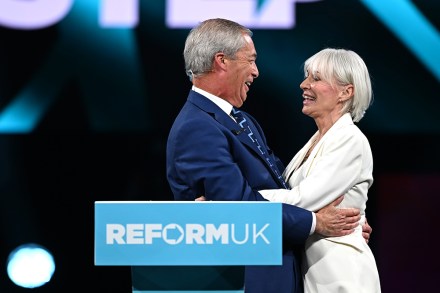
Reform UK’s annual conference wrapped up this weekend – and it was anything but dull. From Andrea Jenkyns belting out her original song ‘I’m an Insomniac’ on stage to Nigel Farage trying to keep a sometimes chaotic movement united, the mood was more rally than conference. Despite the optimism in the room, there were obvious cracks under the surface: mainly, do Reform have enough experience in their ranks for the business of serious government? On Coffee House Shots, Oscar Edmondson is joined by Tim Shipman and James Heale fresh from the conference floor.

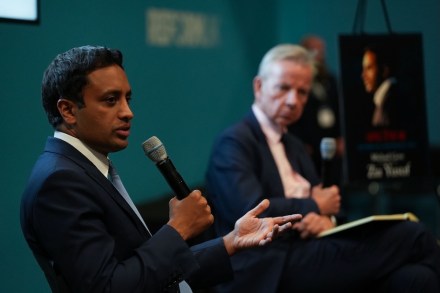
Reform’s Zia Yusuf in conversation with Michael Gove

From our UK edition

70 min listen

At the Reform conference in Birmingham, the Spectator's editor Michael Gove sat down with Reform UK's head of their department of government efficiency Zia Yusuf. They discussed Labour's track record in government, Zia's faith and his tech background, why leader Nigel Farage is his political hero and how AI could change Britain.

The red reshuffle overshadows Reform

From our UK edition

14 min listen

Lucy Dunn catches up with Tim Shipman at Reform's party conference, taking place in Birmingham, to get his reaction to Labour's reshuffle. The reshuffle took place following Angela Rayner's resignation from government. Tim argues that it's clear the reshuffle centred around getting Shabana Mahmood into the Home Office, where she can tackle some of the biggest issues for Labour – small boats and asylum hotels. They also round up the goings on at Reform including leader Nigel Farage's speech, who claimed Labour's reshuffle proved an election could be sooner than we think... Produced by Patrick Gibbons and Megan McElroy.

Inside GB News’s Great British bash

Cockburn spent Wednesday night at the ultra-exclusive Ned’s Club near the White House for a shindig celebrating the launch of GB News’s DC bureau. The network, which launched in 2021, will be airing a US politics show from 7-9 p.m. ET (that’s midnight to 2 a.m. UK time), anchored by Bev Turner. Nigel Farage, who hosts a primetime show on the network, held court by the central bar. Cockburn spotted him chatting to Jim Jordan, who chairs the House Judiciary Committee which Farage had addressed on free speech in Britain earlier in the day.

GB

Reform’s camp following, masculine rage & why do people make up languages?

From our UK edition

51 min listen

First: Reform is naff – and that’s why people like it Gareth Roberts warns this week that ‘the Overton window is shifting’ but in a very unexpected way. Nigel Farage is ahead in the polls – not only because his party is ‘bracingly right-wing’, but ‘because Reform is camp’. Farage offers what Britain wants: ‘a cheeky, up-yours, never-mind-the-knockers revolt against our agonisingly earnest political masters’. ‘From Farage on down,’ Roberts argues, ‘there is a glorious kind of naffness’ to Reform: daytime-TV aesthetics, ‘bargain-basement’ celebrities and big-breasted local councillors. ‘The progressive activists thought they could win the culture war simply by saying they had won it’, but ‘the John Bulls and Greasy Joans are stirring again’.