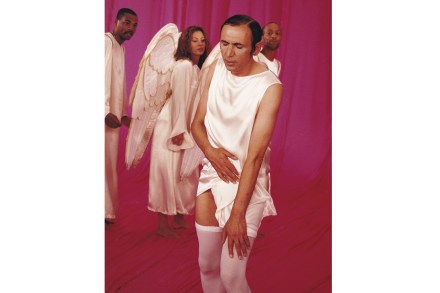
New wave

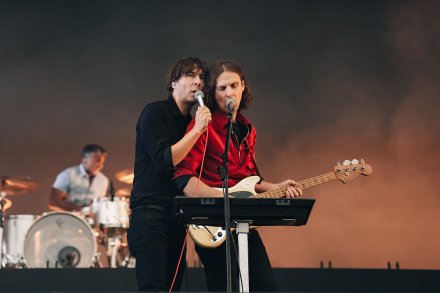
Delightful: Phoenix, at All Points East, reviewed

A few years ago, my nephew informed me that he and his friend were planning to come up to London for the weekend for the Wireless Festival. Did they need somewhere to stay? He looked at me like I was a mad old man. No, of course not. They were going to camp. In Finsbury Park. Because when you go to festivals, you camp. Thankfully, he didn’t turn up on the Victoria Line with his tent and then wonder why no one else was similarly equipped. Phoenix have the air of being as much a lifestyle choice as a pop group Inner-city festivals such as Wireless and All Points East are almost always a series of single-day events. APE is a ruthlessly programmed festival. Rather than try to be all things to all people, each day is targeted at some section of the festival-going population.
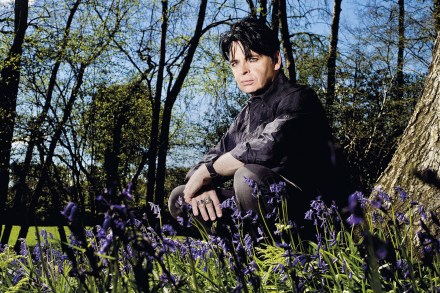
‘My voice is a curse’: Gary Numan interviewed

Reading the opening chapter of Gary Numan’s recent autobiography, (R)evolution, I start to get the odd feeling that I could just as well be reading about my own early life. Like Numan, I grew up near Heathrow and found the aircraft that flew over our house beautiful and magical. My parents were working class and worked hard and supported me all the way. Like Numan, I wanted to be a pilot, and a rock star. And like him, I never quite fitted in. Perhaps I could have formed a seminal band, become a pilot in my spare time and moved to LA. But then I don’t have that voice, or that talent. Never mind. I am chatting to him by Zoom. He’s in his LA home and eagerly awaiting the release of his 18th solo studio album, Intruder.

‘Cocaine addiction is time-consuming’: the rise and fall of Kevin Rowland and Dexys

When Dexys Midnight Runners reached No. 1 in the singles charts in spring 1980 with the song ‘Geno’, the band had to travel to London for their coronation appearance on Top of the Pops. For the first time they could afford the train fare. But Kevin Rowland — their singer, leader, creative director, boss, whatever you want to call him — insisted they continue to jump the barriers at Birmingham New Street. ‘I said, “Come on lads, we’re still going to bunk the trains.” And they went, “What?” “Come on, the inspector’s coming. We’ve got to get in the toilets.” And the drummer said, “Kev. We’re No. 1 in the charts and we’re bunking the trains…”. “GET IN!

The musical benefits of not playing live

Glenn Gould considered audiences ‘a force of evil’. ‘Not in their individual segments but en masse, I detest audiences.’ He retired from public performance on 10 April 1964, at the age of 31, having given fewer than 200 public recitals. The Canadian classical pianist had longstanding philosophical objections to the ritual of performing live. He found applause automatic and insincere, and often asked spectators not to bother. He even wrote a (partly) tongue-in-cheek manifesto, the Gould Plan for the Abolition of Applause and Demonstrations of All Kinds, in which he called for clapping to be banned. Gould believed that the most useful and honest response to music came following a period of solitary reflection, rather than as instantaneous public display.