Nature

Our politicians need a trip to Maine

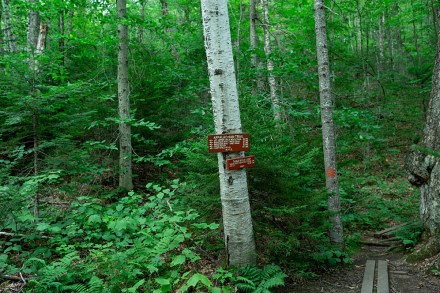
Unpretentious and tucked away, it is not easy to drive past the tiny hamlet of Allagash, population 237, in the far northern tip of Maine. That’s because the blacktop ends at the town’s western edge. Allagash is one of a handful of jurisdictions in the east above the 47th parallel. Beyond the paved road, to the north, west and south stretch more than one million acres of forest. To be sure, there are logging roads in the woods, but no towns, gas stations or supermarkets. Just miles and miles of boreal forest whose birch, pine, alder and spruce blanket the hillsides, lakeshores and river bottoms.

Humans are more than just apes

Revolutions in science happen like Mike’s bankruptcy in Hemingway’s The Sun Also Rises: slowly, then suddenly. For the past two decades, neuroscientists have been interested in the ways that the human brain differs from those of other primates. The prevailing assertion among primatologists was that our genome is only 1 to 2 percent distinct from chimps’. Then in April, a team of more than a hundred of the world’s top geneticists published an article in Nature revealing that it’s actually ten times as different. This has enormous implications. After all, if humans aren’t just souped-up chimps – as primatologists have often suggested – then many widely accepted ideas about our nature must be reconsidered.

apes

Eighty years on, Smokey Bear has aged like a fine oak

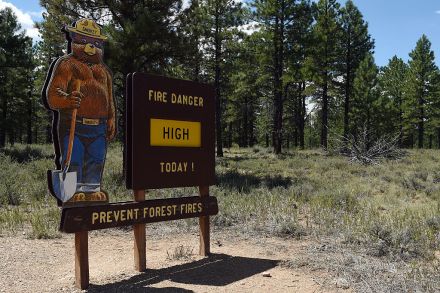
On a muggy mid-morning in early August, I arrived at the Berks County (Pennsylvania) Heritage Center to celebrate the birthday of a bear. This was not your run-of-the-mill bear birthday party, mind you. This one was honoring a bruin who wears pants and no shirt (unlike his edgier cousin, Winnie-the-Pooh, who forgoes britches), a campaign hat just like the park rangers’ and who, at age eighty, shows no signs of slowing down. Yes, Smokey Bear became an octogenarian this year, and a billboard in my central Pennsylvania town informed me of his milestone. Not that we have many wildfires in the damp northeast, but Smokey’s message transcends space and time (and US Forest Service budgets, apparently).

Smokey

Rewilding the world

I recently found myself scrolling World Cement Weekly in search of news of a massive rewilding project in northern Mexico, created and funded by the cement giant Cemex. The growing success of the rewilding movement is strangely little known — though there are now places that are wilder, more vibrant, more teeming with life than they have been for centuries, few outside the movement know anything about them. Two decades ago, a nature-loving chief executive of Cemex decided that the company would acquire 346,000 acres of degraded land on Mexico’s border with America, an area larger than Los Angeles, renamed the El Carmen Nature Reserve.

rewilding

The magic of making maple syrup

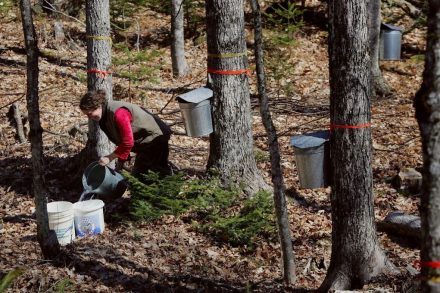
On one of those dark-too-early winter afternoons that might as well be midnight, I assessed my Subaru’s all-wheel drive capabilities with a slick spin up a long, snow-covered driveway. My destination: the sugar shack. Scott and Kelly Kolesar live on a piece of property Kelly’s great-grandfather homesteaded. And for all I know, standing on the clear-cut hillside that’s only ever been disturbed by the planting of some potatoes and strawberries and the hooves of cattle that grazed it decades ago, I could be right back in those early days of central Pennsylvania’s settling. The sky is clear and dark, with no light pollution to speak of, and diamonds twinkle above. The Kolesar home glows as a North Star up ahead, and another beacon next door serves as Halley’s Comet.

syrup

Stanford’s Marc Tessier-Lavigne and the messiness of modern science

The president of Stanford University, neuroscientist Marc Tessier-Lavigne, has resigned in the shadow of an investigation that revealed that some scientific papers he had overseen contained “manipulated data” or evidence of other kinds of scientific malpractice.    His resignation may well be warranted — but before he disappears into ignominy, it would be wise to consider the situation.  In the now dimly remembered past, a scientist devised experiments and, working alone or with the help of a loyal assistant or two, carried them out. Or he sat in a room, as Einstein did, and thought through deep problems, eventually penning an article in which he said forth a bold new hypothesis.

Marc Tessier-Lavigne

65 is a better B-movie than it has any right to be

Growing up, one of my favorite books was Gary Paulsen’s Hatchet, the story of a boy whose plane crash-lands in the Canadian wilderness and who must then fend for survival with only a single tool. 65 tries to pull off something similar, but with dinosaurs and sci-fi weapons. And bizarrely enough, it's a far better B-movie than it has any right to be. Yes, the setup of this film is seriously convoluted. Adam Driver stars as Mills, a long-haul space shipper who works for a spacefaring human civilization based on a planet other than Earth. When his vessel collides with an unexpected asteroid belt, he’s forced to crash-land on Earth — 65 million years before the present day. That’s right: this film takes place a long time ago, but in a galaxy not quite so far away.

Guardian writer doesn’t get why Americans love fall

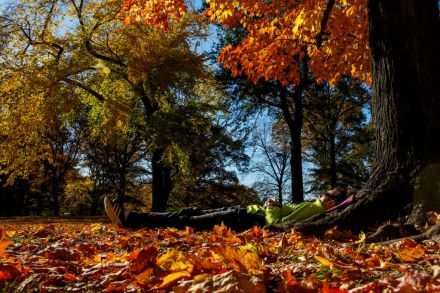
We Americans are used to the Brits weighing in on our affairs. I try to view their concerns with compassion, as a hard-to-kick habit leftover from the pre-Revolution days, or an endearing tendency they can’t help, like when your mother continues to remind you to wear a coat in winter even after you’re well into your forties. But our English cousins have finally crossed the line. Writing for the Guardian, Arwa Mahdawi vilifies that which we Yanks hold most sacred: “the season they call ‘fall.’” According to Mahdawi, autumn is “overrated” “rubbish.” Instead of pumpkin-spicing everything, she suggests we elevate another squash variety, “the humble courgetti,” as our favorite flavor profile of the season. I simply cannot let such abuse go unchallenged.

Leftist tree-huggers and backwoods conservatives unite!

There is paradox among 'outdoorsy' people that manifested itself to me in an indelible way over the weekend. Being something of a 'crunchy con,' I took part in the Pennsylvania Environmental Council’s Public Lands Ride — a group bicycling event that tours riders through Moshannon State Forest — that happened to take place on opening day of archery deer season this year. I was biking beside Six Mile Run, admiring the picturesque outline of a lone fly-fisherman standing in the glittering stream, when I glimpsed a tired-looking Subaru Outback parked along the side of the gravel forestry road. 'A support vehicle,' I thought, wondering why the volunteer would choose to set up her station so close to the one I’d just passed.

nature

Nature is healing

Ignoring the padlocked gate, my six-year-old son Nicholas and I climbed through a break in the metal fence and pushed into the mesh of undergrowth. This was the site of Ducker, the open-air swimming pool that once belonged to Harrow School in London. Here the young Winston Churchill romped (naked, since trunks were for prefects), as, in his own day, did my dad. When I arrived at Harrow in the 1980s, the pool — far bigger than Tooting Bec Lido, which is now the UK’s largest — had just been abandoned. It was covered with graffiti, the haunt of skateboarders. Returning in 2021, I looked for changes wrought by three decades of neglect. Google Maps showed a J-shaped artificial lake, 98ft by 492ft.

nature

Big lakes, small ripples

The summer motorboats still roared this past weekend, their wake roiling the Midwestern lakes. The days continue hot, for the most part, and the sun bright. But something in the lower angle of the light now speaks of the season’s falling off toward winter. Something a little more golden — tentative and ephemeral — than the summer sun. Something more Septemberish. Nonetheless, you could sit on the shore and watch the boats make their runs up and down the middle of the local South Dakota lakes — Lake Madison, Lake Herman — like mechanical salmon, determined to reach their final locks in the waning days. Like August behemoths, roaring their unwillingness to admit the season’s end. And who knows?

lakes milwaukee lake south dakota