Murder

Murder in the dark: The Eighth House, by Linda Segtnan, reviewed

From our UK edition

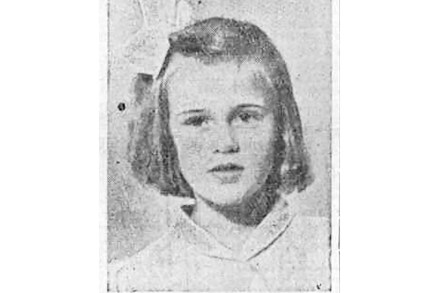
It takes a Scandinavian mother to write like this: ‘Why murder a nine-year-old girl? She wasn’t raped. Rape is the only motive I know of for the murder of little girls, unless the killer is a close relative.’ Linda Segtnan’s The Eighth House benefits from this bluntness. Its author, a historical researcher based in Stockholm, was browsing through a newspaper archive in 2018 when a photograph of nine-year-old Birgitta Sivander caught her attention. The girl lived in a village called Perstorp in southern Sweden until one evening in May 1948 she went out to the football field and did not return. A search was organised, the human chain making its way into the nearby forest in the middle of the night to look for her. They found her clogs.

Behind the Venezuelan migrant crime wave

Jose Antonio Ibarra, a twenty-six-year-old Venezuelan illegal immigrant, was charged in connection with the gruesome murder of Laken Riley, a nursing student at the University of Georgia last week. Another Venezuelan, thirty-two-year-old Renzo Mendoza, was arrested last week on two felony charges for sexually assaulting an underage child in Virginia.  These cases, along with a series of others connected to Venezuelan migrants, have become central to the debate on immigration policy. Tuesday morning, for instance, Republican members of the House Judiciary Committee sent a letter to the Department of Homeland Security asking for more information about Ibarra.

tren de aragua venezuela

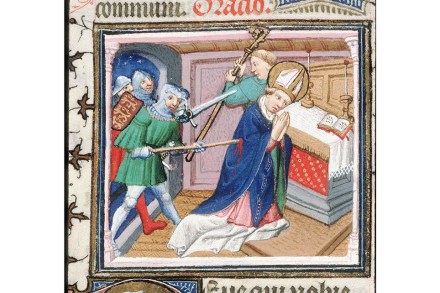
What became of Thomas Becket’s bones?

From our UK edition

The St Brice’s Day Massacre? I must admit I hadn’t heard of this ‘most just extermination’ of Danes in Oxford at the instigation of King Aethelred the Unready in 1002, perhaps because the teaching of history in this country tends to kick off in 1066. You certainly don’t think of Oxford as a place that pioneered techniques of ethnic cleansing. Crypt is a collection of seven essays that unearth details about how certain people lived and died in the past. If you didn’t already know Alice Roberts’s background as an anatomist and biological anthropologist, you’d have a good chance of deducing it from this book.

An Oxford spy ring is finally uncovered

From our UK edition

Oxford and Cambridge have many rivalries, but espionage has always been a one-sided contest between the two. Burgess, Maclean, Philby, Blunt and Cairncross were all Cambridge men. If this were put in Boat Race terms, Cambridge would have rowed halfway to Hammersmith Bridge before the dark blues had their blades in the water. Charles Beaumont’s excellent A Spy Alone (Canelo, £9.99) tries to redress the imbalance with its depiction of a richly imagined Oxford-based spy ring. His protagonist, Simon Sharman, is a former agent turned private security consultant. An Oxford man, he is approached when a Russian oligarch decides to donate some of his millions to the university. Sharman is tasked with investigating just how dirty the money on offer is.

Satirical pulp: The Possessed, by Witold Gombrowicz, reviewed

From our UK edition

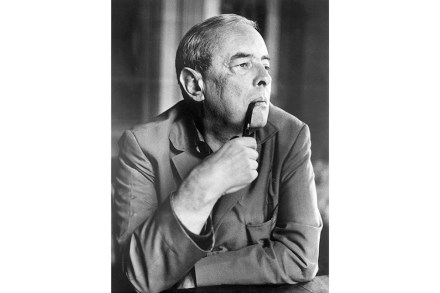
On 1 September 1939 Germany invaded Poland. It’s hardly an event which needs its significance re-stating, but there was one outcome which has received rather less attention than the impending crisis in Europe. After the first instalments – serialised in newspapers in the summer of that year – a bizarre, flamboyant, mock-gothic novel by an unknown writer, ‘Z. Niewieski’, was forced to cease publication on 3 September. Witold Gombrowicz, the author of The Possessed and master of Polish modernism, had penned the work under a pseudonym, and, he claimed, only for money. If that distance from the book weren’t enough, he then put an ocean between himself and the manuscript.

Mocking murdered leftists is not based

At 1:30 a.m. on Monday, Philadelphia freelance journalist Josh Kruger was shot seven times at the base of his stairs by an intruder. He stumbled, bleeding, into the street and collapsed on the sidewalk before being transported to the hospital, where he soon died. Come 10:00 a.m., news of his death was reported by local outlets, and Philadelphia’s media ecosystem was in a full-fledged state of lamentation. Friends, professional acquaintances and public leaders poured their hearts out for Kruger. But the moving display of mourning didn’t last long.  Before Kruger’s body went cold, prominent figures on the dissident right caught wind of the murder and discovered to their delight that he was a vocal defender of Philly’s progressive District Attorney Larry Krasner.

josh kruger murdered

Camari Mick is making pastry, not solving crimes

"I was really fascinated with the process, the science behind everything,” recalls Camari Mick, the now twenty-nine-year-old star pastry chef, who studied anatomy in high school. “I love true crime: I was very into Snapped and crime junkie podcasts.” When she approached her parents, however, they asked her to reconsider. “My dad looked at my mom, looked at me, looked back at my mom and looked at me, and said: ‘Are you sure?’” At the time, Mick was running a mini-business from home, making baked goods to sell to friends, teachers and neighbors. “You’re doing really well, you clearly love being an entrepreneur, why don’t you go into this avenue?” her father asked her. His advice paid off.

mick

An untrue true crime story: Penance, by Eliza Clark, reviewed

From our UK edition

Remember the teenage girl who was murdered in Crow-on-Sea in 2016? A horrific story. Google it. Or the journalist Alec Z. Carelli, the guy who went to school with Louis Theroux, Adam Buxton and Giles Coren and wrote a book about it? Remember how it was pulled because of the controversy over the way he obtained some of his material? Well, the publisher has decided to release that book after all. There will be no upset loved ones –except perhaps those who were affected by the true crimes mentioned None of this is true.

Ireland’s most notorious murderer still casts a disturbing spell

From our UK edition

Mark O’Connell was three years old when Malcolm Macarthur – a silken-tongued toff in a bow tie – went on his killing rampage in 1982, and 33 when he was released from prison in 2012. Eight years later, when he began this book, O’Connell describes stalking Macarthur around Dublin in the hope of securing the kind of interview that would cause Ireland’s most famous murderer to ‘tremble in terror and awe at the moral magnitude of his iniquity. I wanted to witness the breaking down of his ego defences, the revelation of some terrible emotional truth within’.

Lies about the Katyn massacre added insult to the horror

From our UK edition

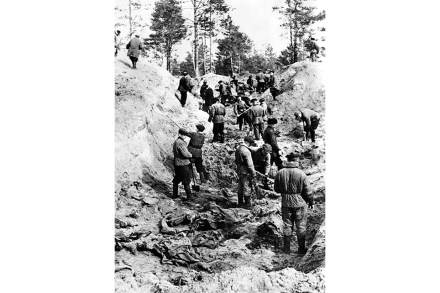
On 5 March 1940, as the USSR stamped its authority on a Poland it had partitioned with Hitler, Stalin signed a decree to murder 14,700 Polish officers in the woods by Katyn. These ‘hardened, irremediable enemies of Soviet power’ were not informed of their sentence and simply shot in the back of the head, a form of execution favoured by the secret police, the NKVD, for whom this method was just part of bureaucratic procedure. NKVD forgers changed the dates on the documents found in the dead officers’ pockets at Katyn When the Nazis turned on the Soviets in 1941 and marched east, they found the mass grave.

Why Idaho brought back the firing squad

Bryan Kohberger, the man accused of stabbing four Idaho college students to death, could face a firing squad if convicted.  At his arraignment Monday, Kohberger “stood silent” when asked to enter a plea, leaving the judge to formally enter a not guilty plea on the suspect’s behalf. A trial is scheduled for October 2.  The prosecution has sixty days to notify the court if they want to pursue the death penalty — and because of a new Idaho law that goes into effect on July 1, the state could administer the death penalty by firing squad if lethal injection drugs are not available.  Idaho governor Brad Little signed the law on March 24 after it passed both chambers of the Idaho Legislature.

bryan kohberger firing squad

A gruesome discovery: Death Under a Little Sky, by Stig Abell, reviewed

From our UK edition

The journalist Stig Abell has such a versatile CV – moving from the Sun to editorship of the TLS and then to his present morning slot on Times Radio – that it’s no surprise he has dipped a toe into the crime-writing waters where so many semi-celebrities increasingly swim. What may be surprising, given the rigours of the genre, is how well he’s done it. Death Under a Little Sky sits on the cusp of cosy crime. Jake Jackson is a police detective in London whose life changes when an oddball uncle dies, leaving him a large house deep in a nameless part of England, complete with acreage and a lake. The legacy coincides with the end of Jackson’s marriage and comes with enough cash to allow him to resign from his job.

What the Royal Society of Chemistry gets wrong about free speech

From our UK edition

Why has the Royal Society of Chemistry published a 37 page opinion piece entitled 'Academic free speech or right-wing grievance?' in their new journal Digital Discovery? Digital Discovery publishes 'theoretical and experimental research at the intersection of chemistry, materials science and biotechnology' focusing on 'the development and application of machine learning'. So it is a little surprising for them to publish a piece that 'argues that those who wish to have an honest debate about the limits around freedom of speech need to engage that conversation in a manner that avoids resonance with the language of White (heterosexual, cisgender male) supremacy, lest their arguments provide intellectual cover to those who would attack historically marginalised communities'.

Should we judge a work by the character of its creator?

From our UK edition

‘Most of my heroes are monsters, unfortunately,’ Joni Mitchell once said, ‘and they are men.’ The singer-songwriter was able to detach the maker from the made. Should we do the same? Is it ethical? Even possible? These are the questions Claire Dederer deftly considers in Monsters, which puzzles through the problem of what we ought to do about great art by bad men. Ideally, nothing. Early on in her quest, Dederer longs for someone to invent an online calculator: The user would enter the name of an artist, whereupon the calculator would assess the heinousness of the crime versus the greatness of the art and spit out a verdict: you could or could not consume the work of this artist. Alas, said calculator has yet to be programmed, so it’s down to her to do the maths.

Was this footballer killed for scoring against the Nazis?

From our UK edition

Vienna, April 1938. To mark the Anschluss, the annexation of Austria by the Third Reich, the German football team plays a match against the Austrian team, which will cease to exist when the match is over. The Austrians are much better, but can’t seem to score – aha, the match has been fixed by the Nazis. And then, in the 70th minute, Austria’s best player, Matthias Sindelar, can’t take the pretence any more and puts the ball in the German net. At the end of the match, to underline his feelings, he performs a victory dance in front of the Nazi dignitaries. This might sound like fiction but it really happened. Sindelar, the ‘Paper Man’ of this book’s title, was 35 at the time, and, in his prime, had been probably the best player in the world.

The Murdaugh trial is twisted true crime at its peak

The murder trial of prominent South Carolina patriarch Alex Murdaugh has it all: two deaths, a lethal drunken boat accident, a suicide-for-hire plot, the mysterious death of the family's housekeeper and a suspicious hit-and-run. That's why the case has caught the attention of true crime fanatics and the national media — ABC News, Discovery, HBO, CNN and Netflix have all taken a stab at various documentaries and podcasts. Others still might find themselves lost in the schadenfreude of watching a powerful and wealthy family descend into tragedy. The Murdaugh family has long exercised a significant amount of legal influence in the Low Country region of South Carolina.

alex murdaugh

Does your mass shooting suit my worldview?

In the wake of Saturday’s horrific shooting at a Lunar New Year celebration in the heavily Asian neighborhood of Monterey Park, California, Democratic lawmakers sprang into action, speculating that the violence may have been racially motivated. Hours later it emerged that the shooter was himself also Asian. The frequency of mass killings in this country is harrowing. But Cockburn finds such tragedies are made all the more gruesome when politicians so often jump ahead of the facts, ascribing motivations or reasons to the violence that are politically beneficial to them or fit their ideological framework. Representative Adam Schiff, for example, pegged “bigotry towards AAPI individuals as a possible motive.

monterey

AP conveniently forgets to mention that politician accused of murder is a Democrat

Cockburn is partial to a murder mystery, but in some cases it seems that the mainstream media are going out of their way to hide relevant facts. The Associated Press, for example, serves the important function of scribbling up neutral versions of smaller local stories and syndicating them nation- and worldwide. It's intriguing, therefore, that when the wire service reported on the trial of the Clark County public administrator Robert Telles allegedly killing a Las Vegas investigative journalist, they conveniently forgot to mention that he’s a Democrat. While Cockburn is sure that the AP made an honest mistake, like every yuppie he has found himself on his fair share of crime scenes. Getting a sense of things is generally pretty easy: Colonel Mustard with the dagger in the library.

robert telles nevada ap

Why women shouldn’t run in the dark

Eliza Fletcher was abducted and murdered on her morning run last Friday. The mother of two young boys was up at 4:30 a.m. to squeeze in a workout before a hectic day of prepping her kids for school and teaching kindergarten. Many working moms understand why Fletcher was out running so early. There was probably no other time in her day to do it. Many runners understand why she was running in the dark. Training takes time and discipline, so pre-sunrise hours are popular to get in necessary miles. Fletcher was a serious runner who had qualified for the Boston Marathon and was heavily involved in the running community online. A chilling video image of Fletcher, dressed in purple shorts and a pink sports bra just before the abduction, left female runners nationwide gripped with fear.

eliza fletcher

Murder most foul: The Marriage Portrait, by Maggie O’Farrell, reviewed

From our UK edition

There’s a moment near the end of Robert Browning’s dramatic monologue ‘My Last Duchess’ when it becomes clear that the duke, whatever he might claim, did kill his wife: ‘I gave commands;/ Then all smiles stopped’, he lets slip. In The Marriage Portrait, Maggie O’Farrell’s sombre, haunting novel based on the historical couple described in Browning’s poem, this revelation comes rather earlier. The young Lucrezia knows with ‘a peculiar clarity’ that her husband ‘intends to kill her’ right from the first page. After leaving Florence to begin her married life with Alfonso II, Duke of Ferrara, Lucrezia died within a year.