Mikhail gorbachev

The man who made Reagan

Ronald Reagan has been dead for nearly twenty years, but sometimes it still feels like he’s still the head of the Republican Party. The fortieth US president has been etched in American folklore as one of the country’s most effective and historic statesman, the man who stared down the Soviet Union and pursued policies that ultimately brought down the so-called “Evil Empire” in December 1991. Republican politicians of all stripes, from presidential aspirants to local councilmembers, utter his name at every opportunity. The first GOP presidential debate took place at the Reagan Library in Simi Valley, California, where multiple candidates looked back at the 1980s as a time when the mighty US shook off the cobwebs from the Vietnam War and rediscovered its self-confidence.

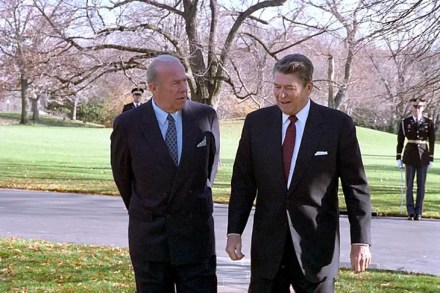
President Reagan walking with George P. Shultz outside the Oval Office (Wikimedia Commons)

Gorbachev’s war and peace

Tolstoy tried to write a history of Napoleon’s invasion of Russia, but found that his story required the broader canvas of fiction. We like to think that fiction emerges from reality, and that a novel, which is as much as species of hallucination as it is a social document, might retain enough of its physicality to be, as we say of War and Peace,’realist’. But the traffic between fiction and reality goes in both directions. ‘What force moves the nations?’ Tolstoy asked in the philosophical coda that, returning fiction to history, he added to the end of War and Peace. The discipline of history, its reliance on facts, was at the heart of the Enlightenment.

gorbachev