Language

How the Great British Bake Off inspired Great British Railways

From our UK edition

‘Why didn’t they call it Very British Railways?’ asked my husband. Unwittingly (as in most of his remarks), he had put his finger on something odd about the new name for the nationalised rail structure, Great British Railways. It follows the model of Great British Bake Off. In 2013, the Oxford English Dictionary noticed the tendency in a quotation from a magazine published in 2006: ‘The Great British queuer is a bit of a myth.’ In that construction a reference to Great Britain is ‘used punningly, as though great rather than Great British were the modifier’. In the 19th century, the same joke was deployed in the phrase Great British Public. It had the ironic implication that the public was not so great.
‘Level’ has a bumpy history

From our UK edition

‘I must level with you, level with the British public, many more families are going to lose loved ones.’ That is what Boris Johnson said on 20 March last year. On 14 May this year, he said: ‘I have to level with you that this new variant could pose serious disruption.’ In between, the Prime Minister often spoke of levelling up. He even got the Queen at it, in her ‘Most gracious speech’, as it is formally called: ‘My government will level up opportunities across all parts of the United Kingdom.’ Mr Johnson explained how that is done: ‘These new laws are the rocket fuel that we need to level up this country.

Shakespeare didn’t need to know the difference between ‘its’ and ‘it’s’

From our UK edition

An item on the BBC news site didn’t mean what it said: ‘The latest move is part of a wider crackdown by China to reign in the country’s fast-growing tech platforms.’ China may wish long to reign over us, but in this case it wanted to rein in activity. It wasn’t that the author didn’t know the difference between a horse’s rein and a monarch’s reign. But the moribund metaphor of reining in allowed a homophone to sneak in. If there was a spell-checker on the author’s computer, it would have let it through. I find that a very common spelling mistake is lead in place of led, as in ‘Boris led the party from victory to victory’.

The insidious creep of corporate friendliness

From our UK edition

Have you noticed it? The slide towards faux-friendliness and fake sincerity from the companies with whom we used to have an impersonal and transactional relationship. The deal used to be simple: we paid them, they did things or provided stuff, thank you and goodbye. If something went awry, we told them and, with luck, they fixed it. Feelings, other than occasional frustration, did not come into it. But in recent years, presumably inspired by American corporate culture, companies are no longer content with worming their way into our wallets. Now they want to commandeer the emotional part of our brains as well. They’ve done their research into behavioural science and the psychology of retail. They have started to emote, to empathise, to understand and to ‘chat’.

The importance of gossip (according to the ancients)

From our UK edition

Gossip appears to be good for the mental health. That should make the females of the ancient world some of the healthiest people around. Not that men did not gossip. The essayist Plutarch (c. ad 100) wrote disapprovingly of the ‘adulteries, seductions, family quarrels and lawsuits’ they loved to hear about (barbers’ shops were especial hotbeds of gossip); but his big gripe was that they were such bores. He described one droning on to Aristotle, and indulgently adding how amazing his stories were. Aristotle replied: ‘What is amazing is that anyone with feet puts up with you.’ Another crasher, after a long rigmarole, said: ‘I’ve bored you, philosopher.’ Aristotle replied: ‘Certainly not! I wasn’t paying attention.

The shifting language of shame

From our UK edition

As his tweed jacket flapped open to one side of his stomach, my husband stood up unsteadily and arched his arm, jabbing his finger towards me and chanting: ‘Shame on you! Shame on you!’ It didn’t work, because I’ve been living with him so long that, as Berowne says in Love’s Labour’s Lost, ‘We are shame-proof’. His little performance was in response to some news item about Tell the Truth, a spin-off of Extinction Rebellion. Its members don’t actually want journalists to tell the truth, but to do as they say. Their first ‘demand’ is that the climate crisis ‘must be front-page news every single day’. They also demand we change our language.

‘Religious literacy’ rules risk gagging the press

From our UK edition

There should be more ‘religious literacy’. So says the All-Party Parliamentary Group on Religion in the Media, chaired by Yasmin Qureshi MP. Amen to that. Religious ignorance is now virtually universal, so errors appear in news stories every day. But the APPG report seems less concerned with facts, more with attitudes. It wants news to concentrate more on ‘lived experience’, less on doctrine and ritual; it asserts that ‘religious literacy also incorporates respect for religion and belief as a valid source of guidance and knowledge to the majority of the world’s inhabitants’.

The dirty truth about ‘sleaze’

From our UK edition

‘Sleaze, sleaze, sleaze!’ exclaimed Sir Keir Starmer in Prime Minister’s Questions last week, hoping that a triple serving might stick. He meant to suggest financial corruption, though his language came from the hospitable semantic field that also corrals sexual meanings. The sexually dirty also overlaps constantly with the literally dirty. In 2013 Ukip’s Godfrey Bloom remarked that women who didn’t clean behind the fridge were ‘sluts’. This annoyed women who didn’t clean anywhere (but paid foreigners minimal rates to do it) and women who said that his was a sexual accusation.

Do spelling and grammar still matter?

From our UK edition

Some universities have announced that spelling and grammar (i.e. morphology and syntax) are not all that important, but quality of thought is. Up to a point, Lord Copper. Ancient Greeks were fascinated by language and invented much of the terminology in which we still talk about it. Protagoras (5th century bc) first classified nouns as masculine, feminine and ‘things’ (neuter). Aristotle (4th c. bc) defined articles, nouns, conjunctions and verbs, and talked of vowels, consonants, syllables and inflections as well as groups of words producing a collective meaning (‘utterance’), noting that ‘there can be utterance without verbs’. Dionysius from Thrace (2nd c. bc) divided nouns into cases (nominative, vocative, etc.), and singular and plural.

What’s so great about ‘super’?

From our UK edition

‘Wizard,’ said William. ‘Super,’ said Ginger, in William and the Moon Rocket (1954). More recently we have had Alex Salmond, the leader of the new Alba party (a grand coalition embracing albinos, Albanians, albatrosses and Albigensians) declaring that it can achieve in Scotland ‘a supermajority for independence’. Is a supermajority even a thing? (This form of question, with thing, has been asked by the Americans since about the year 2000, according to the OED.) The Guardian has found evidence that the term supermajority is puzzling voters. How big is it? Does it have a legal effect? Again, it is America that came up with supermajority. In Congress, a two-thirds majority is needed to override a presidential veto.

How ‘ACAB’ links David Bowie and BLM

From our UK edition

A favourite piece of graffiti to spray on the Cenotaph or the plinth of Churchill’s nearby statue is ACAB. It stands for ‘All coppers are bastards’, though Americans substitute the word cops for coppers. In graffiti form it is sometimes rendered 1312, from the place of the letters in the alphabet. As a slogan, ACAB was taken up by Black Lives Matter. In an Independent comment piece, Victoria Gagliardo-Silver declared that ‘ACAB means every single police officer is complicit in a system that actively devalues the lives of people of colour’. It has come a long way from an uncontroversial statement among the criminal classes of my youth in the 1960s about their natural enemies. The phrase was always associated with song.

America isn’t speaking our language

From our UK edition

I haven’t yet read the report published by the Commission on Race and Ethnic Disparities. But, looking at the recommendations, I think there is one missing detail. We also need some loose agreement on terminology attuned to the conditions of British English as distinct from American English. Let me explain. I would not dare to pronounce on what is acceptable terminology in Spanish, for the simple reason that I do not speak the language and certainly don’t understand the context. Without context, you can’t fully understand meaning. So I truly do not know whether ‘negrito’ is offensive or, as many claim, a term of affection. Perhaps it can be both. Certainly Spanish uses far more physical epithets than we do.

The uncomfortable truth about ‘shonky’

From our UK edition

A reader sent in a television preview from the Daily Star for Tarantino’s Inglourious Basterds in which ‘Brad Pitt leads a squad of Jewish-American soldiers on a Nazi killing spree’. The film, it added, is ‘not as funny as ’Allo ’Allo! but Pitt raises laughs out of his shonky language skills’. The reader was shocked by what she thought a crude piece of anti-Semitic vocabulary. I am old enough to be aware of shonky as an offensive term referring to Jews, but I don’t think that was meant here. Indeed it is frequently used in the papers to mean ‘wobbly’ (as if it were wonky) or ‘ropy’.

Where did Alex Salmond’s ‘Alba’ party get its name from?

From our UK edition

‘What, old monkey-face!’ said my husband with unnecessary lack of gallantry. He was referring to the 18th Duchess of Alba, who held 40 titles of nobility and died in 2014. She was a bit out of his league, but it is true that her bone structure came to give her face a simian air. As usual my husband had got it all wrong. Alex Salmond did not name his new party after the Spanish dukedom of Alba that gave the world the Dutch-clobbering 3rd Duke in the 16th century. That duke’s followers were called Albistas, which might come in handy as a label for the Salmond group. The new party’s name is that of Scotland in Irish and Gaelic. The BBC has had a Gaelic television channel called Alba since 2008.

My French lesson has taken a most unexpected turn

From our UK edition

‘Alas, David can’t be here this afternoon,’ I told the French teacher as she let me into her light and spacious home. ‘He has an appointment to see a specialist about his ears.’ I tried to say this in French. Conversational exchanges that take place between her front door and the lesson table are usually conducted under a flag of truce and she restricted her expressions of gaping horror to a minimum. ‘His ears?’ she said. ‘Poor David! What is wrong with his ears?’ ‘I think he was blown up by a shell,’ I said. ‘And his eardrums were damaged in the explosion.’ Our French teacher lives a quiet and blameless country life of artistic and intellectual endeavours and gardening.

‘Sacred space’ has become a crowded marketplace

From our UK edition

‘This is the book that horses wish every equestrian would read,’ says the blurb for Sacred Spaces: Communion with the horse through science and spirit by Dr Susan Fay. It might sound like putting the cart before the horse to have equines deciding our reading list, but everyone wants a bit of space at the moment. ‘Thank you for giving us the space,’ said the Duchess of Sussex to Oprah Winfrey at the end of their ample airtime. This is not Star Trek’s ‘space, the final frontier’, nor yet the spatium verae paenitentiae, the time for repentance, that the Christian asks before death. Yet space is the prime thing now seen as sacred.

How to kill the English language

From our UK edition

Probably, most of you will have only the dimmest idea what a ‘fronted adverbial’ is. I used one in the last sentence. Can you spot it? Very good. Those among you who did are either a) professional linguists, b) seven-year-olds, or c) are, like me, recovering from several long months of home-schooling a seven-year-old. Forgive me if in mentioning it I retraumatise members of category c). ‘Fronted adverbials’ have become something of a cause célèbre among the parents of primary school children. They even occasioned a prime ministerial joke, interpreted in some quarters as a dig at a certain former education secretary, about ‘every detail of the syllabus, from fronted adverbials to quadratic equations’.

Manchester University scraps the word ‘mother’

From our UK edition

Universities have traditionally played an important role in preparing young people for a life outside academia. These days, though, it appears that many institutions are more interested in lecturing their academics than teaching students – especially when it comes to using the right kind of language. That perhaps explains why the University of Manchester released on Wednesday a new ‘Guide to inclusive language’ for its staff, made by its ‘equality, diversity and inclusion team’.

The concrete truth about ‘Formica’

From our UK edition

If I ever again accompany my husband to a medical conference in Spain, and want to tell my hosts that I am embarrassed (as he often makes me), I should not say embarazada, for that word means ‘pregnant’, which at my age would be unusual. Such false friends can add to the gaiety of foreign travel. Among false friends, I must confess to assuming, all my adult life, that Formica, the kitchen laminate, had something to do with the ant, formica in Latin. It came as a shock last week to discover that the inventors in 1913 simply meant Formica as a substitute ‘for mica’. Mica was an electrical insulator — the original purpose of Formica. In my defence, it is true that Formica, fabric coated with resin, did use bakelite as a resin.

The New American Language

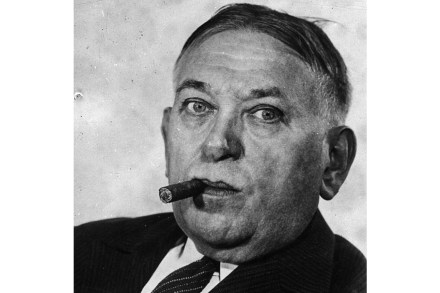
I suspect that were Mencken alive today having attained the respectable age of 140 years, he would be busy preparing The American Language: Fifth Edition and contemplating titling the book ‘The New American Language’ in recognition of the media-speak developed over the past couple of decades by news broadcasters and commentators, chiefly those belonging to the television industry. Each trade has its specialized lingo, due to the functional need for the terminology required to describe its unique operations. The electronic commentariat is no exception to this tendency of particular occupations to invent a vocabulary and idiom all their own. Where it does differ from a great many of them has to do with its reasons for doing so.

language