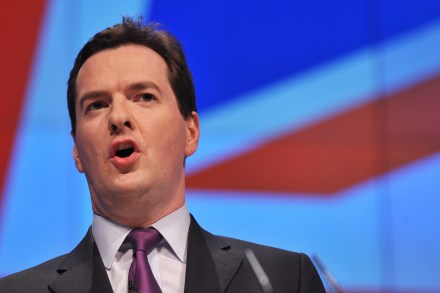
A joke too far?
Tom Harris lost his job as Labour's ‘Twitter tsar’ today after uploading this Salmond-themed Downfall video onto YouTube.
Tom Harris lost his job as Labour's ‘Twitter tsar’ today after uploading this Salmond-themed Downfall video onto YouTube.
‘Another week, another speech about the evils of capitalism.’ So joked Nick Clegg at the start of his speech to Mansion House earlier, and there was some truth in this particular jest. All three parties are jostling to be seen as the harbingers of a new economy at the moment — one that doesn't reward failure; that benefits everyone ‘fairly’; that won't seize up as the old one did; that etc, etc. Ed Miliband sketched out his rather insipid vision for this economy last week; David Cameron will hope to do a better job later this week. Today, though, was the Deputy Prime Minister's turn. So what did Clegg say?
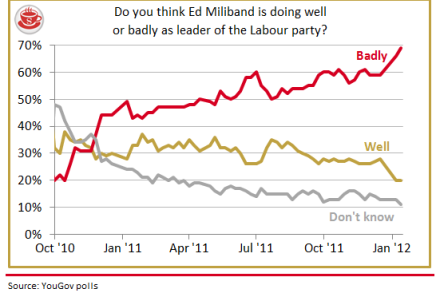
Ed Miliband's poll ratings are going from bad to disastrous at the moment. Last week his YouGov approval rating dropped to its worst ever, with just 20 per cent of respondents saying he's doing a good job, and 66 per cent saying he's doing a bad one. And today they slip even further. Again 20 per cent say he's doing ‘well’, but now 69 per cent say ‘badly’: And, most worryingly for the Labour leader, the number of Labour voters giving him the thumbs down (49 per cent) now outnumbers those giving him the thumps up (46 per cent). That's compared to the 95 per cent of Tories who think Cameron's doing well, and the 72 per cent of Lib Dems for Clegg.
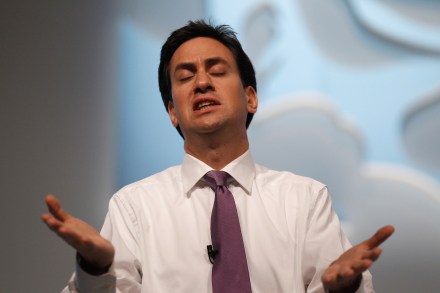
In the news bulletin after Ed Miliband’s interview on the Andrew Marr show, the headline was about Miliband saying he does listen to criticism of his leadership. It rather summed up Miliband’s problem at the moment: he can’t get beyond all the chatter about his leadership. In terms of the substance, Miliband’s explanation of Labour’s new economic position showed just how difficult it is going to be to explain it to the public. Miliband argued, as Balls did on Saturday, that the cuts are currently going ‘too far, too fast’ but that he can’t promise to reverse them. As one Tory said to me yesterday, Labour is saying that the cuts are the problem but we might have to adopt them.
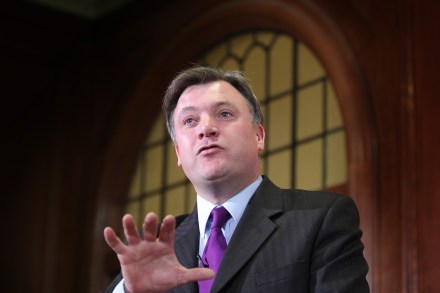
Even as Ed Balls embraces the need for austerity today, he takes a very different position to the coalition on why it’s necessary. The government has always blamed the need for cuts on the ‘awful economic inheritance’ bequeathed it by Labour. Balls, on the other hand, puts the blame squarely at George Osborne’s door. In his Fabian Society speech, he said: ‘George Osborne’s economic mistakes mean more difficult decisions on tax, spending and pay.’ His argument is that, by cutting ‘too far and too fast’, the coalition has caused the economy to stagnate and thereby created the need for more austerity. Labour has, of course, long been trying to shift the blame for the cuts away from themselves and onto the coalition.
In the Cameroon effort to redefine the politics of fairness, the benefit cap of £26,000 a year is key. When George Osborne announced it in his 2010 conference speech, he explained it – rightly – as a matter of fairness that ‘no family on out-of-work benefits will get more than the average family gets by going out to work’. The Tories were also aware of just how potent a wedge issue it would be. If Labour opposed the cap, they would be in favour of some households in which no one is working receiving more from the state than the average salary people achieve by working. This is, to put it mildly, not a position that would go down well on the doorsteps. But the cap has hit a snag: Simon Hughes.

‘I must be responsible and credible in what I say.’ No, it's not Bart Simpson writing on the blackboard at the start of The Simpsons, although it may have been said with just as little enthusiasm. It's Ed Balls on the Today programme this morning, explaining his decision to endorse George Osborne's public sector pay freeze. Balls' interview in today's Guardian is his biggest effort so far to sound 'responsible and credible' on the economy.
With Scottish independence very much the issue of the week, we thought you might enjoy this Spectator leader from 1979, arguing for a 'No' vote in that year's referendum on Scottish devolution: To preserve the Union, 24 February 1979 ‘So, Sir, you laugh at schemes of political improvement?’ ‘Why, Sir, most schemes of political improvement are very laughable things.’ The Scotland Act, which comes before the judgement of the Scottish people on Thursday, is certainly laughable. Would that it were no more than that.

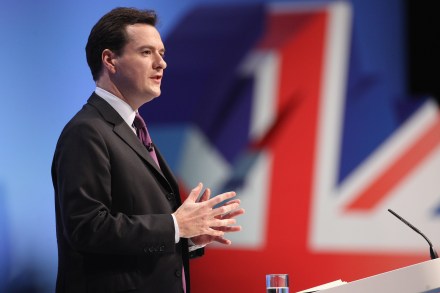
Edinburgh It became clear last night why George Osborne was put in charge of the Coalition Government’s fightback against Alex Salmond and separatism: he is the only one who has the ability to really score points off the Nats. The Chancellor’s intervention on currency and bank notes – suggesting that an independent Scotland might not be able to keep the pound and that, if it did, it might be banned from producing Scottish bank notes – hit the SNP hard. Osborne’s remarks shook one of those comfortable certainties which the SNP has been peddling for so long – that Scotland would simply keep sterling after independence and everything would progress as normal.
It gets worse for Ed Miliband in the polls today. After revealing last week that just 20 per cent of the public think he's doing well as Labour leader, YouGov now find that only 17 per cent think he'd make the best Prime Minister. That's his lowest score yet, and it compares to 41 per cent for David Cameron. But the way those numbers break down may be even more worrying for Ed. Only half of current Labour supporters say he'd be the best PM, and a minority — just 43 per cent — of 2010 Labour voters pick him. By contrast, Cameron has the backing of 97 per cent of Tory voters. Of course Miliband's personal ratings have been poor for a long time, but they're now worse than ever.
The exchange about rail fares in PMQs earlier was, it's true, not one for the photo album. But the way it's resolved itself this afternoon has been considerably more diverting. You see, it turns out that David Cameron was right: Labour did arrange for these fare increases when in government. And, what's more, Ed Miliband was wrong: the coalition didn't ‘reverse’ the cap on fares that Labour then conveniently introduced in the run up to the general election. That cap was limited to one year by the Labour government itself. It was always intended that it would expire on 1 January 2011, at which point — barring a new cap — the train companies could go back to the hyper-inflated fares they'd imposed previously. And that's what happened.

Miliband survives! That news should steady Labour nerves. For today at least. Their leader has the knack of turning near-certain defeat into absolutely-certain catastrophe, but he bumbled through PMQs this afternoon without suffering a serious setback. He has so little ground from which to attack the government that he had to lead on a niche issue. Rail fares. He asked the prime minister why the operating companies have managed to hike prices by 11 per cent on the busiest routes. Cameron: ‘Because of a power given to them by the last Labour government.’ With that lethally terse response the PM sat down. To his credit, Miliband wasn’t rattled.

Today's PMQs was rather a bland affair. Ed Miliband started with three questions on train fares that David Cameron batted away, but there is a little row brewing over whether Cameron's claim that he is simply continuing the policy of the last government is correct. Later, Miliband moved onto the safe territory of the Union and consensus broke out with only the half dozen SNP MPs dissenting from it. Angus Robertson, the SNP's Westminster leader, then asked the PM a question that, in a preview of the SNP's campaign tactics, was designed purely to get the words Cameron, Thatcher and Scotland into the same sentence. There were two other things worth noting from the session.
PMQs 11 January.

At the weekend, Tories were anticipating giving Ed Miliband an almighty kicking at PMQs. Lord Glasman’s description of Labour’s economic record as ‘all crap’ had given them a killer line. As one member of the Cameron circle joked to me, ‘we’ve never had more material to work with.’ But Ed Miliband now has a get out of jail free card. If he asks six questions about the Union and the referendum, it will be impossible for Cameron to have a pop at him without looking distinctly unstatesmanlike. On Scotland, the two leaders need each other. The Unionist side cannot win without the Labour party and the Labour party will find it very hard to win general elections without Scotland.
This is, I know, a statement of the obvious but Ed Miliband is no Teddy Roosevelt. There are two reasons to be thankful for this. First, TR was really a ghastly man; secondly, if Ed Miliband were able to muster a quarter of Roosevelt's brio he'd be faring rather better than he is. In the present circumstances, the opposition should be thumping the government every day. Granted, this requires more credibility than either Mr Miliband or Mr Balls can boast but the fact remains that a) George Osborne's economic hopes have been vanquished by events and b) there is little substantive difference between his proposals and those made by Alistair Darling before the general election last year. Events have pushed the government towards accepting a timetable they once thought impossibly timid.
Was Ed's Big Speech worth the extended wait? Not really. It wasn't a stone-cold terrible speech, but neither was it the rambunctious, attention-grabbing number that his leadership could do with. In fact, we could have saved ourselves the effort by simply reading his New Year's message again. That was considerably shorter, and covered almost all of the same ground. Squeezed middle? Check. Tackling vested interests? Check. An admission that Labour will need to cut? Ch… oh, you get the point. The best that could be said about today's speech is that it presented some of these arguments more clearly than in the past. Indeed, the attack on George Osborne's fiscal agenda was, by Miliband's usual standards, particularly punchy.
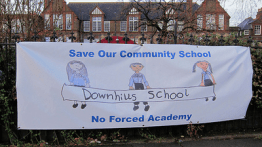
‘Anyone here from the Spectator?’ Last night a packed meeting at Downhills Primary in Haringey began with this ominous query from the chairman, Clive Boutle, who leads a local campaign against academies. Seated at the side of the hall I kept quiet. ‘No one?’ said Boutle, ‘Great, we’re safe.’ The meeting had attracted about 800 protesters and activists who oppose Michael Gove’s decision to force Downhills – a failing multi-ethnic school – to become an academy. ‘Michael Gove really hates us,’ continued Boutle, his manner urbane rather than menacing. ‘The government doesn’t like Haringey. There hasn’t been a Tory here since Noah was in short trousers. So we’re no risk.
Ed Miliband is trying to do something interesting today. He is attempting to answer the question, ‘what’s the point of Labour when there’s no money left to spend?’ This is the problem that Miliband has been grappling with since winning the leadership and there’s no easy answer to it. It seems that today Miliband will give us more of a sense of the ‘new economy’ which he wants to see in this country. The test of the speech will be whether it gets beyond generalities about a long-term vision for an economy that is ‘fairer’. The challenge for Miliband will be to make his subtle message heard above the chatter about his leadership which so dominated his Today Programme interview.
There’s much chatter in Westminster today about the fact that George Osborne is chairing the Cabinet committee on Scotland. Osborne is, of course, the Conservatives’ chief electoral strategist as well as the Chancellor of Exchequer. This has led to some suggestions that he wouldn’t be too upset by a referendum defeat that would make it an awful lot easier for the Tories to win a majority at Westminster. This is unfair: Osborne is a Unionist. What those around Osborne have long been interested in is the option that the coalition seems to be ruling out: fiscal autonomy. The circle around Osborne have long believed that it is only when Scottish politics is about how to raise money as well as how to spend it that the Tories will revive north of the border.