Israel

The Iran nuclear talks are on the brink of collapse

From our US edition

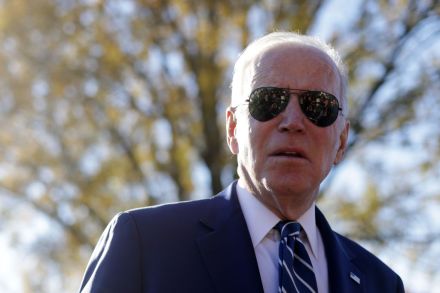
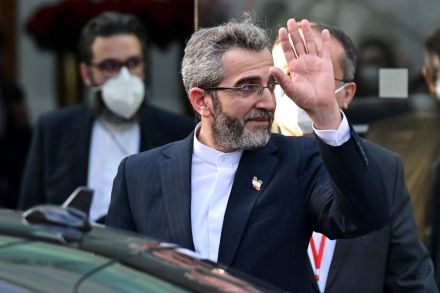
With diplomats fearing that the Iranian nuclear talks will collapse, minds are inevitably turning to what happens the morning after. In the realm of politics, this has amounted to buck-passing. Last week, White House press secretary Jen Psaki told journalists: “None of the things we’re looking at now…would be happening if the former president had not recklessly pulled out of the nuclear deal, with no thoughts about what might come next.” In the real world, meanwhile, with regional peace in the balance, the stakes are rather higher. As the Biden administration’s softly-softly approach plunges towards global humiliation, American negotiators have been waking up to what should have been obvious from the start: you can’t build an effective Iran strategy with carrots.
Biden chickens out of Iran negotiations

From our US edition

We were promised a war of nerves in Vienna between Washington and Tehran, a game of chicken. Instead, President Biden has chickened out. He's also blaming Israel. Call it fowl play. Here's how it should be going. The United States wants Iran to re-commit to refreezing its nuclear program. Iran demands in exchange the revoking of the economic sanctions against it. Each side insists that it won't give up on its demands — even if that could lead to the collapse of the negotiations, the demise of the Joint Comprehensive Plan of Action (JCPOA) and eventually to a military confrontation. The diplomatic and military tensions between the United States and Russia over Ukraine involve just such an exercise in brinkmanship.

iran

Eighty years after Wannsee

From our US edition

Eighty years ago in January, fifteen men sat around a table at a villa near Berlin and decided to eradicate a nation. To be precise, they decided how to eradicate a nation. Their decision, their “solution” as they perversely termed it, would lead to the murder of more than six million European Jews, though that is the easy-to-remember round number to which we so often default. The murders had started long before the Nazi leadership met at Wannsee in January 1942: this was not the first time a group of European leaders had planned to rid themselves of the Jews. The meeting clarified not just the goal of wiping out Europe’s Jewry, but the path to solving the “Jewish problem” by modern means.

jews

Joe Biden, foreign policy realist

From our US edition

President Joe Biden talks the liberal internationalist talk but walks the realist walk. The recent Summit of Democracies wasn't idealism but part of a strategy to contain China and Russia. Internationalist rhetoric aside, Biden has a dark Realpolitik side — which explains why he was able to survive so many decades in Washington and get elected as president. Some of my friends on the right have criticized me for recommending Biden for the diplomatic move that should have earned him the 2021 Machiavelli Award. Announcing a new military pact with Britain and Australia (AUKUS) to deter China stabbed France in the back — or to put it another way, emulated the modus operandi of traditional French diplomacy.

Was it inevitable that Iran would go nuclear?

From our US edition

Was it inevitable that Iran would one day gain nuclear weapons? Identifying causality in human actions is a tricky exercise, especially when it comes to historical events, like the outbreak of World War Two. Was appeasement the cause? Or perhaps a war with Germany was unavoidable as long as Adolf Hitler was in power? It may also be fated that a nation of ninety million people, proud about its history and place in the world — Persia was already an advanced civilization when barbarian tribes roamed the British Isles — would become a nuclear military power. That nuclearization process actually commenced under Mohammad Reza Shah and continued because of concern that, thanks to French assistance, Iran’s adversary Iraq was on its way to developing a nuclear weapon.

iran nuclear

Mossad is preparing to strike at the heart of Iran’s nuclear programme

Iran is about to be hit by a fresh wave of Mossad operations, sources in Jerusalem have told me. This is the result of a change in Israeli policy: from now on, when Tehran’s proxy militias make trouble in the region, the Jewish state will retaliate on Iranian soil. ‘No more attacking the tentacles of the octopus,’ one source said. ‘Now we will go for the head.’ For the foreseeable future, I can confirm, this will not take the form of air raids, missile strikes or drone attacks. Instead, Israel’s feared secret service has been told to carry out pinpoint operations inside the Islamic Republic, inflicting surgical but devastating punishment.

Exclusive: How Israel is attacking Iran’s nuclear sites

From our US edition

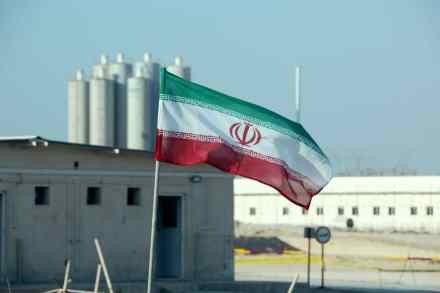
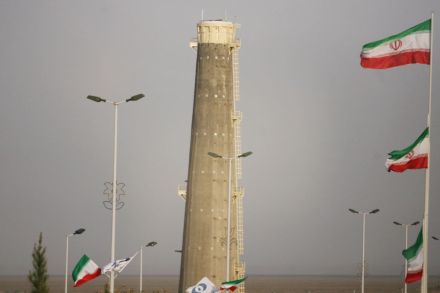
Israel has carried out three major operations over the last eighteen months against Iran's nuclear sites. These attacks involved as many as a thousand Mossad personnel and were executed with ruthless precision using high-tech weaponry including drones and a quadcopter — and spies within Tehran's holy of holies, its nuclear program. While Joe Biden’s nuclear negotiators try to snatch catastrophe from the jaws of defeat in Vienna, Israel is taking things more seriously. Last week, Naftali Bennett, the Israeli prime minister, pivoted to a new policy on Tehran: retaliating against aggression from militias backed by Tehran with covert strikes on Iranian soil. This builds on the extensive capabilities that the Mossad has built up in the Islamic Republic in recent years.

The fantasy of an Israeli-Palestinian ‘peace’

From our US edition

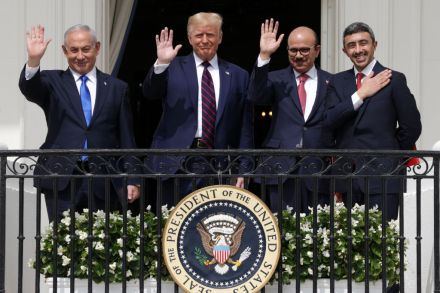
Long-time readers of this site may be aware that yours truly has not only applauded the Trump administration’s successful efforts to normalize Israel’s relationship with several Arab countries but has also proposed awarding the Nobel Peace Prize to Jared Kushner, the architect of the Abraham Accords. There were many reasons for my bullish sentiments regarding the Trump administration’s Middle East policy. First and foremost, as I pointed out, it disrupted the old American paradigm that held that any effort towards rapprochement between Arabs and Israelis hostage to the ultimatums of the radical Palestinian leadership.

peace palestinian

Priti Patel’s Hamas ban doesn’t go far enough

It’s been a rough old week for Hamas. The UK announced plans to proscribe the organisation, Justin Bieber ignored its call to cancel his 2022 concert in Tel Aviv, and even the recently friendly Labour party has vowed that it ‘does not and will not support BDS’. One minute, you’re going about your business, trying to drive the Jews into the sea, and the next you’re being treated like you’re the bad guy. Priti Patel’s decision to add Hamas to the Home Office list of terrorist organisations corrects a 20-year-old error which saw the Izz al-Din al-Qassem Brigades — Hamas’s paramilitary wing — outlawed in 2001 but the rest of the organisation unaffected.

Has Micah Goodman found the path to peace?

From our US edition

He makes an unlikely prophet, winding his way through the tables at an outdoor café in Jerusalem, scruffy baseball cap cupping his head, flashing a 100-watt smile and laughing too nervously and long. But this is the visionary who may have just found a way to ease the Israeli-Palestinian puzzle. Dr. Micah Goodman is an iconoclast. His 2017 book Catch-67 sought to identify pragmatic ways to “shrink the conflict” between Israel and the Palestinians, rather than aim to resolve it. The left accused him of being too right-wing. The right derided him as a leftist. Catch-67 catapulted Goodman to the bestseller list and instant celebrity.

goodman

The sinister targeting of Israel’s ambassador at the LSE

A mob waving flags and chanting slogans hounds a Jewish leader, forcing her to be bundled into a car and driven off for her own safety. These were scenes that might have been expected on 9 November 1938, when the ‘Kristallnacht’ pogroms raged across Nazi Germany, marking the beginning of the Holocaust. Instead, they took place 83 years later, on 9 November 2021, outside that august institution, the London School of Economics, in the heart of the British capital. The recent BBC series Ridley Road smugly suggested that antisemitism in this country was confined to decades past; real life is far more worrying. Antisemitic, you say? That’s a bit strong.

In Israel, there’s never an easy fix

From an Israeli army base on the border with Lebanon, I can see the village of Maroun al-Ras. An Iranian flag flies from the dome of the mosque. Nearby, strapped to a post, is a 20ft cutout of the late Iranian general Qassem Soleimani, which was put there earlier this year by Hezbollah after he was killed by an American air strike. His right arm and index finger are stretched out, pointing menacingly over the valley at Israel. Hezbollah, backed by Tehran, control Maroun al-Ras, and I can hear the buzz of a drone watching them. Some Israeli officials say Iran could have enough enriched uranium for a nuclear bomb in just a few weeks. I’m here with Bicom, the Britain-Israel Communications and Research Centre.

Labour is still overrun with anti-Israel cranks

As unhinged Labour conference motions go, the party’s anti-Aukus resolution will likely capture the headlines. The text describes the new defence pact between Australia, the UK and the US as a ‘dangerous move that will undermine world peace’. Sir Keir Starmer is on record backing the alliance but the Labour leader can at least take comfort in how close the card vote was: a mere 70.35 per cent of delegates voted for the motion. For a classic Labour conference motion, though, the prize has to go to the composite on… the NHS? Covid? Fuel shortages? No, silly: Palestine.

The Democrat ‘squad’ will regret shooting down Israel’s Iron Dome

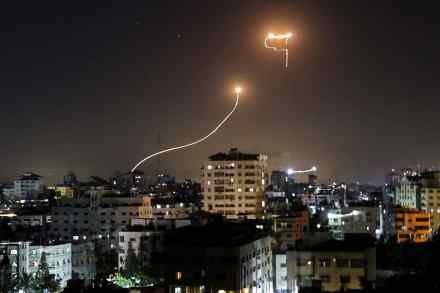
America’s left-wing progressives won a victory this week in their long-running battle with Israel. They managed, at least temporarily, to block $1 billion (£730 million) in U.S. funding to replenish the missile interceptors Israel used to shoot down the latest barrage of terror rockets from Gaza. The funding was initially included in Speaker Nancy Pelosi’s stopgap spending measure to raise the debt ceiling and fund the U.S. government. The victory was short-lived since House leaders stuck the funding into another bill after the public outcry. Who opposed the funding? The leaders were the 'Squad,' particularly congresswomen Ilhan Omar and Rashida Tlaib. Like others on the hard left across America and Europe, they despise Israel.

Exclusive: the New York Times stole my story

From our US edition

Question: When is a New York Times exclusive not a New York Times exclusive? Answer: On Sunday, when America’s paper of record stole my scoop. It sounds bizarre, but it’s true. Last February, I revealed top-secret details of the killing of the Iranian nuclear scientist Mohsen Fakhrizadeh in the pages of London’s Jewish Chronicle, the world’s oldest Jewish newspaper. Among the revelations — given to me by impeccable sources that I know well — were that the top Tehran official had been killed by Mossad using a remote-controlled gun that weighed one ton and had been smuggled into Iran piece by piece over several months.

new york times

How Harvard went woke

From our US edition

On January 1, 1993, I arrived at Harvard to take up a newly endowed professorship in Yiddish literature. It seemed preposterous: me at Harvard, Yiddish at Harvard. The university had never figured in my aspirations. My impressions of the university had been formed mostly from what I knew of its program in Jewish studies, which was jokingly referred to as ‘the Yeshiva on the Charles’ because of its emphasis on Talmudic and medieval sources. Its almost exclusively male Department of Near Eastern Languages and Civilizations felt obliged to appoint a female. My gender played an even more prominent part in the deliberations of the Department of Comparative Literature where I was to hold a joint appointment.

ruth wisse harvard

How China drove a wedge between America and Israel

Two weeks ago, CIA director William Burns – who has rather a lot on his plate just now – had a quiet word in the Israeli prime minister’s ear about Chinese investment in the Jewish state. It was the latest and most urgent of America’s attempts to prevent Israel from slipping further towards the Beijing dragon’s maw, an issue which has increasingly threatened to drive a wedge between the two allies. It’s no secret that in recent years, Uncle Sam has found himself asleep at the wheel while China has been pushing ahead in the global race. Four decades of pursuing a policy of friendship towards Beijing had simply opened the door to exploitation.

Why Israel is rolling out a third Covid jab

Israel has today become the first country in the world to offer a third Covid-19 booster vaccine on a large scale. Prime Minister Naftali Bennett announced that Israel will vaccinate all people over the age of 60 again, with the new Israeli President, Isaac Herzog, and his wife, the first people to receive their third shot on Friday morning. Legitimate concerns led to the decision: the number of new Covid cases in Israel has been rapidly increasing, including among the vaccinated – although to a much lesser degree compared with those who have not been vaccinated. There were 2,143 confirmed cases on Thursday, with 286 hospitalisations.

Why Israel must win over its Arab population

Which Middle Eastern country offers the best life for Arabs? The answer, as they say, might surprise you. Take any measure you like – democratic representation, women’s rights, lack of corruption, freedom of speech, the protection of sexual minorities – and it is clear that Israel comes out on top. I remember covering an Isis gun attack on the Reina nightclub in Istanbul in 2017. An Arab-Israeli woman, 19-year-old Lian Zaher Nasser, was one of 39 people who lost their lives in the atrocity. The attentiveness of the Israeli diplomatic service to her family was striking, and equal to anything I’ve seen elsewhere. Years later, a senior Israeli intelligence source told me of his abiding sense of guilt in failing to prevent the attack.

Who cares what Ben & Jerry’s think about Israel-Palestine?

When you think of the Israel-Palestine conflict, ice cream doesn’t usually come up. But that may be about to change. Ben & Jerry’s has finally broken its silence, announcing yesterday that it will ‘end sales of our ice cream in the occupied Palestinian territory’. Perhaps in the years ahead we’ll come to see this depriving Israeli settlers of Caramel Chew Chew and Truffle Kerfuffle as some kind of tipping point. We won’t, of course, because that’s ridiculous. As is a Vermont-based over-priced ice-cream brand weighing in on far-flung conflicts. But that seems to be where we’re at now – with corporate America in general and with Ben & Jerry’s in particular.