Islam

Zoe Heller versus Salman Rushdie and Joseph Anton

From our UK edition

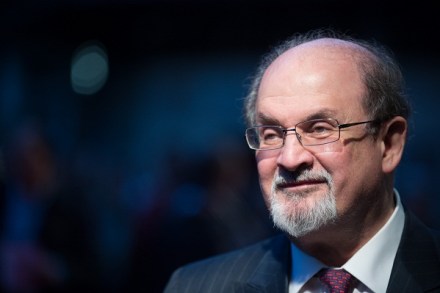
The literary world anticipates Salman Rushdie’s response to Zoe Heller’s cauterisation of his memoir, Joseph Anton, in the New York Review of Books. Heller’s pointed review is deeply considered. It is a delight to read, even though some of its arguments are uneven and some of its conclusions are trivial next to the themes of Rushdie’s unlovely yet important book. Heller is, in my view, right to slam the grandiloquence of Rushdie’s ‘de Gaulle-like third person’ narration.

Israel under Islamist siege

From our UK edition

I have a piece in the Wall Street Journal (Europe) today on the pyrrhic ceasefire between Israel and Hamas. Also - this week’s magazine carries a cover piece by me on the change that is happening in the region. As though determined to prove me right, the new Egyptian President has – with the praise of Hillary Clinton and Ban Ki-Moon still ringing in his ears – made certain declarations of intent: ‘Egypt's President Mohammed Mursi has issued a declaration banning challenges to his decrees, laws and decisions. The declaration also says no court can dissolve the constituent assembly, which is drawing up a new constitution. President Mursi also sacked the chief prosecutor.

Operation Pillar of Defence leads Israel to strategic failure

From our UK edition

Last night’s ceasefire is a strategic failure for Israel. While the end of military action must be welcomed, it is hard to see what Netanyahu has achieved beyond the killing of Ahmed Jabari. Despite a week of tit-for-tat missile fire, Israel secured none of its strategic objectives. In fact, in many cases it actually strengthened Hamas and diminished Israel’s security. Here’s some of the ways in which Israel has been weakened by Operation Pillar of Defence: 1) Hamas was able to break the psychological barrier of attacking Tel Aviv. No one has fired missiles at the city since 1991 when Saddam Hussein tried to undermine coalition forces in Operation Desert Storm.

Israel’s Tragedy: Even If She Wins She Loses – Spectator Blogs

From our UK edition

Next time someone bores on about the so-called decline of the British literary novel you might consider pointing out to your dinner-party companion that this is not such a bad thing. It suggests, if the thesis is true, that there aren't too many problems in this realm that are still worth exploring, far less solving. Consider, by contrast, the twin and warring agonies of Israel and Palestine. Is there a better, bigger, subject for any novelist working today than this? I suspect not which is one reason why the likes of Amos Oz and David Grossman (and, doubtless, others too) are vital in every sense of the word. These dual tragedies evoke terror and pity in equal measure. There are few innocents and many guilty parties.

The Gazan conflict poses a dilemma for Mohammed Morsi

From our UK edition

As tensions between Israel and Gaza continue to flare, the real story is what’s happening in Cairo. The conflict represents an acute crisis for the Muslim Brotherhood, which knows the West has long been apprehensive about how it would conduct itself with regards to Israel. So far, the Brotherhood has been in no rush to give a definitive answer, offering instead a mix of sabre-rattling and olive branches. Its hand is now being forced. Internally, the Brotherhood is divided over the Gaza conflict. Hard liners see this as an excuse to tear up the peace treaty, reassert Egyptian pride, and impose themselves on the conflict.

Some questions for the apologists of Hamas

From our UK edition

The latest offensive between Israel and Hamas may only just have begun. But already a set of the usual lies have entered the British coverage. Let me pose a few questions to the people who are propagating them. 1) Why are Hamas firing into undisputed Israeli territory? The territory that Hamas are firing rockets into is not disputed territory. They are firing into Israel proper – that is, into land which absolutely everyone except for Israel’s annihilationist enemies recognises is the land of Israel. Is this Hamas’s way of calling for a two-state solution? Is it their way of trying to persuade Israel to sit down with Hamas’s enemies in the PA? Of course not.

Abu Qatada walks free at our expense

From our UK edition

Just last month I wrote about the inverted priorities of our judiciary and police who busy themselves with the arrest of individuals for things posted on social networking sites. Earlier today police bailed a 19 year old man after he was arrested for posting a video of a burning poppy on Facebook. The video was allegedly accompanied by a statement which read: ‘How about that you squadey c****.’ The sentiment is undoubtedly crass and offensive, but I suspect few would support his prosecution for offences under the Malicious Communications Act 1988. In itself this is a remarkable indication of just how inverted the police’s priorities have become. Yet, he is not the only suspect to be bailed today.

Abu Qatada’s victory proves how low we have been laid

From our UK edition

For years a collection of politicians and commentators said that the ECHR and ECtHR would have no impact on British justice. Then they said that they would have no negative impact on British justice. Then it was said that while they might have some negative impact on British justice this would be out-weighed by the good done. Now some say that though the good may be outweighed by the bad the ECHR and ECtHR are still worth something anyway. They, and we, should be plain. It no longer matters what the British government or Home Secretary wants. It no longer matters what the British courts want. It no longer matters what the British public wants. Because the Prime Minister, Home Secretary, Parliament, British courts and British people no longer have power in this country.

Abu Qatada and the problem of freedom-stomping friends – Spectator Blogs

From our UK edition

And so, once again, the judges are in the dock for insisting that due process be followed even when, as in the case of Abu Qatada, it is inconvenient to do so. On the face of it, the decision to thwart Qatada's deportation to Jordan seems unreasonable. But the truth is that few of us are in any position to judge the worth of the Jordanian government's assurances that none of the evidence used against Qatada will have been tainted by torture. It may be that, as the ECHR ruled, those assurances are credible (and if so, that's in part thanks to the work of bodies such as the ECHR) or it may be that, as the Special Immigration Appeals Commission has determined, they are not.

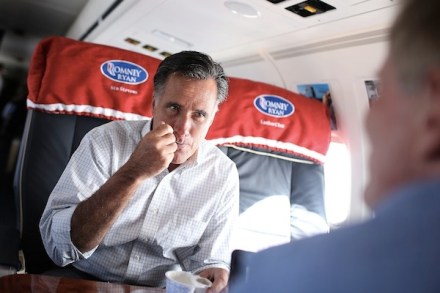
Why I would vote for Mitt Romney

From our UK edition

What is the role of a commentator in an election in which he or she cannot vote? And how would I vote tomorrow if I could? The response of many British journalists to the American elections is to do one of several things. These include becoming either a mystical seer or a partisan hack. The former have been doing particularly well in this election. People with no notable back catalogue of work on the US keep popping up writing, ‘Why Romney cannot win unless he does X’ pieces, or ‘Why Obama has it in the bag if he does Y’, etc. Few of these seers know what they are talking about. Most are just churning out the received wisdom of their political ‘side’ and will carry on regardless even after repeatedly being proved wrong.

Muslims and the Republican vote

From our UK edition

Will American Muslims swing the US Presidential election? It seems highly unlikely, if not improbable, but that’s the line being pushed by the Council on American-Islamic Relations, a not uncontroversial lobby group with ties to the Muslim Brotherhood. A poll released by the group last week found that 68 per cent of American Muslims intend to vote for Obama. By contrast, only 7 per cent are committed to voting for Romney in next week’s election. That represents more than treble the number who voted for McCain in 2008 (when just 2.2 per cent of Muslims voted Republican) while the Democrat share of Muslim votes is down from just under 90 per cent in 2008.

The government kicks the Sharia debate into the long grass

From our UK edition

Because our Parliament discusses little of significance anymore, most of the public tend to ignore it. The perception that the weekly silliness of Prime Minister’s Questions constitutes Parliamentary business is enough to put any normal person off.  And apart from that weekly bun-fight, even the media barely bothers to report on the work of either House any longer. Occasionally something still happens in the Commons or the Lords that is worthy of serious attention but because of its form elsewhere, such occasions fail to get the attention they deserve. Such is the Bill proposed by Baroness Cox, which had its second reading in the Lords on Friday.

A protest beyond parody

From our UK edition

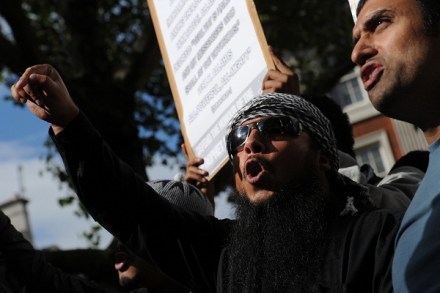
Yesterday 10,000 Muslims travelled from across Britain to the London offices of Google to demonstrate that they do not understand anything about the country they live in. The protest was one of a number planned against a film uploaded onto Youtube some months back. One of the organisers, Sheikh Masoud Alam, described the film thus: 'This is not freedom of expression, there is a limit for that. This insult of the Prophet will not be allowed.' Sadly, for him, the Sheikh is wrong.  What he terms ‘insult’ of a historical figure is most certainly allowed and judging by the quality of their argument, it seems unlikely Mr Alam and friends will persuade anyone of the contrary anytime soon.

‘Arab Spring’ is a misnomer

From our UK edition

What do you do when confronted with a prejudice so strong it takes your breath away? In my case, I did what was immediately necessary. I took a deep breath to replenish lost oxygen, and moved on. It wasn't the time or place to take on this particularly ugly example of intolerance; but it is an intolerance which needs to recognised. I was giving a lecture at a charity that trains journalists from around the world. Some are already making their way in the industry and are expected to do well. I was talking about my theory that the term 'Arab Spring' actually clouds our understanding of what has been happening in the region over the past 18 months.  From the Egyptian coup d'etat onwards, I've argued that calling these events the 'Arab Spring' automatically frames them as positive.

Britain’s illiberal state

From our UK edition

It can seem surreal, almost otherworldly, to read about our judiciary these days. Just a few days ago my colleague Douglas Murray wrote about the peculiarity of imposing a custodial sentence on Matthew Woods for posting bad-taste jokes on Facebook about the abduction of April Jones. As if to confirm that the Bar is indeed trading in absurdities, another court has now sentenced Barry Thew to eight months in prison (four of which relate to a bail offence) for wearing a t-shirt on which he scrawled the crude message: ‘One less pig; perfect justice’ and ‘killacopforfun.com haha.’ It should be obvious that one need not laugh at the jokes of Mr Woods or support the sentiments expressed by Mr Thew to recoil at their treatment by the state.

As the West titters, Islamists are bedding in

From our UK edition

I am starting to believe that this country is no longer interested in news, only gossip. Sometimes the gossip is about a celebrity, sometimes a celebrity politician. Twenty-four hour news-channels suggest that the removal of a dead entertainer’s gravestone constitutes ‘breaking news’. We have just had three party conferences so empty and insular that the outside world did not intrude meaningfully on one of them. But whilst we sink tittering beneath the waves the rest of the world is going about its business as usual. Rachid Ghannouchi was allowed to live in this country for years. He used his time preparing for an Islamist takeover of his home-country of Tunisia. After the ousting of Presiden Ben Ali he duly came to power.

Better elected Islamists than dictators?

From our UK edition

If readers have a couple of hours to spare can I recommend watching a debate which took place in America last week? Not the predictably unenlightening Presidential one, but a discussion of one of the most important and complex dilemmas of our time. Organised by the excellent Intelligence Squared US, the motion is: ‘Better Elected Islamists than Dictators’. It includes three excellent speakers, Zuhdi Jasser, Daniel Pipes and Reuel Marc Gerecht. The discussion is interesting in part because the side arguing for the motion do not like Islamists and the side against the motion do not like dictators. As Daniel Pipes pithily sums up at one point, ‘nobody likes anybody’. The question, though, is what we do about it.

The Pineapple of Hate

From our UK edition

We have had the dreaded cartoons, films, teddy-bear and more. But I bet that until now nobody imagined we would ever see a (cue dreaded music) ‘Pineapple of Hate’.  Yet despite the now familiar feeling that this is all some terrible spoof, the fruit has joined the growing list of household items which can be legitimately regarded as ‘blasphemous’. As Student Rights reports, the crime-scene was the recent freshers’ fair at the University of Reading. For it was there that the Atheist, Humanist and Secular Society stall included a pineapple with the word ‘Mohammed’ on it. I always doubted that the Danish or French cartoons looked much like the prophet of Islam.

Geopolitics in the 21st Century

From our UK edition

Some dog-munching old thug from Pyongyang has been addressing the United Nations, warning that his country is the ‘world’s hotspot’ and a spark could trigger a thermonuclear war. It’s quite possible I’m wrong about this, as I am wrong about a lot of things, but North Korea worries me far less than one supposes it should. Partly because it is so far away. And partly because the North Koreans are utterly useless and their fatuous ideology is shared by nobody else in the world (apart from one or two academics in British universities). Even a country as thoroughly grim as China finds Pyongyang ludicrous and insupportable; when push comes to shove, the country is utterly alone. And none of its missiles seem to work. So much for juche, then.

Party conferences: a vapid kind of hell

From our UK edition

As I may have intimated last week, political conference season is a particular kind of hell. Most of us just are not diverted by faked class warfare or efforts by Ed Balls to be more ‘butch’ than David Cameron. Anyhow – whilst the few remaining members of political parties come together to remind the rest of us why we want nothing to do with them, here are some things that are actually happening. 1).