Iphone

Making Tax Difficult: another Whitehall farce

Welcome to the new tax year, with its overflowing hamper of half-baked, growth-eating, enterprise-crushing Labour measures. And if you happen to be one of the 4.4 million self-employed who scrape an independent living despite rising costs and red tape, welcome to what must surely be one of Whitehall’s longest-running but least funny sitcoms, Making Tax Digital (MTD). If your income from self-employment (or rents as a landlord) exceeds £50,000 a year, you must henceforth submit quarterly digital updates to HMRC; next year the threshold will drop to £20,000. You’ll have less time to pursue your trade but your costs will rise, because you’ll need new software and more professional advice.
How emotions shape our decision-making

Ask any estate agent: most potential house buyers arrive with a detailed list of criteria for their new home, only to end up buying a property which meets almost none of them. The same is true of dating – few of us are married to people chosen on the basis of an initial checklist. Henry VIII tried this approach and it didn’t turn out well. You could dismiss this as mere whimsicality. However, the seeming messiness of such decision-making – the fact we refine our preferences in response to what we find available – is what makes consumer capitalism much more innovative than the faux-rational capitalism practised by large organisations. By demanding a problem be defined precisely and inflexibly before you are allowed to solve it, you close the door to more creative solutions.

Black Mirror season seven offers a welcome return to form

From our US edition

Charlie Brooker’s cautionary technological tales have now been running for well over a decade, and they are almost in danger of seeming old-fashioned. When Black Mirror began in 2011, Instagram was only a few months old, the iPhone was a new novelty just coming into the mainstream, and Elon Musk was best known for being CEO of Tesla. Now, virtually everything in the world has changed, and Big Tech plays roles in our lives that the ever-cynical Brooker could barely have imagined. There is, naturally, a residual irony that in order to afford the budgets – and starry casts – that the show continues to demand, it long since left its original home on Britain’s Channel 4 for the deeper-pocketed Netflix, which still funds it into its seventh series.

black mirror

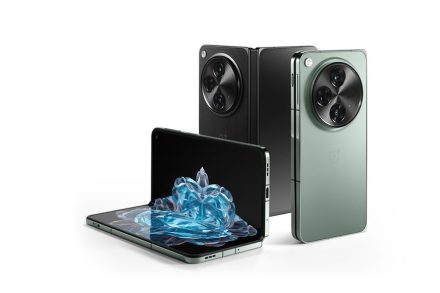
Should you buy a folding phone?

From our US edition

Just five short years ago, Samsung released the first mainstream folding phone with their debut Galaxy Fold. It had some quirks — a small, slim, external display, thick bezels, an odd asymmetrical notch and an unprecedented $1,980 price tag — but what mattered most was the screen. Open the slim, TV-remote-shaped phone and you gazed upon a great, wide, 7.3-inch screen, bigger than any you could carry in your pocket before, with a folding crease in the middle. You could multitask, watch full-screen YouTube videos and browse the web as you would on a tablet. That is, you could do so temporarily. Early review units catastrophically broke at even the mention of a grain of sand, creating a run of viral tweets and videos.

folding phone

My month using a tablet instead of a smartphone

From our US edition

Several years ago — long before Elon renamed it X, restricted most features behind a paywall and made it altogether less pleasant to use — I uninstalled Twitter from my phone. Then, on my laptop, I set the Minimal Twitter extension to hide all interaction counts. I still have no idea how many followers I have.  I wasn’t hopelessly addicted to the site, nor was it enraging me on a frequent basis. Put simply, though a Twitter-using liberal, I was not a “triggered lib.” But whenever I wasn’t doing something else, or waiting in line, or walking to make some coffee, I flicked through it. When I should have let the silence breath, I pulled out my phone and refreshed my feed.

tablet smartphone

How I incurred the wrath of my iPhone

As I sat down to dinner in a lovely old country pub my reservation was cancelled by my iPhone, which was having a tantrum. The owner of this restaurant was serving us with a smile, we had been shown to our table, drinks and menus had been brought. But the buzzing lump of metal in my bag was adamant this was not happening. My iPhone had packaged up a montage surprise, complete with a replay of our private conversation I was experiencing one of those moments where reality splits into two: the one you are experiencing and the one your phone claims you are. A lot of people obediently accept the phone’s version no matter what. This is presumably why drivers follow their satnavs into garden walls, or swerve along the motorway looking at pictures of dogs on Facebook.

Nothing makes technology transparent again

From our US edition

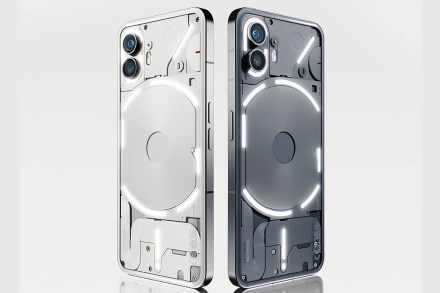
Consumer technology is, usually, profoundly dull. I love technology, but even I must concede the undeniable. A new pair of light gray, plastic cupped, noise-canceling headphones are functional, and often great, but they hardly get the blood rushing. Yet another gray Windows notebook has released! I struggle to stifle a yawn. And then — worst of all — are the phones. In the sixteen years since the first iPhone debuted, smartphones have become ubiquitous; the market is so large and flooded that innovation is no longer worth the risk. Phones are not cool new devices, but tools. You don’t care how a hammer looks; you care about the price and if it can hit a nail. The latest iPhone is a tool for accessing the internet and taking selfies. Most Android phones are the same but cheaper.

Photo courtesy of Nothing

The golden noose around Apple’s neck

From our US edition

"Innovation comes from saying no to 1,000 things to make sure we don't get on the wrong track or try to do too much,” said the late Steve Jobs. “We're always thinking about new markets we could enter, but it's only by saying no that you can concentrate on the things that are really important." These days, Team Apple is all about finding new markets, no matter how removed they are from the company's core focus. Jobs once flirted with an advertising-supported operating system but ultimately gave it a pass. Now, in a strange twist, Apple is doing just that — selling ads in its services that are part of its platform. It wants to become a pooh-bah of digital advertising (it had tried before in 2010 with iAds, an effort that fizzled out).

Are iPhones sending women gaga?

The girl wound down her window, stuck her mobile phone out into midair, and started to take pictures of the sun. I was behind her Mini on the southbound slip road off the A3 to the Cobham roundabout. On the left was the backed-up turn for Hersham down the Seven Hills Road which is always busy in the morning. I was queueing in the less busy right hand lane to go around the roundabout to Cobham to do the horses. It should not have taken me long, even at 8 a.m. But the woman in the cream Mini in front of me was busy with her phone pointed up into the sky at a sun so blazing it was impossible to look anywhere near it. What she captured I have no idea. It’s hard to think of anything more pointless than trying to photograph a blinding heat haze.

The tyranny of the smart phone

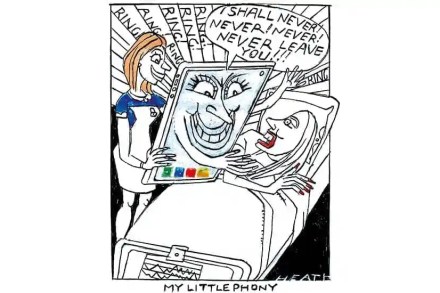
‘Can I ask you why you don’t want a smart phone?’ said the chirpy manager, as I stood blinking in front of him in the intensely red Vodafone shop. I took my iPhone out of my bag and explained that I wanted a second phone with no brain whatsoever. A stupid, backward phone was what I wanted. Not a scheming, conniving monster like this one. And I said this quietly, so that my iPhone didn’t hear me, because that is how frightened I am of it. ‘Ah!’ said the pin-striped tech wizard, as if he had heard of this situation before, or perhaps increasingly. Reaching for the bottom shelf, he told me there was only one such phone in his shop. He put a tiny, plastic Nokia in my hands. It was so basic it was as light as a feather. I said that would do fine.

Clubhouse left me with one question: why am I here?

For my 13th birthday in 1995 I requested — and got — my own ‘line’. This meant that I could jabber all night without taking the phone out of service for everyone else. Getting your own line was a rite of passage for teenage girls in America back then, and everybody just sighed and let us get on with it. Talking on the phone all the time was simply something girls did. Women, meanwhile, at least according to film and TV, spent their time sitting by the phone eagerly awaiting calls from men that usually didn’t come. But then the feminised world of the endless, open-ended voice call dwindled with the arrival of mobile phones and a preference for texting, messaging, tweet-messaging, and the easy WhatsApp voice note.