Internet

Scroll model: confessions of a clickbait writer

From our UK edition

Working on a ‘trending’ news desk is the journalistic equivalent of being a battery-farmed hen. When I was still at university, I wrote pieces for one of the most-visited clickbait news sites in the UK, which boasts 300 million followers worldwide. My brief was to pump out a 400-word article in 45 minutes, every 45 minutes, for nine hours straight. My fee for these 12 articles was £125 in total (£13 per hour or, more saliently to a student, a pint for 250 words). All of you will have come across clickbait online. Some of you might even admit to having clicked on it.

Russell Brand lauds magical amulet keeping him safe from WiFi

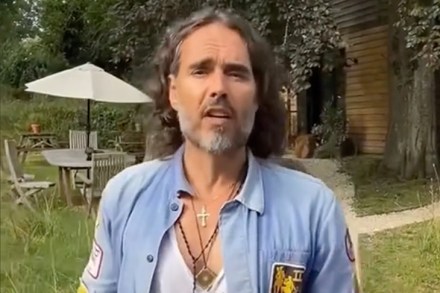
Comedian-turned-“right-wing Christian influencer" Russell Brand has discovered a new stream of income: hawking enchanted objects. Brand appeared in a recent TikTok ad for Aires Tech, claiming “airports are places full of WiFi and all sorts of evil energies,” and so everyone needs a “magical amulet from Aires Tech” to keep you safe from “all sorts of signals out there.” The amulet, or the “Lifetune Flex,” sells for $239.99 on their website. The gold encasing and green center make it look like something that belongs around Doctor Strange’s neck: very majestic, very wizardly. Criticism, understandably, abounds. “They are gutter-slime,” a video essayist tweeted, grouping Russell Brand with Jordan Peterson.

russell brand amulet

The meme election

Each subsequent election seems to get more and more online. The Kamala Harris campaign, armed with a strategy devised by a few twenty-five-year-old women in a Bushwick coffee shop, thinks the election will be won by hiding the candidate away and replacing her with a string of memes and cringe slogans. Unfortunately, they may be right. When you have a candidate that has a problem stringing three unscripted sentences together into something coherent, you must find some other way to shove her across the finish line. That means spiriting her away from the press as much as possible, limiting speeches to only those with a teleprompter and changing your policy positions so many times that no one has any idea what you’re actually running on. Hey, it worked for Joe Biden.

election
Bet-David

Inside the unlikely success of Patrick Bet-David

A right turn off Montauk Highway onto a leafy street in the Hamptons town of Water Mill brings you to a wooden gate, behind which sits a 12,000-square foot modernist estate that rents, with staff, for $75,000 a week. At the moment it’s the vacation home of Patrick Bet-David, an unlikely character to find in this area of New York. Over the last two years, Bet-David has improbably emerged as one of the most prominent voices in right-wing media. His prodigious influence is belied by the fact that around here, he’s more undercover heretic than acclaimed celebrity.

The peculiar appeal of ‘sad-girl literature’

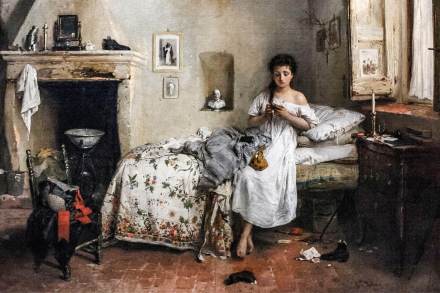
A stack of books balances on a fluffy white Michael Aram bedspread: Ottessa Moshfegh’s My Year of Rest and Relaxation, Lisa Taddeo’s Animal, Candice Carty-Williams’s Queenie and Lily King’s Writers & Lovers all touted as “sad-girl lit-fic book recs.” Lana Del Rey’s lugubrious melodies play on repeat; “I’m pretty when I cry” and “baby blues / baby blues,” in particular, are favored lyrics. This is a specific quarter of TikTok (or BookTok), the lachrymose world of “sad-girl lit.

sad-girl

A fiery examination of the damage wrought by internet culture

From our UK edition

Historically, when a woman was giving birth, she was attended by the women she trusted most, including her child’s prospective godmother. The word ‘gossip’ derives from the Old English ‘god-sibb’, meaning godparent, but came to refer to what went on around the childbed. As Erica Jong later put it: ‘Gossip is the opiate of the oppressed.’ Gossip has since moved online – see Mumsnet and the network of Facebook pages called ‘Are we dating the same guy?’. Women use the latter to post warnings to alert others to serial cheaters – and worse. Perhaps inevitably, it has become the focus of several lawsuits brought by men who have been publicly maligned. Is it possible to keep the old ‘whisper network’ alive without being sued in the process?

X and the return of the social-media sandbox

Elon Musk’s X, the social media site once known as Twitter, is a wasteland. It consists of uncontrolled pornography, crypto spambots, broken “mentions,” unpaid invoices for subscriptions, a useless search algorithm and unverified accounts spreading baseless conspiracy theories and being financially rewarded for juicing controversial or untrue content. It has become practically unusable as a functioning social media platform. But old Twitter, after what it had become, had to be absolutely and unequivocally destroyed for the sake of the future of open online discourse. The Jack Dorsey-Parag Agrawal iteration of Twitter had become part of an intelligence and corporate media censorship apparatus, which would spring into action against any user it viewed as an ideological opponent.

X

Why is Generation Z so undersexed?

There is a girl on TikTok, a bleached-blonde New York transplant who just passed a million followers, whose videos I cannot stop watching. The secret to her rise was “Get Ready with Me” storytimes in which she sat in front of the camera applying mascara and retelling — in painstaking detail — her lurid misadventures. Some highlights: throwing up on a guy’s bed after a wine-fueled hook-up and then realizing he had a girlfriend of two years, battling Montezuma’s revenge at a restaurant in Cabo, getting a UTI so bad she thought it was a kidney infection, inadvertently shipping a ton of “hot girl summer whore clothes” to a guy whose white sheets she bled all over after acquiring a polyp.

mystique
comments

The delight of reading the New York Times Cooking comments

The cardinal rule of the internet may be “never read the comments,” but in at least one corner of the web, the rule should be never to skip them. I’m talking about the New York Times Cooking blog and app, the most-used resource in my kitchen. NYT has more than 20,000 recipes in its database. Many of them sport hundreds of “community notes” left by passionate home cooks. In my years using the app, I’ve noticed a few trends in the comments. The most famous NYT Cooking comment annotates the classic recipe for Katharine Hepburn’s brownies. The commenter gushes about the recipe before veering into a story about sharing her brownies with a German acquaintance. The note ends with a twist: “Eventually, she moved to the US and stole my husband!

How did the internet become so horrific?

From our UK edition

I can dimly remember the internet getting going, gradually staking its claims on our attention with hardly anyone except tech nerds – and famously David Bowie – realising what was going on. In our defence it was the 1990s and we had a lot else to think about: Britpop, The End of History, lads’ mags, guacamole, supermodels, Tony Blair, Monica Lewinsky, etc. But here we all are now, in a world where I can do my banking from bed, America is fragmenting like papier-mâché in the rain, and primary school children can get porn on their smartphones. Can anyone recall the incremental steps that brought us here?

Against LOLflation

Between the deranged cancellations still roiling online life the Muskification of Twitter, and the undead nature of the Donald Trump-attention economy, there is no shortage of legitimate matters to depress someone like me who cohosts a podcast about internet bullshit. And yet for some reason, I’m fixated on an insignificant issue: LOLflation. The majority of you know what “LOL” stands for: “laughing out loud.” What it’s supposed to mean, when communicated via text or direct message or (less often) email, is: you just wrote something funny enough that I physically laughed. This is touching not just because it’s flattering to make someone laugh, but because it temporarily breaks the spell of the online world.

lolflation

The year’s horrors have left me speechless

I’ve started and stopped three articles, written 1,500 words and hated every single one. This column was due days ago and I’ve been stuck. Completely blocked. I’m not sure if it’s one thing or many things — and sometimes the only way through writer’s block is to sit down and write all the jumbled, disconnected thoughts that are jamming me up. So I will start this piece and end this year with an apology to my editor and to you, dear reader. There is the thought that stands in the way of every other thought — and because I refuse to put horrifically graphic images in your head while you sip your coffee, I’ll let you fill in the blanks yourself. But the thought goes something like: “Hamas did X and Y and Z and I’m supposed to write or care about anything else?

horrors
marketplace

The promise and peril of Facebook Marketplace

Items currently available for sale on Facebook Marketplace within eleven miles of my kitchen table (a partial list): Two antique candlesticks, $20 One 1994 Lane cedar chest, $110 One Birkin philodendron, $20 Drunk Elephant Bronze Drops, $30 I became a Facebook Marketplace power user when my husband and I moved from a one-bedroom in San Antonio to a lovelorn Victorian in Pennsylvania. We had 3,000 square feet to furnish, and a budget depleted by closing costs and moving expenses. Marketplace is a classified-ad section of Facebook that was introduced as a less-seedy alternative to Craigslist, a place your grandma could browse for an antique footstool without stumbling across a solicitation for feet pics.

Inside Biden’s plan to regulate the open internet

The sun sets slowly over rural Indiana. In a quaint, sunlit kitchen, a concerned family gathers around a laptop. The pixelated face of a doctor fills the screen, her voice crackling with urgency. She’s discussing critical, life-saving interventions for the family’s patriarch, the victim of a recent, unexpected stroke. As she tries to explain the diagnosis, the video starts buffering, the voice breaks up and the screen freezes. Why was the internet struggling? Dissuaded by an onerous regulatory environment, investors wouldn’t take a risk on rural infrastructure projects. Lacking incentives to develop new technologies, the local providers fell behind the curve.

biden plan regulate open internet

Doombragging: the rise of sustainable boasting

A post came across my social media feed last week that looked like half the posts in my social media feed: a smiling Caucasian couple at an outdoor restaurant table with palm trees in the background. But the caption was more unusual: “The world is suffering beyond measure — but we have to find moments to be grateful for good health, good food and nice weather. Hoping for good news every day. (Heart emoji).” On the one hand, this is very true: we do have to find moments to be grateful for good health, good food and nice weather. But why the first part? Is the world really suffering beyond measure? And if it is, why do you need to mention that in a post that features you and your spouse going out for what looks like a pleasant meal?

doombragging

The rise of the lazy-girl job

To anyone who’s ever dismissed Gen Z as a cluster of feckless snowflakes, or shunned them as gritless, superficial posers raised on instant gratification and social-media filters; to anyone who thinks this juvenile rabble will never amount to more than bitter complainers about rising house prices and corrupt capitalism — I implore you! Take a moment to consider that these zoomers, these mini millennials, these whiny warriors of wokeland, have just instigated the labor market trend we didn’t know we needed: the rise of the lazy-girl job. If you instinctively recoil at any new phrase with “girl” in it — “hot girl summer,” “girlboss” — I’m right there with you.

taylor lorenz

Taylor Lorenz is optimistic about the internet

“People,” wrote Dwight Macdonald, “feel a need to be related to other people.” Not a happy sentiment, not intentionally. This was how mass culture — “masscult,” he called it — created diversion out of artless entertainment. His example was John Barrymore, an icon of a great acting dynasty whose alcoholic decline brought out raucous crowds, “because it showed them he was no better than they were.” Macdonald’s old pessimism came back to me toward the end of Extremely Online, which is more than a history of the internet creator “revolution.” Taylor Lorenz, a Washington Post columnist with a vivid online life, is its John Reed, chronicling the influencers’ victories while cheering them on.

America’s undersea lifelines

It is out of sight and usually out of mind, but recent events are forcing Americans to focus on the security of a vast network of undersea cables that the nation depends upon. In early February 2022, cables connecting Taiwan to its Matsu Islands off the coast of China were cut in what appears to be an act of sabotage that Taipei later ascribed to Chinese vessels. It took nearly two months for the internet to be up and running again, highlighting the importance of a largely ignored element of a country’s critical infrastructure.  According to TeleGeography, a telecommunications research and consulting firm, there are around 552 undersea cables, connecting almost every inhabited landmass. Most are fiberoptic, utilizing light to transmit massive quantities of data.

cables

The social media era of news is over

On Thursday, BuzzFeed CEO Jonah Peretti announced that the company is shuttering its news division. Starting in 2012 under the editorship of Ben Smith (then of Politico, now running Semafor), BuzzFeed News never made a profit — but it did win lots of journalism awards and became a large part of the digital journalism ecosystem. More people than I can count worked there at some point in the last twelve years. The writing had been on the wall for BF News for a while, but the speed with which its demise occurred is still sort of a shock to the system. Places don’t often just cease to exist. Rockets may experience "rapid unscheduled disassembly,” but newsrooms mostly don’t.

facebooks social media buzzfeed news

Is trans trending downward?

How will we know when we’ve reached “peak trans?” The term, which dates back almost a decade, refers to the point at which the number of people who consider themselves trans reaches its apex and starts to drop. A report from last year shows the number of people who identify as trans or nonbinary is declining. Researcher Eric Kaufmann, who conducted it, notes that in the last decade, there was a 1,000 percent increase in the share of American teenagers who identified as transgender.  What can account for that kind of increase? Visibility? Awareness? An evolving social landscape that de-emphasizes the differences between men and women? Maybe all of the above — but I think there’s a more persuasive argument: it was trending, and now it’s not.

jessica yaniv progressive misogyny trans