Internet

Doombragging: the rise of sustainable boasting

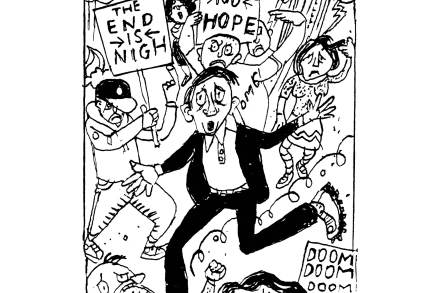
A post came across my social media feed last week that looked like half the posts in my social media feed: a smiling Caucasian couple at an outdoor restaurant table with palm trees in the background. But the caption was more unusual: “The world is suffering beyond measure — but we have to find moments to be grateful for good health, good food and nice weather. Hoping for good news every day. (Heart emoji).” On the one hand, this is very true: we do have to find moments to be grateful for good health, good food and nice weather. But why the first part? Is the world really suffering beyond measure? And if it is, why do you need to mention that in a post that features you and your spouse going out for what looks like a pleasant meal?

doombragging

The rise of the lazy-girl job

To anyone who’s ever dismissed Gen Z as a cluster of feckless snowflakes, or shunned them as gritless, superficial posers raised on instant gratification and social-media filters; to anyone who thinks this juvenile rabble will never amount to more than bitter complainers about rising house prices and corrupt capitalism — I implore you! Take a moment to consider that these zoomers, these mini millennials, these whiny warriors of wokeland, have just instigated the labor market trend we didn’t know we needed: the rise of the lazy-girl job. If you instinctively recoil at any new phrase with “girl” in it — “hot girl summer,” “girlboss” — I’m right there with you.

taylor lorenz

Taylor Lorenz is optimistic about the internet

“People,” wrote Dwight Macdonald, “feel a need to be related to other people.” Not a happy sentiment, not intentionally. This was how mass culture — “masscult,” he called it — created diversion out of artless entertainment. His example was John Barrymore, an icon of a great acting dynasty whose alcoholic decline brought out raucous crowds, “because it showed them he was no better than they were.” Macdonald’s old pessimism came back to me toward the end of Extremely Online, which is more than a history of the internet creator “revolution.” Taylor Lorenz, a Washington Post columnist with a vivid online life, is its John Reed, chronicling the influencers’ victories while cheering them on.

America’s undersea lifelines

It is out of sight and usually out of mind, but recent events are forcing Americans to focus on the security of a vast network of undersea cables that the nation depends upon. In early February 2022, cables connecting Taiwan to its Matsu Islands off the coast of China were cut in what appears to be an act of sabotage that Taipei later ascribed to Chinese vessels. It took nearly two months for the internet to be up and running again, highlighting the importance of a largely ignored element of a country’s critical infrastructure.  According to TeleGeography, a telecommunications research and consulting firm, there are around 552 undersea cables, connecting almost every inhabited landmass. Most are fiberoptic, utilizing light to transmit massive quantities of data.

cables

The social media era of news is over

On Thursday, BuzzFeed CEO Jonah Peretti announced that the company is shuttering its news division. Starting in 2012 under the editorship of Ben Smith (then of Politico, now running Semafor), BuzzFeed News never made a profit — but it did win lots of journalism awards and became a large part of the digital journalism ecosystem. More people than I can count worked there at some point in the last twelve years. The writing had been on the wall for BF News for a while, but the speed with which its demise occurred is still sort of a shock to the system. Places don’t often just cease to exist. Rockets may experience "rapid unscheduled disassembly,” but newsrooms mostly don’t.

facebooks social media buzzfeed news

Is trans trending downward?

How will we know when we’ve reached “peak trans?” The term, which dates back almost a decade, refers to the point at which the number of people who consider themselves trans reaches its apex and starts to drop. A report from last year shows the number of people who identify as trans or nonbinary is declining. Researcher Eric Kaufmann, who conducted it, notes that in the last decade, there was a 1,000 percent increase in the share of American teenagers who identified as transgender.  What can account for that kind of increase? Visibility? Awareness? An evolving social landscape that de-emphasizes the differences between men and women? Maybe all of the above — but I think there’s a more persuasive argument: it was trending, and now it’s not.

jessica yaniv progressive misogyny trans

Taylor Lorenz is a crybully

The Washington Post is one of America’s most revered news organizations. Once led by Katharine Graham, an era-defining media CEO, and edited by news legend Ben Bradlee, the Post is famous for the Watergate-era journalism of Bob Woodward and Carl Bernstein, which made it the nation’s political paper of record. Today, one of the Post’s most high-profile employees is an internet-culture reporter named Taylor Lorenz. Her involvement in numerous scandals involving reporting errors, frequent falsehoods, violations of journalistic norms and troubling online interactions call into question whether outlets like the Post can continue to function effectively as the Fourth Estate in the age of online clout-chasing and click-based news.

Lorenz

The top five things Paul Krugman has gotten wrong

Every two years or so, the Spectator World issues a takedown of New York Times columnist and “expert” economist Paul Krugman, who has a notable history of being wrong about absolutely everything. Well, it seems it's that time of year again. The Australians are getting in on the Krugman-dunking game so why shouldn't we? Here’s Cockburn's authoritative ranking of Paul Krugman's Greatest Hits. Krugman denies the recession Fresh from his New York Times opinion piece titled “I Was Wrong About Inflation,” Paul Krugman decided it was time to be wrong about the recession. On Brian Stelter's CNN show Reliable Sources, Krugman said, “I think that what's happening now is that there's been a kind of a negativity bias in coverage.

paul krugman

Sinking into the pixels

More than two decades into internet ubiquity, we’re finally seeing the rise of a generation raised by screens as much as by their parents and peers. Smartphones and social media may not have reared their ugly heads completely until the 2010s, but even in the lead-up to the millennium, computers and the “World Wide Web” were a frequent topic of pop cultural conversation. Within those conversations was always an enormous amount of anxiety. Chatroom “stranger danger” and scammers posing as Nigerian princes seem quaint now compared to the overflowing sewers on display daily in the most craven corners of the web. Digital anxiety is done.

world's fair

The problem with being anti-woke

From our UK edition

I'm going to do something that will likely annoy you, dear reader: I am going to make an argument about a certain class of people without naming names. If I do name names, any response will devolve into a debate over whether I am unfairly tarring the individuals in question. That’s beside the point, because the phenomenon in question is undoubtedly real. That phenomenon is anti-wokeness curdling into reactionary crankery. Don’t get me wrong: as I’ve previously written, I think there’s a moral panic afoot in many liberal institutions. Whether you want to call it 'wokeness' or something else, it seems undeniably the case that a culture of illiberalism has corroded these spaces.

The nihilistic rise of ‘loss porn’

From our UK edition

It’s been a terrible few weeks for that guy you know. Bitcoin dropped to a ten-month low (apparently thanks to something called ‘stablecoins’), while $1 trillion has been wiped off the largest tech companies on the stock markets. ‘Retail investors’ – non-professionals with little more than an internet connection – are struggling. You might expect many of them to put their heads in their hands and log off. But that would be to misunderstand the nihilism of online culture. Losing is the same as winning, only better. The thing to do is to post evidence of your catastrophic losses.

Blackpill: inside the incel death cult

Young men are giving up. They are the losers of the endless beauty pageant that is online life, dating in particular. Their failure to attract women or find rewarding employment is the stuff of jokes: they are “incels” (involuntary celibates), basement-dwellers, forty-year-old virgins. Meanwhile, they sink into a digital swamp of gloom and isolation that leads to resentment, radicalization, murder and suicide. In their internet forums, they call this “taking the blackpill.” The blackpill had yet to be named in 2014, when twenty-two-year-old Elliot Rodger rampaged through Isla Vista, California, killing six people and injuring fourteen more before his suicide, but he was fueled by its spirit of nihilism.

blackpill

Big tech wants us to empathize with robots

It seems like we can’t help getting attached to robots. It also seems like the people making the robots are counting on that. In the 2015 video game Fallout 4, one of the factions with which the player can align him- or herself is “the Railroad,” an organization that helps seemingly sentient androids escape from the lab in which they’re created. A friend of mine mocked me mercilessly for aligning myself with the “SJWs” of the Railroad and insisted that the androids — who spoke eloquently of their emotions, friendships, and aspirations — actually had the same moral worth as a toaster. I laughed, but secretly still felt I’d made the right choice. Surely it was always better to err on the side of greater empathy.

Is Twitter about to step up its censorship?

From our UK edition

Farewell then @jack. Jack Dorsey’s departure from Twitter on Monday came as no surprise given that the firm Elliott Management, one of Twitter’s activist investors, almost ousted him last year. Only the coronavirus may have prolonged the inevitable. Twitter’s stock keeps dropping. It may not reach the revenue and daily user projections for 2023 that it set last February. It also has the smallest ‘Big Tech’ user base, behind Facebook, YouTube and TikTok. The prevailing theory is that Dorsey’s departure involves Elliott Management, which controls two board seats and over $1 billion in stock shares, and which flexed enough muscle to boot Dorsey out.

Internet users are the new surrealists, and they keep changing the world

From our UK edition

As 2021 continues to progress at a dizzying rate, one of the recurring social phenomenon we’re seeing is the surreal eruption of online activism in the real world. From the recent explosion of GameStop share prices – hiked up by amateur investors co-ordinating online – to the large-scale protests and riots in Washington following the 2020 Presidential election, the communities in cyberspace continue to spill out into the real world. The question is: why are these kinds of actions becoming an increasingly unsettling occurrence in the usual running of society? In the lexicon of web-design, the term UX, user experience, is often used to describe how an individual may interact with a product, specifically a webpage.

Memes vs Wall Street: how Reddit took on US hedge funds

From our UK edition

What did you do this week? I spent it drenched in sweat, launching a vicious assault on Wall Street hedge funds which cost them $5 billion (£3.7 billion). And I didn’t even have to put my trousers on. Along with thousands of other degenerates, I bought shares in GameStop, a struggling US video game store whose value has soared by 2,000 per cent in the last four weeks. Behind the surge is a wild Reddit community called WallStreetBets, where bored young men gamble on barely researched stock tips and crack tasteless jokes. The community, whose tagline is ‘like 4chan found a Bloomberg terminal’, has a long and hilarious history of aggressive stock market bets leading to eye-watering gains and losses.

The toxic side-effect of the Trump Twitter ban

From our UK edition

Almost two weeks on from the storming of the US Capitol it’s becoming plainer that the most substantive changes to our political and public spheres are brewing not in Congress but on the internet. First, let’s be clear: Twitter had to act against Trump. By deleting his account, it shut down a large part of his ability to provoke civil unrest. Trump has not been unfairly ‘censored’ and free speech does not give someone the right to stoke violence and insurrection: either in principle or in law. The wider ethical and even philosophical ramifications of gagging the leader of the free world are a different story.

Meme warfare on the convention stage

Who’s on the roster of speakers for the Republican National Convention is just as revealing as who’s not. Nowhere in sight are former GOP standard-bearers like George W. Bush and Mitt Romney. Included, on the other hand, are several anonymous civilians turned into internet celebrities by viral videos. Among them is Nick Sandmann, the teenager at the center of the Covington Catholic confrontation captured on film at the National Mall last year. Also featured will be Patricia and Mark McCloskey, the couple whose armed confrontation with protesters outside their St Louis home in June also circulated widely online. Their inclusion clearly signals that the party is leaning into the meme warfare strategy that helped propel Trump to victory in 2016.

meme warfare

Trump vs Twitter: the battle begins

From our UK edition

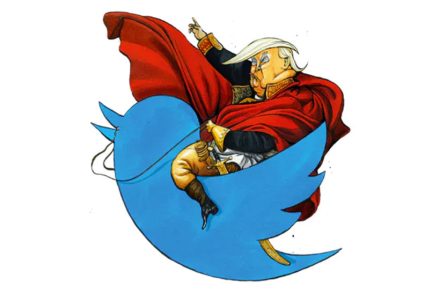
When Tony Wang, general manager of Twitter in the UK, described the company as the ‘free speech wing of the free speech party’ he was expressing an ideal that would soon collapse. This was in 2012, long before the prospect of a Donald Trump presidency was anything other than a flippant punchline in The Simpsons. Six months after the 2016 election, Twitter’s co-founder Evan Williams expressed his regret for the part they played in securing Trump’s victory. The implication – that the decisions of the general public are shaped by bad actors who prey on their malleability, and it is the responsibility of technocrats to do something about it – is one that has since become depressingly familiar.

I survived a 20-minute internet outage during lockdown

It’s 1 am. I finally finish preparing my sourdough to go in the fridge. Time for some Netflix. What? No connection. Hulu doesn’t connect either. Dear God, no. Amazon Prime? Nope. It’s worse than I thought. Please just be my router, please just be my router. I unplug the router and wait 30 seconds. Plug it back in. Nope. Where did I put that damn manual? Now I need to find something small enough to stick in the reset hole button. I get a toothpick. I say a prayer. It’s not the router. The internet is down. God has abandoned us. I feel a great disturbance in the force. As if millions of gamers suddenly cried out in terror — and were suddenly silenced. I feel something terrible has happened.

internet