Hong kong

China’s ‘useful idiots’ keep their honours

From our UK edition

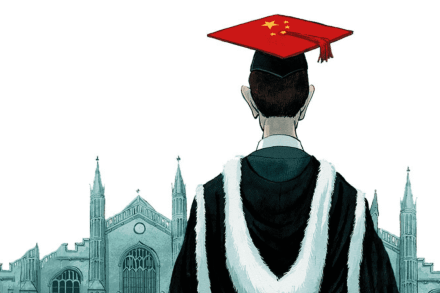
Ministers like to talk a good game on China. But, as the Commons witnessed just two weeks ago, all too often there's a very different reality when it comes to calling out Beijing's abuses. After the Foreign Office declined to describe China's atrocities in Xinjiang as 'genocide,' now it's time for the Department for Education to turn the other cheek. For universities minister Michelle Donelan has ducked the chance to call on Britain's seats of learning to cut their ties with apparatchiks of the communist regime.
The Pillar of Shame and the erasure of Hong Kong

From our UK edition

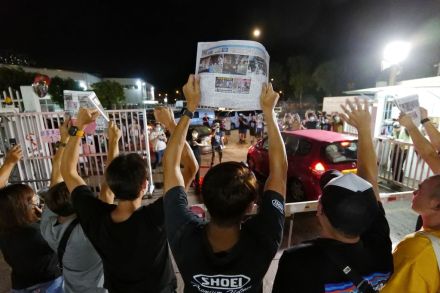
In the dead of night one of the most prominent memorials to the Tiananmen Square massacre, the Pillar of Shame, was removed from Hong Kong University this week. The eight-metre high statue – commemorating the thousands killed in Beijing’s brutal crackdown on peaceful demonstrators in June 1989 – was filmed being loaded into a container late on Wednesday night. It is not the only piece of public art to have been targeted. At dawn on Christmas Eve a bronze ‘Goddess of Democracy’ – a replica of a statue built by students on Tiananmen square – was dismantled by the Chinese University of Hong Kong. And at Lingnan University a wall relief featuring the ‘Tank man’ was removed during the night.

Don’t let China’s climate sins cloak its crushing of Hong Kong

From our UK edition

China’s failure to bring anything new to COP26 surprised no one. The world’s worst carbon emitter offered no advance on President Xi Jinping’s earlier promise to reduce coal use after 2025 and bring overall emissions to a peak in 2030 — thereby negating for at least a decade much of the rest of the world’s efforts to clean up the planet. But spotlighting China as a climate sinner should not be allowed to cloak its other villainhood, as an abuser of human rights: so let’s not forget Hong Kong. The fate of the once-British enclave and its future as an international business centre have been much on my mind lately.

Folk music is still very much alive and kicking

From our UK edition

As a writer who obsesses over the right title to grab a target audience, seeing a book subtitled ‘Song Collectors and the Life and Death of Folk Tradition’ I say, count me in. It’s a challenging subject, not often trodden with aplomb. I wasn’t even dissuaded when the first line on the inner jacket — ‘This is the first ever book about song collectors...’ — caused me to wonder what those multiple volumes cluttering up my groaning shelves were. Michael Church could have started with Mary Beth Hamilton’s admirable study of blues collectors, In Search of the Blues (2007), an excellent template.

The Supreme Court’s shameful statement on Hong Kong

From our UK edition

In a statement which will doubtless surprise the scores of lawyers, democratic politicians and human rights activists who are currently in jail awaiting show trials under Hong Kong’s National Security Law, the UK Supreme Court today made an announcement which is the best piece of free PR that Hong Kong’s Chief Executive Carrie Lam has had in years. The President of the Supreme Court, Lord Reed, has issued a statement saying that UK judges will be staying on Hong Kong’s Court of Final Appeal and that ‘the judiciary in Hong Kong continues to act largely independently of government and their decisions continue to be consistent with the rule of law.

Will the American media stand up for Hong Kong before it’s too late?

On October 1 of last year, the New York Times printed an op-ed from Regina Ip, executive council and legislative council of Hong Kong, headlined ‘Hong Kong is China, Like it or Not’.  Ip advocated on behalf of China’s new ‘security’ law in Hong Kong. This law employed harsh police and military tactics to crack down on pro-democracy protests and resulted in the arrest of Apple Daily editor Jimmy Lai. This week, Apple Daily itself was shut down and several of the newspaper’s journalists were also arrested. But recent developments in Hong Kong did not happen overnight and did not happen behind closed doors. They happened in full view of the world.

hong kong china apple daily

Why Hong Kong’s Tiananmen Square vigil will be different this year

From our UK edition

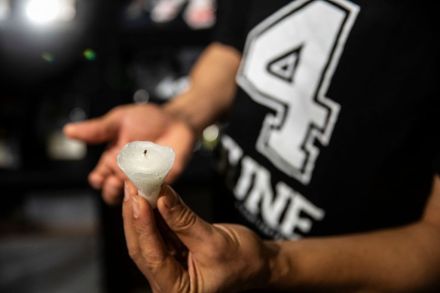
Every year since the tanks rolled into Tiananmen Square on 4 June 1989, Hong Kongers have gathered in their thousands to remember the fallen. The annual Tiananmen Vigil, where candles light up Victoria Park, was an event laden with significance. It was a statement that Hong Kongers would not forget those who had died under the heavy boot of the totalitarian state. It was a symbol of the city’s distinctive history and its autonomy from Beijing. Even last year, despite the authorities banning the protest under the pretext of Covid-19 restrictions, thousands gathered peacefully. It's unlikely the same will happen tomorrow. The organisers of last year’s vigil are in jail. This year’s vigil has been banned.

Why I fled Hong Kong

From our UK edition

On 26 June 2020, I boarded a plane from Hong Kong international airport bound for the United Kingdom. Last week, after a wait of four months, I was finally granted asylum in Britain. My journey from elected legislator in Hong Kong to political refugee reflects the erosion of freedom in the city I love. The Chinese government has made considerable efforts to portray me as a violent agitator, a secessionist who wanted to separate Hong Kong and China. This is because I support democracy in Hong Kong and believe in accountability for Beijing's despotic regime.  The Chinese government’s approach is to smear you then use that smear to justify all political persecution, including extra-legal assaults and imprisonment. I have experienced both, unfortunately.

Beijing’s cruel attempt to stop fleeing Hongkongers

From our UK edition

The Chinese Communist party regime likes to portray itself as the new superpower, displaying its strength on the world stage. In reality it is an extraordinarily fragile, sensitive, fearful, petty and vindictive snowflake of a dictatorship that is so surprisingly un-self-confident that it responds to any criticism with aggression, any dissenting or disloyal idea with repression, and any perceived slight with tit-for-tat retaliation. We have seen this last week with the decision by Beijing to impose sanctions on nine British citizens — politicians, lawyers and an academic — and four entities, including the Conservative party Human Rights Commission, which I co-founded and serve as deputy chair.

Boris’s China plan is a missed opportunity

From our UK edition

From Brexit to China, ‘cakeism’ – the idea that it is possible to govern without making hard choices – appears to be the defining philosophy of Boris Johnson's government. A hawk to the hawks and a dove to the doves; the Prime Minister wants to be all things to all men. The result is that the government have so far failed to make the hard decisions needed when it comes to China. But as with lockdown in March 2020, dither and delay is only going to increase the difficulty and trouble ahead down the road. The publication of the integrated review today makes this painfully clear.

Immigration is no longer a political problem

From our UK edition

Ask voters what the most important issue facing Britain is and just 2 per cent say immigration. Even when you expand it to the most important issues, the figure only reaches 6 per cent. This is a dramatic turnaround from 2015 when 56 per cent listed immigration as one of the top issues facing the country. In my Times column today, I ask what explains this shift. The end of free movement and the resumption of border control has taken much of the heat out of the issue In part, it is Covid. Before the pandemic, net migration to Britain was running at 313,000. In the past year, though, hundreds of thousands have returned to their home country for lockdown. The Office for Budget Responsibility estimates that the population might have fallen by 1.

The Reddit rampage is a sign of market turmoil ahead

From our UK edition

The Reddit story — in which a ragtag army of small investors have executed a spectacular short squeeze against hedge-fund goliaths — can be interpreted two ways. Some say it’s another populist citadel--storming in the spirit of the moment, but this time an admirable one because its target is ‘Wall Street’, which everyone hates: the so-called ‘stick it to the man’ version. Others see a fever of price-chasing, part-driven by lockdown despair, akin to crypto-mania and the surge in online gambling; in this version, it has nothing to do with serious investment but is a sure signal of more market turmoil ahead.

The legal profession’s troubling relationship with China

From our UK edition

There has been considerable agonising in legal circles over the propriety of David Perry QC, who had accepted a brief to prosecute pro-democracy protestors in Hong Kong. One of the defendants in the case is the 82-year-old barrister Martin Lee QC, the founder of a pro-democracy party in Hong Kong, who has been accused of taking part in an ‘illegal assembly’. It seems now that Perry, who has refused to make any public comment since the story broke, has now withdrawn from the case. If so he has made a wise decision. He is not the only lawyer who has had to wrestle with the ethical question of how close you should get to regimes that most of us would regard as disagreeable or even evil. It is certainly not only a question faced by criminal lawyers.

How should Britain respond to the takeover of Hong Kong?

From our UK edition

The veteran British diplomat the late Sir Percy Cradock said that Chinese leaders may be ‘thuggish dictators’ but ‘they were men of their word and could be trusted to do what they promised’. Well, the past year has put an end to the latter half of that statement. From coronavirus to the brutal treatment of Hong Kong, the behaviour of the Chinese Communist party has made it clear that the approach of liberal democracies to China must change. Last week, when the West’s media was distracted by the chaos in the US Capitol, police in Hong Kong arrested 55 pro-democracy activists on the charge of subversion. It is the latest example of the consequences of the national security law imposed by Beijing on the city in June.

The EU must ditch its deal with China after the arrests in Hong Kong

From our UK edition

Earlier this morning, 53 democrats from Hong Kong were arrested. Their crime? Trying to win last September’s elections. As absurd as it sounds, the new reality in Hong Kong is that it is now effectively a criminal offence, under the National Security Law, for the opposition to have the audacity to try and boost its representation in parliament. 'The operation today targets the active elements who are suspected to be involved in the crime of overthrowing, or interfering (with)...the Hong Kong government’s legal execution of duties,' said John Lee, Hong Kong’s security minister. But, as he later suggested, in reality this meant that those who were arrested were simply trying to win a majority of seats in Hong Kong's legislature.

Biden should embrace Britain’s new Indo-Pacific strategy

While final negotiations on the UK’s relationship with the EU continue to drag, No. 10 is moving rapidly to expand Britain’s role in the Indo-Pacific, returning ‘east of Suez’ after a half-century absence. Tied to this goal, Prime Minister Boris Johnson unveiled a modest, yet real, increase in Britain’s defense spending last month, totaling some $21.25 billion and pledging to once again make Great Britain the foremost naval power in Europe. Johnson’s budget announcement sets the stage for implementation of London’s long-awaited ‘Integrated Review’, which is touted as the most significant strategic reassessment of the UK’s diplomatic and security policies since the end of the Cold War.

indo-pacific

Letters: Labour’s left vs left struggle

From our UK edition

Left vs left Sir: Your leading article (‘Comfort spending’, 28 November) makes the classic mistake about modern politics which prevents so many from grasping what is going on. You refer to Sir Keir Starmer as the leader of a battle against Labour’s left by its ‘centre’. Since Neil Kinnock’s pantomime battle with Militant in 1985, political journalists have been beguiled by a fantasy. They think that Labour leaders who attack villainous leftist factions do so in the cause of moderation. But this is in fact a battle by the sophisticated left — of post-1968 cultural revolutionaries — against the crude and embarrassing steam-powered left of Militant or Jeremy Corbyn. Each thinks the other is the wrong kind of socialist.

How the UK can help Hong Kong

From our UK edition

Those of us who spent our formative China-watching years reading Chinese Communist party publications learnt early on that the word ‘basically’ was a synonym for ‘not’. ‘The party has basically succeeded in…’ meant that there was a problem. Hong Kong is basically an autonomous region. Xi Jinping is satirised by liberal Chinese as the ‘Accelerator-in-Chief’, whose policies are hurtling the CCP’s regime towards collapse. This could be wishful thinking on their part. Certainly, he has sped up the demise of the ‘one country, two systems’ concept.

China has taken control of Hong Kong’s legislature

From our UK edition

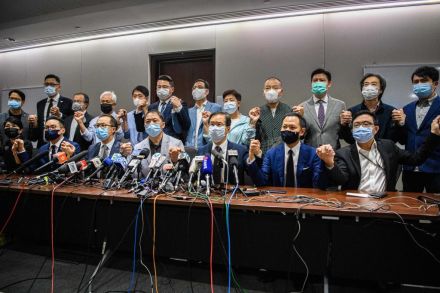
Hong Kong’s legislature has today moved one step closer to becoming a local branch of the Chinese Communist Party, after the disqualification of four of the most moderate, mainstream pro-democracy legislators resulted in the resignation en masse of every single pro-democracy legislator in protest. For the first time since 1997 the body now has no pro-democracy voices, marking yet another nail in the coffin of ‘one country, two systems.’ The four legislators who were ousted by Beijing – Alvin Yeung, Kwok Ka-ki, Dennis Kwok and Kenneth Leung – are hardly radical pro-independence activists.

The New York Times has no editorial policy

The New York Times put many lives in danger in June when it published an op-ed from Republican senator Tom Cotton, advocating for President Trump to send the National Guard into several riot-torn cities. At least that’s what several of the paper’s employees claimed, both in an open letter to the paper’s editor and the editor of the opinion board. Cotton wrote threatening words such as ‘Some elites have excused this orgy of violence in the spirit of radical chic, calling it an understandable response to the wrongful death of George Floyd. Those excuses are built on a revolting moral equivalence of rioters and looters to peaceful, law-abiding protesters. A majority who seek to protest peacefully shouldn’t be confused with bands of miscreants.

hong kong new york times