History

Playing the opportunist

From our UK edition

In historical writing the Restoration era has been the poor relation of the Puritan one before it. It is true that we all have graphic images, many of them supplied by Samuel Pepys, of the years from the return of the monarchy in 1660: of the rakish court and the mistresses of the merry monarch; of the Restoration playhouses and the newly-founded Royal Society; of the disasters of the great plague and the fire of London and the Anglo-Dutch naval war. Yet until very recently there has been no equivalent to the scholarly foundations which were laid by Victorian narratives of the civil wars and the republic, and on which the successive controversies about the Puritan revolt, from the ‘gentry controversy’ of the 1950s onwards, have been erected.

All the Men’s Queen

From our UK edition

It is entirely possible that nobody, not even perhaps Queen Elizabeth herself, has ever known what she was really like, so great the charm, the smiling gaze, the gloved arm, the almost wistful voice, the lilting politeness, yet so strong the nerve, so dogged the spirit, so determined the trajectory. And so many were the gossamer veils that enwrapped her aura that these two extremes invariably melded into a rose-centered sweetness. For nearly 70 years Queen Elizabeth, like most royalty, nurtured the cultivation of a façade. To an adoring mass, she was Titania; few glimpsed the dagger beneath her flower-strewn couch. In William Shawcross’s majestic and elegantly written biography, we come closer than any other to the kernel of Queen Elizabeth’s being.

Apologies, but no apologetics

From our UK edition

This is a massive work, 1,132 pages long, not counting the index. This is partly because the author, Professor of the History of the Church, at Oxford, seems anxious to downgrade the importance and uniqueness of Jesus of Nazareth in founding the religion which bears his name, and therefore deals first with the millennium which preceded his birth, tracing the roots of the religion in Greek and Hebrew culture. This takes up 73 pages, but is too cursory to be effective and should be skipped. The section on Jesus is not much more than 20 pages, and reflects all the most irritating aspects of modern Anglican New Testament criticism. The personality of Jesus never emerges, and one is left with the thought that if so little of it is true, what was all the fuss about?

Magnificent killing machine

From our UK edition

Lancaster: The Second World War’s Greatest Bomber, by Leo McKinstry Leo McKinstry’s Lancaster: The Second World War’s Greatest Bomber offers more than is promised by the title. As in his last book, Spitfire: Portrait of a Legend, McKinstry has taken an iconic airplane and, in telling its history, gives not only the technical dimensions of its invention but also the myths that came to surround it. He relies heavily upon the recollections of airmen, quoting interviews and their unpublished memoirs alongside a traditional narrative of engineering and combat. This new book is less a simple history of the Lancaster than a broader history of the second world war from the perspective of a single weapon. The Lancaster began as a failure.

Cries and whispers | 23 September 2009

From our UK edition

The habit of dividing the past into centuries or decades might be historiographically suspect, but by now it seems unavoidable. And it is possible that, because we now expect decades to have flavours of their own, they end up actually having them. We change our behaviour when the year ends in 0. Can there be anyone who has never used ‘The Twenties,’ ‘The Thirties,’ ‘The Fifties’ or ‘The Sixties’ as historical shorthand, expecting his interlocutor to know exactly what he means by it? By comparison with the Sixties, the flavour of the Seventies is indistinct and muted.

Concentrating on sideshows

From our UK edition

It is becoming difficult to say anything new about Churchill as a war leader. The basic facts about the conduct of allied strategy have been known for many years. Diaries and memoirs, and the occasional loose anecdote, still dribble into the public domain, adding spice but nothing fundamental to our knowledge. What remains is analysis and opinion, and even that is a crowded field. Max Hastings’ Churchill as Warlord, 1940-45 covers, within a narrower chronological frame, the same ground as Carlo d’Este’s recent book, Warlord: Churchill at War, 1874-1945. Hastings’ views are a good deal more balanced than d’Este’s, as well as being better researched and argued. But the essential point made by both authors is the same.

Family album

From our UK edition

Fay Weldon’s new book is told by Frances, Weldon’s imaginary sister — one she would have had if her mother had not had a miscarriage a few years after Weldon was born. Fay Weldon’s new book is told by Frances, Weldon’s imaginary sister — one she would have had if her mother had not had a miscarriage a few years after Weldon was born. Frances steals a husband from Fay, becomes a successful novelist and finds herself in a changed world in 2013. Oh, and Frances is an unreliable narrator. Eighty-year-old Frances starts writing the book as bailiffs pound on her door and she hides on the stairs with her grandson.

An apology for Alan Turing

From our UK edition

In early August this year, John Graham-Cumming, a computer programmer, presented a petition to the government asking to give the war time hero and scientific genius, Alan Turing, a posthumous apology for his prosecution in 1952. So far it has gained over 29,000 signatories (it only needed 500 to gain a response). Another petition was set up allowing people resident outside the UK to show their support, and there’s another 10,000 signatories on that one. I couldn’t urge you more strongly to add your own name to the list. Turing was one of the most important and innovative scientists of the 20th century- a genius and a national hero.

Can Cameron learn from Wilson?

From our UK edition

Few Tories will enjoy looking back on 1974, but they may find it useful to study the second Wilson government and its successor, the Callaghan government, when it comes to the question of Europe.  Back then, we had a government coming to power in the midst of a severe economic climate, and which sought to change the pro-European course that its predecessor had set, including by re-negotiating Britain’s relationship with the EU and by appealing to fraternal parties in France and Britain. However, it ultimately ran into blades of domestic discontent and international indifference. The question is: could this end up being the story of a Conservative government from the middle of next year? Sure, there are key differences between then and now.

In the hands of fools

From our UK edition

Miranda Carter certainly has a penchant for awkward, often impossible characters. Her fascinating biography of Anthony Blunt explained, as well as anyone could, that strange mixture of aesthete, snob, revolutionary and traitor. Now she turns to the three monarchs who ruled Russia, Germany and Great Britain at the outbreak of the first world war. Nicholas II, Wilhelm II and George V are not as intelligent or as interesting as Blunt but they sat at the centre of great powers and great affairs. What a strange and sad collection they were. Nicholas hated being Tsar and did his best to avoid difficult decisions. Even as Russia stumbled towards revolution he refused to cede an iota of power, in the conviction that God had entrusted him with an unalterable autocracy.

Commemorating the victims and the survivors

From our UK edition

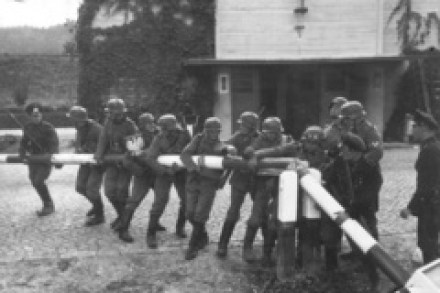
Seventy years ago today, and only a week after the Molotov–Ribbentrop Pact had been signed, a Nazi German battleship opened fire on a Polish fort on the Westerplatte peninsula outside Gdansk and began the Second World War. For my family living in Poland, the onslaught of war would change everything. Henrik and Karolina Finkel, having seen their parents and siblings wiped out not long after the German invasion, disguised themselves as Catholics and lived a make-belief life outside the Warsaw Ghetto.

Political viewing

From our UK edition

If you feel like wearing a political anorak on this sunny bank holiday Monday, then here's a video history of the Conservative Party which the Tories have updated for the launch of the new 'History' section on their website. Alastair Cooke introduces the whole project on the Blue Blog, here.

Prelude to Waterloo

From our UK edition

Napoleon has humbugged me, by God. He has gained 24 hours’ march on me!’ The Duke of Wellington’s exclamation was at least honest; he made only a show of calmness when told at the Duchess of Richmond’s ball on 15 June 1815 that the French were across the border. His reputation stood in the balance, along with the peace of Europe; yet by midnight on the 18th he had a famous victory to his name — ‘a battle of the first rank won by a captain of the second’, Victor Hugo would call it, trying to find some consolation in the complete French defeat at Waterloo.

Obama’s Summer Reading List

From our UK edition

Since we're speaking of lists and, you know, it's still August, Barack Obama's summer reading list  is a mixture of the good (George Pelecanos) the middlebrow (David McCullough) and the too-contrived-and-appallingly-written (Tom Friedman). Joe Carter critiques the list and asks: In all seriousness, though, what books would you recommend the President read during his vacation? Assuming you had to stick to the same  3:1:1 ratio (3 novels, 1 biography, 1 policy-oriented nonfiction) what books would you slip into his travel bag? This, obviously, is a game everyone can play. So here are some suggestions: 1. Lincoln by Gore Vidal.

MI6, insider dealing and robbery: it’s another Harold Wilson conspiracy theory

From our UK edition

The timing of Harold Wilson’s resignation on March 16 1976 is an enduring mystery and conspiracy theories abound. Had the onset of Alzheimer’s unnerved him? Was he about to be denounced as a Soviet spy? There’s even a preposterous suggestion that Lord Mountbatten gave up his regular lunches with Barbara Cartland to plan a military coup against Wilson. The eminent lawyer, Sir Desmond de Silva, adds a further theory in today’s Times: stolen documents proving that Wilson was involved in insider trading were for sale to continental magazines, and that might have forced Wilson out. Sir Desmond, who later defended one of the alleged thieves, said: “I had known nothing about this burglary.

The biggest failure of the Tory opposition years

From our UK edition

Fantastic, thought-provoking stuff by Matthew Parris in the Times today, as he looks back on the past 12 years of Tory opposition and asks: "Just what did they achieve?"  His response is generally unfavourable: that, until more recently, the wilderness years have largely been wasted years.  And he highlights the Tories' inability to take on Labour over their wasteful spending and burgeoning deficit: "But it was on the central domestic question of the era that the Tories’ nerve failed almost fatally. At first new Labour held to the tight spending plans that it inherited from John Major’s outgoing administration. Then the Government let go. The letting go was, in retrospect, fairly spectacular.

Lessons from the past

From our UK edition

Oh the relief of quantitative easing! Who could fail to welcome a fiscal laxative guaranteed to loosen the bankers’ constipated hold on credit? But before much more of the mixture is gulped down, it may be salutary to glance at the effect of the purgatives administered to ease economic bowels in the late 17th century. The credit crunch that afflicted the country in the 1690s produced results with which we are familiar. In the words of Lord Macaulay, ‘the great instrument of exchange became thoroughly deranged, all trade, all industry were smitten as with a palsy’.

The greatest edit in history

From our UK edition

Seeing as it is the Fourth of July, I hope Coffee Housers will indulge me in a quick post on the Declaration of Independence. The document was, of course, drafted by Thomas Jefferson. But Ben Franklin ran his eye over Jefferson’s draft and made a few changes. One of them, can I think, lay claim to be the most felicitous edit in history. As Franklin’s biographer, Walter Isaacson, explains, Franklin took, "We hold these truths to be sacred and undeniable" and changed them to the words now enshrined in history: "We hold these truths to be self-evident." (The picture is of Franklin’s marks.) The Declaration of Independence remains an inspiring document, the highest expression of country party ideology. If you have a moment today, do re-read it.

Beyond the call of duty

From our UK edition

David Crane’s latest book is much more interesting than its title would lead you to believe. If you buy it hoping for a collection of stories of derring-do and British pluck, you won’t be wholly disappointed: you will indeed learn how Frank Abney Hastings, having got himself sacked from the Royal Navy for behaving like a petulant teenager when given his first command, went on almost single-handed to invent naval steam-powered gunboats, and used the first one he built to sink a ridiculous number of Turkish ships in the Greek War of Independence.

Modesty in words and work

From our UK edition

Attlee’s Great Contemporaries: The Politics of Character, edited by Frank Field This book consists of a 50-page introduction in which Frank Field, shrewdly though large- ly in eulogistic vein, analyses the character and political principles of Clement Attlee, followed by 28 essays, many of them book reviews or articles first published in the Observer, in which Attlee considers various of his contemporaries, from Lansbury and Keir Hardie to Aneurin Bevan and Montgomery. Field argues that these articles are uniquely revealing of the values which shaped Attlee’s own career and his understanding of ‘the collective nature of leadership in a free, and in particular, a social democratic society’. This claim is, on the whole, well-justified.