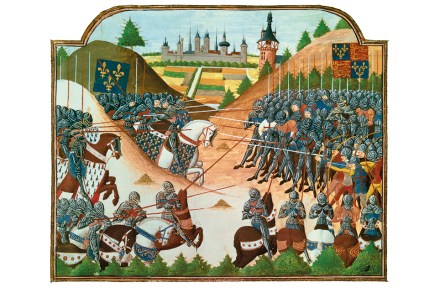
Henry v

The new Elon Musk biography lacks a clear vision

From our US edition

In the prologue to his biography of Elon Musk, Walter Isaacson evokes the Hero’s Journey in its most pop-culture incarnation: It’s one of the most resonant tropes in mythology. To what extent does the epic quest of the Star Wars hero require exorcising demons bequeathed by Darth Vader and wrestling with the dark side of the Force? Isaacson’s assumption is that Luke Skywalker is the hero of the original film A New Hope. His preamble is titled “Muse of Fire,” a reference to the most famous prologue in literature, the opening lines of Henry V. In Shakespeare’s play, the poet, recognizing the gargantuan feat before him, asks the Muse for help: O, for a muse of fire that would ascendThe brightest heaven of invention!

elon musk

The Hundred Years War ends in England’s agonising defeat – but triumph for Jonathan Sumption

On 5 February 1328 the last Capetian king of France was laid to rest in the royal mausoleum of Saint-Denis. It is now 33 years, and more than 3,000 pages since Jonathan Sumption’s first readers followed Charles IV on his last journey, as his funeral procession wound its slow way from Notre-Dame across the Grand Pont and out through the streets of Paris into the open countryside to the north of Europe’s most populous and richest city. The death of Charles IV led to a crisis of succession that for the next four generations would embroil France and England in a war of unimaginable savagery.

The real Dick Whittington and the folklore legend

In that dark world the air pulsed with the melancholy clangour of bells. If, as legend has it, the chimes of St Mary-le-Bow told Dick Whittington to turn again, then what were they saying to all the other medieval Londoners, dwelling in houses so crowded on fouled streets that the sun could not break through? In the shadow of implacable plague, even London’s super rich were piercingly aware of life’s fragility. Their homes were scented with lily, lavender and the smoke of applewood. They had to be. The city was a close maze of abattoirs and tanneries and streams sluggish with excrement. Yet here, too, were brightly ornamented religious houses and gardens rich with symbolism and medicinal herbs.

Harold Bloom, the Falstaff of lit crit

From our US edition

In a time when literature is held to be futile, it is cheering that some literary values persist. One of those values, confirmed by T.S. Eliot in ‘The Function of Criticism’ (1923), is that writing a book is almost invariably less futile than writing a book about books. Criticism, Eliot wrote, could not be ‘autotelic’, expressing only itself, because criticism was about other things, like ‘the elucidation of works of art and the correction of taste’. The critic, then, performs a kind of clean-up operation after the party.Harold Bloom, who died yesterday at 89, was a rare exception to that rule. For Bloom, criticism was the vehicle of spiritual autobiography.

harold bloom