Greece

Le Sirenuse: the loveliest hotel in the world

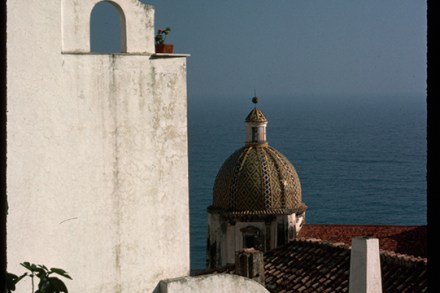
Look out from the balcony of your room at Le Sirenuse and you’ll see the trio of rocks jutting out of the Tyrrhenian Sea that gave the hotel, one of the last true greats in the world, its name. The three jagged islets form an archipelago, which is said by the Greeks to have been the home of sirens whose enchanting songs lured sailors to their deaths. Le Sirenuse, a scarlet palazzo wedged into the cliff-face of Positano, boasts similar powers of attraction. In a place known around the world for its beauty, Le Sirenuse stands out. It has developed a reputation as the loveliest hotel in the world; somehow, it exceeds that billing.

Cheers to corkscrews!

For the first 50 years of the corked bottle, there was no easy way to get into it. The combination of cork and a strong glass bottle came together around 1630, but the first mention of a device to open the bloody thing wasn’t until 1681. Cavalier get-togethers must have resembled the teenage parties I attended, with everyone desperately trying to open bottles using keys, pens, knives etc. Or using that technique where you bang the bottle against a wall with the heel of a shoe. Halcyon days. More likely the Cavaliers would have just taken the top off cleanly with a swift blow from a saber. Early devices for extracting corks were called “bottle screws.” According to wine writer Hugh Johnson, the word “corkscrew” was first used in 1720.

corkscrews

Zakynthos: then and now

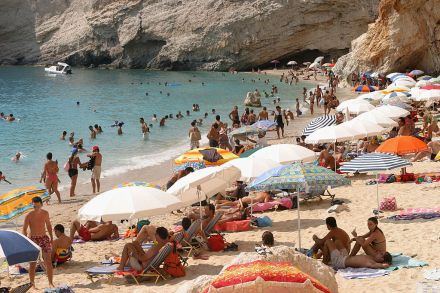
“You just missed Chris Hoy. He was here leading cycle rides over the summer,” the Peligoni Club’s receptionist informed me breezily as he lugged my suitcase down the gravel path to my villa. Lively Greek music drifted on the (non-existent) breeze, thick air seeming to press down on us despite the late hour.  I’d come to Zakynthos seeking some solo restoration — and sure, even self-improvement. I hadn’t pictured puffing up a rock-strewn hill behind a six-time Olympic gold-medal-winning medalist, in 90-degree heat. But that’s how they roll, here; this family-run, members-only beach club regularly flies in experts to add star quality to the pared-back, luxurious spaces.

zakynthos

Why I never enjoy going on holiday

This Letter from London is coming from Kardamyli, a small town by the sea in the southeast of Greece. I’m on holiday. Readers who are now rolling their eyes at the thought of yet another account of someone’s “amazing” holiday experience have my sympathy. I feel your pain; there’s nothing worse than the “my amazing holiday” bore. In the 1970s people who subjected friends to long and tedious slideshows of their holiday snapshots appeared in British sitcoms as the bores next door. Now we don’t project our pics onto our living room walls; we post them on social media. And friends feel obliged to post comments like, “Wow! That looks amazing!” and, “I’m so envious!” But what they’re really thinking is: what a terrible show-off you are.

holiday

Married in Meteora

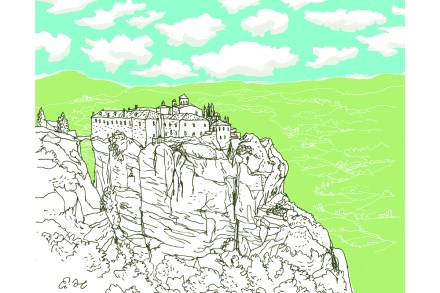
I first visited the Greek monastery of Agios Stefanos on the rocks of Meteora in the early spring of this year, one week after my baptism into the Orthodox Church. Greece was heavy with Great Lent fasts and preparations for Christ’s resurrection — Easter. I had just escaped the clutches of an extremely sweet but annoying young tour guide with whom my very Greek now-father-in-law had set my fiancé and me up for a tour of the ancient churches. I wanted nothing to do with this young man in a tour van who sounded like he was reciting words from a tape recorder. Later I found out he was, and had taught himself English by doing so (which is pretty endearing in hindsight).

meteora

Souvlaki with graffiti

I’m drawn to sketchiness but even by my sketchy-drawn standards, the state of Athens is deflating. The cradle of Western civilization now appears to be the graffiti capital of the Western world. The luridly colored scrawls are everywhere; Greek grannies air their carpets over balconies marred by multicolored tags and swirls. The Parthenon temple still looks mighty grand atop the ancient Acropolis citadel, but down in the modern city a lot of people look hard-up and downtrodden: lined faces, permanent frowns, hastened aging, disheveled clothes. Wandering through central Athens, I passed two shuttered shops set back from the street. About twenty homeless people lounged in the alcove, amicably passing round substances to smoke and ingest.

Athens

All Greek to us

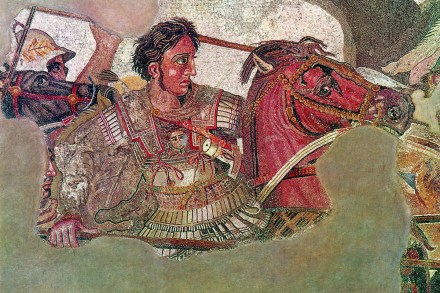
We are traveling through a shower of Greek anniversaries, triumphant and calamitous. Last year marked the 25th centenary of the Battle of Salamis in 480 BC, when 300 Greek warships defeated a Persian armada four times larger and ended the Persian empire’s expansion into Europe. This year marks the bicentenary of the beginning of the Greek War of Independence from the Ottoman empire in 1821, which resulted in the first European nation-state to be founded on the Enlightenment values of the American Constitution. Next year will mark the centenary of Greece’s defeat in Asia Minor in 1922, which ended the modern Greek state’s aspirations to absorb all the lands where Greeks lived and had lived since antiquity, an event still referred to as ‘the catastrophe’.

greek

Paying the ferryman in Greece

It was not an auspicious start. Arriving at JFK the specified three hours before my departure to Athens I was met with a check-in line stretching out the door. The man behind me, in traditional dress and with a shocking amount of luggage for a single traveler, kept shouting ‘Senegal!’ Two hours later, check-in for my flight was closing. I was still at least half an hour away from the desk and so I shamelessly cut the line, earning myself a tongue-lashing from a dyspeptic German but also a boarding document one minute before the flight closed.

greece

Walking to Byzantium

I decided to walk from Athens to Byzantium — Constantinople, the medieval Queen of Cities, lately Istanbul. I had a little red tent and a vision of noble penury that evoked the ghosts of Cyriaco of Ancona (d. 1452) and Paddy Leigh Fermor (d. 2011). My girlfriend said she'd join me later. The lines that now smudge my map look more like the flight of a woozy bluebottle than the traces of a man with a plan. My earliest memories of the trek are melancholy.

Byzantium

Salamis tactics

The 2,500th anniversary of the Battle of Salamis — the decisive naval battle of 480 BC in which the Greek fleet, vastly outnumbered, devastated the invading Persian armada in the straits near Athens — fell on September 29. So we went to take another look at the nautical objects in the Piraeus Archaeological Museum. It is not exactly a small museum — it is housed in a high-ceilinged, two-story building in the port of Piraeus, next to the remains of a Hellenistic theater — but it receives few visitors. Even Piraeus taxi drivers don’t always know where to find it. Tourists usually give Piraeus a miss; they tend to be ‘museumed-out’ from the big museums up the road in Athens.

piraeus salamis

Will Turkey and Greece clash over a tiny island?

An obscure Mediterranean flashpoint may soon come to a crisis; that would be the minuscule and remote Greek island of Kastellorizo (or Megisti; Meis in Turkish). Like many other Greek islands, it lies much closer to the Turkish than the Greek mainland (1 mile vs. 357 miles). Unlike other small Greek islands, its location between Rhodes and Cyprus bestows outsized military and economic importance on it.Were Kastellorizo, with a population of under 500, to enjoy the full rights bestowed on it by the 1982 UN Convention on the Law of the Sea, Greece can claim a 200-nautical mile exclusive economic zone (EEZ) that leaves Turkey with a cramped EEZ along its shores; take away Kastellorizo and the Turkish EEZ more than doubles in size.

kastellorizo

The doctor’s dilemma

The facts are stark, if little known. Before World War Two, the Jewish community of Thessaloniki, Greece (Salonica, in its old Ottoman name) numbered over 50,000. Jews were this Mediterranean port city’s most numerous ethnic minority and had shared in many of its past glories. When the war was over, only 5,000, less than 10 percent, of the Salonica Jews survived. Between March 15 and August 10, 1943, the local Greek police, supervised by the SS, arranged the deportation of 45,000 men, women and children in 19 convoys, most of them bound for death at Auschwitz-Birkenau. My grandmother’s family was among them. Talking Until Nightfall is a grim and gripping family saga. It compiles the testimonies of three generations of the Matarasso family.

Why Greeks abhor and applaud Brexit

Pavlos Eleftheriadis is as Anglophilic a Greek as they come. His wife and children are British, and he is a professor of public law at Oxford. But the prospect of Brexit has altered Eleftheriadis’s view of Britain. ‘Psychologically, it’s difficult to accept that half of the society you live in is against the presence of Europeans,’ he says. ‘This came out very strongly, including from the prime minister herself. She said we have to stop the free movement of workers from Europe. It’s her primary objective. This wounds you. You wonder why they say this and what led them to it.’ Eleftheriadis says that he’s never seen a hint of racism or prejudice in professional life. But he’s hedging against the attitudes of the next generation.

athens greeks

The real Durrells of Corfu

There’s a wonderful moment in the third television series of The Durrells in Corfu when Louisa, the mother of Gerald and Lawrence Durrell, has been reading a badly-spelled essay by Gerald, her youngest son. She turns to him with proud love in her eyes and says ‘Larry writes to dazzle. You write to entertain.’Screenwriter Simon Nye could not have better expressed the different literary skills of the two brothers. Lawrence, in his mid-twenties in the 1930s, was destined to become a leading poet of his generation and then, as he put it, to ‘stumble into prose’ with the ground-breaking Alexandria Quartet (1957-60).

durrells