Gordon brown

New Labour's greatest failure

My friend and critic Jonathan Portes obviously took exception to my remarks about Keynesianism having been disproven. His entertaining rebuttal claims to have exposed my misreading of data. That’s not quite how I see it. I agree with him that the appalling build-up of out-of-work benefits happened before 1997. The Tories badly miscalculated incapacity benefit; thinking it would be a one-off way to help those affected by deindustrialization. But, in fact, it created a welfare dependency trap, and the 1992 recession caught too many people in it. John Major had an excuse: a recession. Tony Blair had no such excuse. I wasn’t joking about a quarter of Liverpool and Glasgow

The British constitution has never made sense or been fair. Why expect it to do so now?

Well, yes, Hamish Macdonell is correct. A coherent devo-max option could win the referendum for Unionists. Some of us, ahem, have been arguing that for years. There were, of course, good reasons for insisting that the referendum vote be a simple Yes/No affair. A single question cuts to the heart of the issue and, notionally, should produce a clear outcome. Nevertheless it also greatly increased the risk – or prospect, if you prefer – of a Yes vote. A multi-option referendum would have killed a Yes vote. But if Hamish is correct I am not, alas, so sure the same can be said of Comrades Forsyth and Nelson. James writes

A ‘no’ to Scottish independence won't save the Union

The longer the Scottish referendum campaign goes on, the more I fear for the long-term future of the Union. I suspect that the pro-Union campaign will win this September, but the way in which they will do this is storing up problems for the future. The pro-Union campaign has, so far, concentrated on two messages: the dangers of independence and the fact that there’ll be more devolution if the Scots vote no to independence. These tactics will help with this September’s referendum—indeed Hamish Macdonell argues persuasively that a ‘devo plus’ offer would deliver victory. But strategically they are storing up problems for the future. Gordon Brown is today proposing a

Sarah Brown’s unpatriotic office

‘[T]he old tax havens have no place in this new world. We now call on all countries to apply international standards,’ said Gordon Brown back in 2009 when he was prime minister. Mr Steerpike only mentions this because Brown’s philanthropist wife Sarah has made an odd choice of home for her charity. Sarah Brown is the founder and Executive Chair of the Global Business Coalition for Education – a charitable organisation whose members include heavyweights such as Accenture, Chevron and Tata. The organisation admirably aims to bring ‘the business community together to accelerate progress in delivering quality education for all of the world’s children and youth.’ But the GBCfE is based

Why Ed Balls is deceiving us about his plans, and the 50p tax

Now and again, you have to ask: why did Gordon Brown get away with that massive government overspending that bequeathed such a calamitous deficit? The answer is that he dressed up his profligacy with technical-sounding language, and fooled everyone. Ed Balls thinks he can fool us again. He has told the Fabian Society today that he’d balance the ‘current’ budget – but that’s only one part of government spending. (Investment is the other part, and he’d happily borrow for this.) But this caveat doesn’t appear to have been explained to those reporting on his speech, and today’s news reports wrongly declare that Balls would balance the books overall. (Only George

A credit boom before each bust

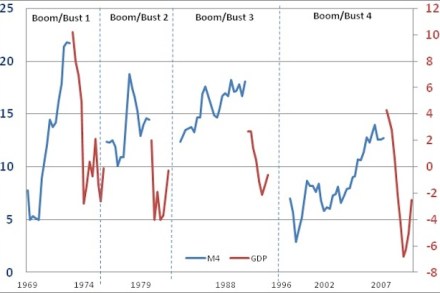
Here is a graph that shows the four economic downturns Britain has been through (red lines) over the past forty years. What I find strking is that each downturn was preceded by the same thing: a surge in the growth of money (blue line). In other words, the bust followed an unsustainable credit-induced boom. The motives and justification behind monetary policy leading up to each boom/bust might have been different. In the early 1970s, monetary policy was shaped by Competition and Credit Control (CCC) reforms. In the late 1980s, those who decided monetary policy wanted to shadow the Deutschemark, then join the Exchange Rate Mechanism (ERM). After that unhappy experience, monetary

Gordon Brown's Chang Song-Thaek-style plot

Before Chang Song-Thaek was executed in North Korea last month for being a ‘wicked political careerist, trickster and traitor for all ages’, he allegedly confessed to his crimes. ‘I didn’t fix a definite time for the coup,’ he said, ‘But it was my intention to concentrate … all economic organs on the cabinet and become premier when the economy goes totally bankrupt and the state is on the verge of collapse …I thought that if I solve the problem of people’s living …by spending an enormous amount of funds …after becoming premier, the people will shout “hurrah” for me and I will succeed in a smooth way.’ Luckily, North Korea

Rod Liddle: Gordon Brown has vanished. Why?

It may come as a grave surprise to you that, when it was offered as a prize in a charity auction, the opportunity to attend a dinner lecture by the former prime minister Gordon Brown failed to reach anywhere near the sum the organisers had expected. Particularly so as the prize promised, as a special treat, the chance to join Gordon for dessert. You would imagine there would be literally millions of people who’d jump at the chance to sit next to Mr Brown as he glowered over his ice cream, to which he had applied copious amounts of salt, totally silent except for the occasional sotto voce murmuring of

Gordon Brown leads tributes to Nelson Mandela in the Commons

All three party leaders paid eloquent tribute to Nelson Mandela in the Commons. But by far the most powerful speech came from Gordon Brown. His speech, which combined wit with a string of serious points, was a reminder of the qualities that made many in the Labour party prepared to overlook his flaws. Brown, the timbre of his voice so suited to these occasions, spoke movingly about the Mandela he knew. He gave us a sense of the man as well as the statesman. He recalled how at the concert for Mandela’s the 90th, the former president had to sneak off to have a glass of champagne as his wife

How the warring ghosts of Blair and Brown still haunt their successors

Six and a half years after Gordon Brown finally badgered Tony Blair out of Downing Street, the relationship between these two men still dominates British politics. Why? Because David Cameron and George Osborne, and Ed Miliband and Ed Balls are, in their different ways, doing what they can to prevent history repeating itself. Their relationships are both informed by the Blair-Brown breakdown. Cameron and Osborne have quite deliberately structured their working lives to avoid replicating the tensions within New Labour. The pair shared a set of offices in opposition with their aides sitting in the same room. This was meant to prevent the emergence of two separate, competing power centres.

Ken Livingstone slams Labour’s ‘moral cowardice’

Ken Livingstone has risen once again from his political grave to criticise Labour’s ‘moral cowardice’ for borrowing through the boom rather than take difficult decisions with the public finances. listen to ‘Ken Livingstone: It was ‘an act of cowardice’ for Gordon Brown to borrow and spend’ on Audioboo

Guido Fawkes to Damian McBride: Who's spinning now?

When Gordon Brown eventually became aware that his Downing Street was about to be engulfed in the Smeargate scandal, he called Damian McBride to try to get to the bottom of the story. The latter recounts the conversation verbatim in Power Trip, his tell-all book dedicated ‘to Gordon, the greatest man I ever met’. Brown says: ‘OK, Damian, I need your word that you will tell me the truth. If the years we’ve worked together mean anything, I need your absolute word.’ ‘Yep, of course,’ McBride replies solemnly, ‘I give you my word, I promise I’ll tell the truth.’ ‘Right,’ says Brown, ‘firstly, is there anyone else in No. 10

Eric Pickles pictures the horrors of a Labour government

Eric Pickles has a vivid imagination. He set out to remind the Conservative faithful today the dangers of letting Labour back into office, and why they, not the Tories, are the real nasty party. He painted a picture of where Britain might be if we were living under a Labour coalition: ‘Labour would have quickly lost the confidence of the markets for failing to tackle the deficit. Mortgage rates would have soared, and after that, taxes too. The Chancellor, Ed Balls, would be extending his so-called “mansion tax” to ordinary family homes…the Business Secretary – Unite’s Baron McCluskey of Mersey Docks – would be abolishing Margaret Thatcher’s trade union reforms

Making it Happen: the staggering story of the RBS downfall

For political junkies, autumn is bringing a fix of three big books. Damian McBride’s expose of Gordon Brown has come out, Matthew d’Ancona’s inside story of the Cameron government will be serialised tomorrow. But I’ve just finished the other biggie: Iain Martin lifting the lid on RBS. Finally, Britain has an answer to Andrew Ross Sorkin’s  Too Big To Fail – except it’s set in Edinburgh rather than Manhattan, and the story is if anything even more mind-boggling. You have as much greed, ego and testosterone as there were in Wall St. But you have, thrown into the mix, the no-less-maniacal ambitions of Gordon Brown whose greed for tax revenues

Gordon Brown’s gossip girls

Brown’s boot boys had a reputation for political assassination, karaoke, and curry and lager. But if Damian McBride is to be believed, they’re really just a gaggle of gossiping girls. ‘How much of an appetite for gossip does Ed Miliband have then?’ Fraser Nelson asked of McBride for this week’s Spectator podcast. ‘He’s a bit like Gordon Brown,’ replied the repentant sinner/spinner: ‘He wouldn’t declare that he was interested in that kind of thing. But if you started saying to him ‘well I think so and so is going out with so and so’ amongst his officials he would go ‘really’ and want to hear about it.  …the worst of

Rod Liddle: Under New Labour, it really was the loony left

There is a little vignette in the first volume of Alastair Campbell’s diaries that makes it abundantly clear that, at the time, we were being governed by people who were mentally ill. It is yet another furious, bitter, gut-churning row involving Campbell, Tony Blair and Peter Mandelson and concludes with Mandelson stamping his little feet and screaming: ‘I am sick of being rubbished and undermined! I hate it! And I want out.’ The cause of this dispute was not whether or not Labour should nationalise the top 200 companies and secure for the workers by hand or by brain the full fruits of their industry. Don’t be silly. It was

The confessions of Damian McBride

The first copies of Damian McBride’s book dropped in Brighton today, and the former spinner has been explaining not just his actions in government but why on earth he decided to write about them. Here are the highlights of his confessions: Nearly everything the former spin doctor has said so far suggests he is quite contrite about his actions. On Newsnight last night, McBride said of his ‘victims’: ‘I do feel ashamed, I do feel sorry to those individuals whose careers I affected and even more so to the sort of innocent bystanders who were caught in the way’ listen to ‘Damian McBride defends his memoirs on Newsnight’ on Audioboo

The ghost of Gordon Brown stalks Ed Miliband’s dangerous business tax plans

Gordon Brown was notorious for complicating our already over-complicated tax system, and it seems that his former aide, Ed Miliband, wants to emulate the master. The danger is that Ed Miliband would do so against the backdrop of a vulnerable economy in a very mobile global market place. His latest idea is to put up corporation tax, arguing that this will “pay” for a freeze in business rates on small firms. In fact, the net burden on business will remain unchanged, so his tinkering would be little help to the small businesses that he allegedly wants to help. There are more devils in Miliband’s detail: the freeze would only apply

Damian McBride shatters the Labour peace

If you want to know just how much anger Damian McBride’s book has created in the Labour party—and particularly its Blairite wing, just watch Alastair Campbell’s interview with Andrew Neil on The Sunday Politics. Campbell doesn’t scream or shout but the anger in his voice as he discusses McBride’s antics is palpable. He did not sound like a man inclined to forgive and forget. This whole row is, obviously, a massive conference distraction. Those close to Ed Miliband had hoped that this year, the Labour leader would get a free run at conference now that his brother has quite politics. But as one of his colleagues said to me late