Gordon brown

Brown dithers over BA

At last, Gordon Brown has been forced from the comfort of silence on the Unite/BA strike. Yesterday, Lord Adonis said that he "absolutely deplored the strike” because the “stakes were too high”. Brown has done nothing more than echo those sentiments, but that is at least a step in the right direction. Obviously, the strike poses an enormous problem for the government. Betting men would get decent odds on BA collapsing, but it is a failing business that needs to change. Labour is a near insolvent party that needs Unite, and not just for its funds but for Charlie Whelan’s tireless work in support if the PM in an election year. So I doubt Labour will take any meaningful action.

Osborne colours the water blue

George Osborne has long been in the City’s crosshairs, and criticism peaked last week when less than a quarter of a City panel believe he has the mettle to be Chancellor. Today, Osborne fights back in the FT, with a piece co-penned by Jeffrey Sachs. The pair set out an argument for immediate ‘frugality’, rather than ‘cuts’, and damn Brown’s economic policy as short-term politicking: ‘We are sceptical that a sustainable economic recovery can be based on either reinflating the sectors that have declined or believing future job creation can come simply from the public sector payroll.

Cameron is synonymous with change

It was mostly standard fare for a political interview, but the Cameron/Trevor McDonald show reminds you of what I think is one of Cameron’s foremost positives, and one that is welcome amid the Tories' current self-doubt. Cameron and his team turned the unelectable Tories into a modern and truly representative force. Jonathan Freedland may argue that the change is cosmetic, but candidates, such as Shaun Bailey, selected by the Hammersmith association, say otherwise. If Cameron saw-off grass-roots interests who were still fighting Margaret Thatcher’s early battles, if not those of Churchill too, he has the resolve to tackle the legacy that Gordon Brown is likely to bequeath him.   I’d expected to be left slightly flat by this interview.

Brown’s latest confidence trick

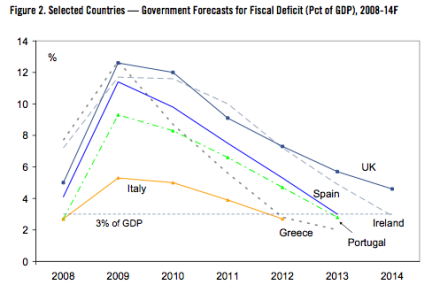
One of the Brownie's we've been hearing recently from the Dear Leader is that it is in some way ambitious to "halve the deficit by 2014". It's a Brownie because it is technically accurate, yet designed to mislead the voter. Two years ago, he forecast no deficit at all by 2014. Now he's projecting one of 5 percent of GDP - simply mammoth - and still makes out that this is something to be proud of. It's a confidence trick: the voter is supposed to think 'I don't know about the figures, but if he's boasting about it then it must be good'.

At last, the Tories get organised

Three weeks ago, James argued that the Tories’ incoherence emanated from their disjointed campaign management. Steve Hilton, Andy Coulson, George Osborne and George Bridges were not communicating and the stark clarity on the economy and ‘Broken Britain’ was obscured. James urged the Cameroon duma to put its house in order. Cameron heeded some of his advice, but this morning brings the most significant change. Tim Montgomerie reports that Andy Coulson and Steve Hilton have at last joined forces and will report direct to George Osborne, who will be replaced by Ken Clarke as the Tory’s economic face. That that this is news reveals the utter chaos  that ruled the campaign; but, as they say, better late than never.

Affluence for influence

I'd assumed the left was dead, but Mehdi Hasan says otherwise. The left is triumphant. Whilst Hasan defines left with abstractions like ‘progressive’ and ‘empowerment’, I prefer something more concrete. Unionism is triumphant. With New Labour in rigor mortis, the Unions slipped their moorings and struck out for old havens. Whelan, Crow, Simpson and Woodley are fixated on disruption. Crow will close the railways next Friday, the BA cabin crew suicide pact is now all but signed in blood, and thousands of civil servants will exchange the pen for the sword. Certainly, the members have grievances, but who doesn’t? Britain is emerging from the deepest recession since 1929 with a financial equivalent one of Kingsley Amis’ existential hangovers.

Clegg: Heir to Thatcher?

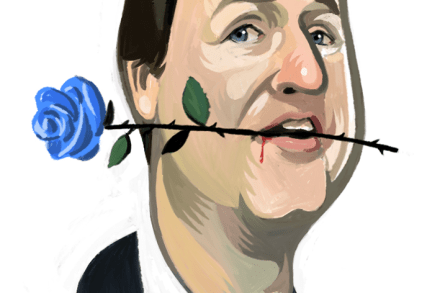
Nick Clegg has a blue rose in his mouth in tomorrow's Spectator, serenading readers - and showing his hidden Tory side. I have to say, he puts his heart into it. Not only does the Lib Dem leader say he'll end the structural deficit with 100 percent spending cuts (not the 20 percent tax rises, 80 percent cuts combo that the Tories advocate), but he even heaps praise in Lady Thatcher. More, he describes her as something of an inspiration: just as she took on vested interests in the 1980s, so he will take on the banks now.   Personally, I can't quite see the equivalence - and Clegg as the Heir to Thatcher is an image that I just can't conjure in my mind. But you can't blame him for trying.

Tornado in the chamber

It was like a volcano going off. At PMQs today Cameron was calmly dissecting the prime minister’s underfunding of the Afghan war when he quoted two former defence chiefs who’d called Brown ‘disingenuous’ and ‘a dissembler’. Then someone shouted, ‘they’re Tories!’ Cameron lost control. Instantly, completely. His temper just went. White in the face, he leaned his flexed torso across the dispatch box, hammering at it so hard that it nearly disintegrated. ‘Is that it?’ he yelled. ‘Is that what this tribalist and divisive government thinks of those who serve this country!?’ Rippling with anger he demanded that the PM dissociate himself from his backbenchers’ smears.

The Budget will be on 24 March

So now we know.  Gordon Brown has just announced that the Budget will be on 24 March – which strongly implies an election date of 6 May.  Brown could dissolve Parliament on 6 April, the manifestos would be published on 12 April, and then we'd be into the campaign proper.  Which means even more speeches, polls and dread speculation than we're getting now. As for the Budget's general flavour, we'll probably get an idea of that today, too.  Brown's currently giving a speech in which he's brushing over recent tremors in the markets, to say that we are "weathering the storm; now is no time to turn back".  Which comes straight off the same old hymnsheet: let's stick to our current deficit reduction plan (such as it is), and turn up the spending taps this year.

The prospect of another EU treaty is a huge problem for reformer Brown

It seems there must be discussion about a potential European Monetary Fund, and an organisation to manage Europe’s economies that circumvents Maastricht, to avert future fiscal crises. So much for Lisbon, the treaty to end all treaties. Quite why no one, especially the treaty's opponents, acknowledged the possibility of a member state's financial collapse whilst Lisbon was being ratified during the recession is a mystery. However, all that is past. The question for the future is will there be a referendum this time round? Adrian Michaels, rightly, point out that the Tories’ eurowars are likely to be renewed at the most inopportune time for Cameron. But Cameron will offer a referendum; his European policy dictates that he must. A further treaty is a problem for Brown.

Charlie Whelan’s role in Labour’s election campaign

If you want a sense of how much work Charlie Whelan and Unite are doing on behalf of Gordon Brown, then I'd recommend you read Rachel Sylvester's column in the Times this morning.  There are the millions of pounds in funding, via the taxpayer, of course.  There's Unite's "virtual phone bank," canvassing votes for Labour.  And then there's Whelan himself – now almost as involved as ever with the Downing Street operation, and "working closely" with Douglas Alexander on Labour's election campaign.  This is, I remind you, the Charlie Whelan who was copied into the Smeargate emails, and whose other indiscretions are better described by Martin Bright and Nick Cohen, here and here.

Yet more good money after bad

So, the government is tying the taxpayer to £11bn of new IT contracts before the election, making the Tories’ planned immediate IT cuts very expensive. Is this latest example of a scorched earth policy? Or Labour ‘getting on with the job’? With the polls narrowing, I can’t see Labour setting a fiscal booby-trap that they could well have to de-fuse. But there’s the rub. Brown scorches the turf beneath his feet as he governs: he cannot stop spending money. An £11bn bender is irresponsible in this climate, plus Labour has a baleful record on IT contracts. It has bungled a staggering £26bn on flawed IT systems, many of which were introduced without pilot schemes.

Have the Lib Dems just saved Labour from a post-election Brown leadership?

To be honest, the leg-flashing that the Lib Dems are doing in front of the Tories and Labour just doesn't really grab my attention.  Their overtures and innuendo may, or may not, turn out to be significant in a few weeks time – but we need a general election before we can judge either way.  In the meantime, they'd be best off keeping their positioning to themselves, and getting on with an election campaign for which they actually have some fairly attractive policies. This story, though, is worth noting down.  Apparently, in the event of a hung Parliament, Nick Clegg just couldn't bring himself to work with Gordon Brown.  Labour, perhaps (as both Clegg and Vince Cable suggested on air earlier).  Brown, no.

The Filth and the Fury

On the back of Andrew Rawnsley's revelations, I decided to write about Gordon Brown's "bad citizens" for the politics column of the Spectator. Under the magazine's new online rules, this is only available a week after publication. But now you can read the filth and the fury in all its sordid glory.  I have since been approached by one of the players named in the piece to say that I had misinterpreted his concern for my welfare as threatening behaviour.  This, I would suggest, is the whole problem.

Brown seems to have blustered his way through yet another potential crisis

Yesterday, Gordon Brown argued that he curbed defence spending to prevent the public finances from spiralling out of control – but added that he had still given the MoD everything they had asked for.  So, when it's anything but defence spending, he boasts of all that extra "investment".  But when it comes to defence, he suddenly grows a fiscal conscience, of sorts.  If we weren't talking about our country's ability to fight two wars, there'd be something crudely hilarious about it all. Today, various defence figures have rounded on Brown; arguing, rightly, that his tractor statistics avoided the fundamental point – that, despite increases in the defence budget, the military was consistently underfunded from 1997 on, and especially during Iraq and Afghanistan.

All quiet on the Chilcot front

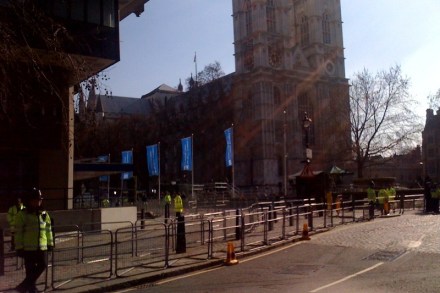
I just took a quick stroll around the block from Old Queen St, to check out the situation on the ground outside the Chilcot Inquiry.  The most striking thing is how few protestors there are – about ten at most, I'd say, and a fraction of the number that marched out against Blair a few weeks ago.  Brown doesn't even make one placard's list of – and I quote – "Lying R. Soles," which includes Blair, Campbell, Straw and Goldsmith. It's all rather suggestive of how Brown has managed, over the years, to separate himself from those who made the political and moral case for war.  But there lies the problem.  In distancing himself from Blair et al, Brown has emphasised how he – as Chancellor – did little more than control the purse strings.

Brown’s betrayal of Basra is the real issue here

Might Gordon Brown get away with it at the Chilcot Inquiry today? I suspect so. The media seems obsessed with the run-up to war, whereas the real crime was the betrayal of Basra. Brown made false claims to Parliament about the fall of violence in the city which, as he would have known, was being left in the hands of Shiite death squads. He would have known that, as the Chilcot Inquiry established, we had just a couple of hundred soldiers trying to keep peace in a city of millions. He misled Britain out of Basra as knowingly and mendaciously as Blair led Britain into Iraq - leaving the people of Basra at the mercy of the militiamen. That is, until the Iraq army (with US support) invaded the city again, and expelled the murderous regime to whom Britain had, under Brown, handed power.

Brown faces his interrogators

Tick, tick, tick ... there's only an hour or so to go before Brown's appearance in front of the Chilcot Inquiry.  And, athough I generally feel that this whole process is a waste of time, effort and newsprint, there's still something grimly fascinating about today's proceedings. Brown has, after all, always tended to keep a low profile when it comes to Iraq.  Let's see whether Chilcot & Co. can trudge their way through the murk of tractor statistics and other obfuscations. We all know, broadly, what they'll be asking.  How did Brown feel about the Iraq War?  And did he, as Chancellor, provide enough money for it?  In which case, there's a sense that Brown has set himself up for a fall today.

Tory lead cut to 2 percent in 60 key marginals

One of the refrains made in response to the recent spate of opinion polls is that they don't really capture what's going on in the marginals – the real battlgrounds where the election will be fought.  Well, now we have a YouGov/Channel 4 poll which specifically covers 60 key marginal sets, and it provides more evidence that Labour are closing ground on the Tories.  Here are the headline figures, compared to the last marginals poll for Channel 4, a year ago: Conservatives --- 39 (down 4) Labour --- 37 (up 1) Lib Dems --- 35 (up 2) And YouGov's Peter Kellner provides a useful explanation of what they mean: "The swing is down to 6.5 per cent. That is higher than the national swing – 4.

Available from all good bookshops…

... this September: Tony Blair's memoirs, entititled The Journey.  Question is, what does this say about his hopes for a Labour victory?  Or will all the juicy Blarite-Brownite stuff be cut out?  Either way, the cover will be what you see on the left.