Germany

Facebook posts about the migrant crisis should be the least of Angela Merkel’s worries

From our UK edition

So the German Chancellor has just been caught on microphone talking with Facebook CEO Mark Zuckerberg: German Chancellor Angela Merkel was overheard confronting Zuckerberg over incendiary posts on the social network, Bloomberg reported on Sunday, amid complaints from her government about anti-immigrant posts in the midst of Europe's refugee crisis. On the sidelines of a United Nations luncheon on Saturday, Merkel was caught on a hot mic pressing Zuckerberg about social media posts about the wave of Syrian refugees entering Germany, the publication reported. The Facebook CEO was overheard responding that "we need to do some work" on curtailing anti-immigrant posts about the refugee crisis. "Are you working on this?

Incomprehensible genius

From our UK edition

London’s Goethe-Institut has a two-month season of films of Rainer Werner Fassbinder (whose 70th anniversary it’s celebrating), but only five movies, each one alternating with a film influenced by him from another country. Considering that Fassbinder created about 60 films, it seems rather a slim effort. Still, half of his output is available on DVD, at no vast cost, and, having revisited many of the films in the past few days, I am more struck than ever by how great he was, and how, thanks to innumerable kinds of pressure, he only intermittently did justice to his phenomenal creativity and energy. He exasperates as often as he enthrals and moves.

The house that Alfred built

From our UK edition

This is a book about boundaries — and relationships. At its heart is the eponymous house by the lake, which in 1927 was the first of many small wooden summer houses to be built in the village of Gross Glienicke. Both its situation, just outside Berlin in the lakeside area that would later abut Gatow airport, and its many occupants, from well-established German Jews to partying neo-Nazis, would expose the property to the more tidal waters of modern German history. But the house has not just provided a stage for human drama; arguably it has been integral to the action itself, helping to shape lives, just as it was itself transformed by Germany’s changing politics.

Merkel’s response to the refugee crisis has made the situation worse

From our UK edition

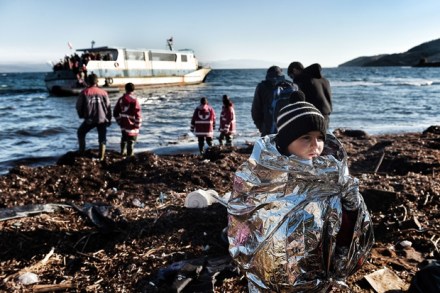
Having, effectively, unilaterally ripped up the EU agreement on how to handle refugees, Germany is now desperately trying to re-impose the rules. At the start of this month, Angela Merkel’s government declared that any Syrian who could reach the country could claim asylum in Germany. This was contrary to the Dublin Convention of 1990 which set out that refugees should seek asylum in the first EU member state that they arrive in. Predictably, Germany’s actions led to a huge surge in the number of refugees trying to reach the country. The volume of people coming is now so great that Berlin has had to put in place controls on the Austrian border. It is also saying that it won’t accept refugees who have been fingerprinted or admitted in another EU state.

Merkel’s folly

From our UK edition

[audioplayer src="http://rss.acast.com/viewfrom22/merkelstragicmistake/media.mp3" title="James Forsyth and Holly Baxter debate Merkel's offer to Syrian refugees" startat=38] Listen [/audioplayer]Of all the irresponsible decisions taken in recent years by European politicians, few will cause as much human misery as Angela Merkel’s plan to welcome Syrian refugees to Germany. Hailed as enlightened moral leadership, it is in fact the result of panic and muddled thinking. Her pronouncements will lure thousands more into the hands of unscrupulous people-traffickers. Her insistence that the rest of the continent should share the burden will add political instability to the mix. Merkel has made a dire situation worse.

Strauss-ful

From our UK edition

Richard Strauss’s Daphne is one of the operas he wrote during the excruciatingly long Indian summer of his composing life, where he seems, in one work after another, to be looking for a subject worthy of his skills, and only finding one in Capriccio, his last opera. For that, he and his ideal interpreter Clemens Krauss collaborated on a libretto that, while garrulous, has a real topic to deal with, and handles it with no portentousness or pseudo-depth. None of that can be said about the depressing series of operas he composed in the 1930s, which either have a serious topic to deal with but not the drama or the music to do it justice, or are nothing more than word- and note-spinning.

Hamburg

From our UK edition

‘What was it like growing up in Liverpool?’ a journalist asked John Lennon. ‘I didn’t grow up in Liverpool,’ he replied. ‘I grew up in Hamburg.’ My father grew up in Hamburg too, at the end of the second world war. The city had been bombed to smithereens. Cigarettes were the only currency, and my grandma had to trade her jewellery for food. When she met a British soldier who offered to take her to England, she grabbed this lifeline with both hands. If only she were alive to see her smart home town today. When the Beatles came here in 1960, they stayed in St Pauli, the dockside red-light zone. When I first came here in 1990, St Pauli was still sleazy. Now it’s the height of chic.

The clock that stopped: the victory of nuclear arms and defeat of nuclear power

From our UK edition

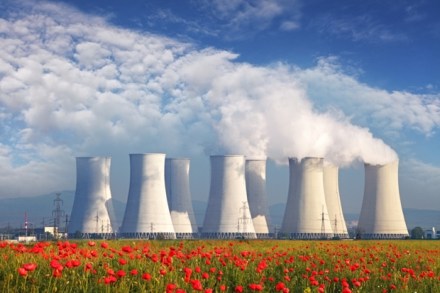
‘I visited the black marble obelisk which marks the epicentre of the explosion, and I saw the plain domestic wall-clock retrieved intact from the rubble with its bent hands recording the precise time of day when the city was obliterated: 11.02 a.m. I was glad to be alone, because I could not have spoken.’ Published here 20 years ago, that was my memory of Nagasaki, the target on 9 August 1945 of the second and last nuclear weapon ever deployed. The subsequent seven decades of non-use of nuclear arms — deterred by that most chilling of threats, ‘mutually assured destruction’ — is one of the miracles of modern history, given the unsafe hands in which much of the materiel was held.

Teenage terrors

From our UK edition

One of the great moments of my student life was opening the door and seeing visitors step back, shocked. I’d shaved my hair off to an eighth of an inch. It felt like velvet but looked spiky and hard. It was all down to Ulrike Meinhof, co-founder with Andreas Baader of the Red Army Faction, who’d just hanged herself in Stammheim prison, in Germany. My friends liked my haircut as we conflated Ulrike the martyr with images of a mullet-haired Jane Fonda raising her fist against the US army on behalf of the tortured Viet Cong.

A deal for the good of the world, but in Vienna rather than Brussels

From our UK edition

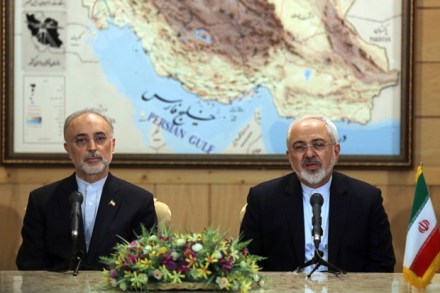
As an occasional lecturer on the abstruse topic of the efficacy of sanctions in conflict resolution, I find myself much more excited about the emergence in Vienna of a settlement of the Iranian nuclear stand-off than I am about a third Greek bailout — which left-wingers of the Syriza party regard as a vindictive form of sanctions regime designed to humiliate the government in Athens and remove its fiscal autonomy. The only thing that’s clear about the Greek crisis is that it’s not over: impossible to see how it could be ‘over’ without the debt relief Prime Minister Tspiras asked for but the Germans adamantly refused.

A beginner’s guide to Euroscepticism

From our UK edition

As a long-time Eurosceptic, I should be happy about the Johnny-Come-Latelys now swelling the sceptic ranks. Following Euro-institutions’ wicked treatment of Greece, many European liberals have finally realised that Brussels might not be the hotbed of liberalism, internationalism and bunny rabbits they thought it was. So, bit by bit, they’re becoming the thing they once looked down upon, the thing they once forcefielded their dinner parties against: Eurosceptics. But I’m not feeling very welcoming to these latter-day doubters, currently live-tweeting their Euro-existential angst and clogging their newspaper columns with tortured questions about whether the EU really is a ‘great achievement of enlightened internationalism’. (Answer: no, you donuts.

The Germans have just changed the whole dynamic of the Euro

From our UK edition

The ancient Greeks used to drop iron bars into the sea to demonstrate the permanence of the agreement they were signing. The point was that the deal would last until the iron floated to the surface - that it was irreversible. The Euro was meant to be the same: once a country had joined it could —and would — never leave. It was for all time. But last night’s discussions have put paid to that notion. We now know from the German’s proposals for a ‘temporary’ Greek exit that a country can leave the single currency. This changes the whole dynamic of the currency union, weakening the position of countries with fiscal problems.

Paul Mason calls Syriza critic a ‘Nazi collaborator’

From our UK edition

Covering the Greece crisis appears to be beginning to take its toll on Paul Mason. Channel 4's economics editor became embroiled in a bizarre Twitter rant last night during which he accused an anonymous blogger of being a 'Nazi supporter' over their criticism of the Syriza government. The comments were made during a heated discussion between Mason and the blogger @GreekAnalyst. A tweet criticising the Syriza government's strategy appeared to rattle Mason, who appears to be unimpressed by Germany's negotiations with Greece following the referendum. Mason expressed his frustration by using a Greek word to insult the user, who runs an anonymous blog strongly opposing the Syriza government: https://twitter.

Cheer up! The Greek crisis shows you were right all along

From our UK edition

I don't know whether the joy on the right was worse than the preening on the left last night but as the result of the Greek referendum swept across social media I found myself thinking that any result so cheerfully welcomed by Marine Le Pen, Nigel Farage, Jeremy Corbyn and Sinn Fein can't be thought altogether cheerful. Of course you needn't judge a cause by its followers but when a cause is followed and endorsed by such a collection of rogues, crooks and cranks it's wise to begin to wonder about it. All this glee seemed especially shabby since, really, it didn't really seem to be about Greece at all.

German rhetoric suggests that they are preparing to try and kick Greece out of the Euro

From our UK edition

Greece has voted No, and resoundingly so. But the reaction from Berlin tonight does not suggest that Germany is prepared to have any further negotiations with the Syriza government. The vice chancellor, and head of the SPD, Sigmar Gabriel has declared that "With the rejection of the eurozone's rules of the game, which has been expressed in this majority 'no' vote, negotiations on further multibillion euro programs are scarcely conceivable." Given that the SDP is more doveish than the CDU and the CSU on the Greek question, this sounds like Germany has given up on trying to strike a deal and now wants Greece to leave the Euro. Indeed, one influential CSU politician has already publicly suggested that Greece might be better off outside the Euro.

Why is the FT ordering Greece to do what Germany wants?

From our UK edition

‘The Greek people,’ the Financial Times leading article said on Monday, ‘would be well advised to listen closely to the words of Ms Merkel. The plebiscite will be a vote for the euro or the drachma, no less.’ It is interesting how menacing powerful ‘moderate’ institutions can become when popular feeling challenges them. In the eurozone theology to which the FT subscribes, its statement above cannot be true. It is not possible (see last week’s Notes) for a member state to leave the euro, any more than it is for Wales to renounce sterling. Eurozone membership, once achieved, is a condition of EU membership. So the Greeks cannot vote to leave the euro, unless they vote to leave the EU — which even the FT is not claiming is happening.

We haven’t had a pan-European war for 70 years. Why is that?

From our UK edition

The EU referendum makes me suspect that the grownups don't know what they're doing. I can see how we got to this point but it seems absurd that something so fundamental should be up - not just  for debate but possibly even - for reversal. It is doubly absurd because David Cameron has said that he will be campaigning - as you would expect of a conservative - for the status quo. So why are you doing this? I mouth at the television, wishing heartily that he would fight his internal party battles on his own time. Bewilderment is, it seems to me, one of the main forces behind this referendum. Some - many - people are bewildered by the EU. Getting your head around it is hard because the organisation is unique: there are no good metaphors for it.

Podcast: Angela Merkel’s burden, Ukip’s American flirtation and Gove’s grammar rules

From our UK edition

This podcast is sponsored by Berry Bros, The Spectator’s house red. Germany has just as much to worry about from a Grexit as Greece. On this week’s View from 22 podcast, economist Fredrik Erixon and James Forsyth discuss this week’s Spectator cover feature on the challenges Angela Merkel faces to keep her beloved European project on the road. It also presents an opportunity for David Cameron to get a better deal for Britain during his renegotiations — can he make the most of the present situation? Freddy Gray and Owen Bennett, author of Following Farage, also discuss Ukip’s flirtation with the American right and the impact it had on the party’s election performance.

If Merkel shrugs…

From our UK edition

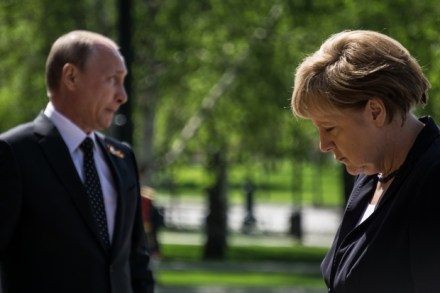
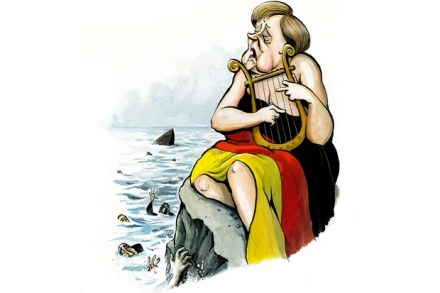
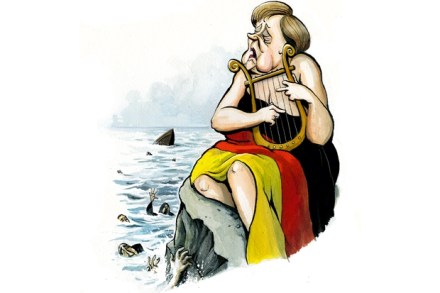
[audioplayer src="http://rss.acast.com/viewfrom22/angelamerkel-sburden/media.mp3" title="Fredrik Erixon and James Forsyth discuss the challenges facing Angela Merkel" startat=36] Listen [/audioplayer]German chancellor Angela Merkel may still be the most formidable politician in Europe, but this week she lost a bit of her reputation as the scourge of Mediterranean debtor nations. Greece’s firebrand leftist premier, Alexis Tsipras, actually gets on well with Merkel, however much his countrymen enjoy burning her in effigy and adorning her portraits with Hitler moustaches. In a recent profile of their relationship in Der Spiegel, Tsipras gushed, ‘She has this East German way of telling you honestly and straightforwardly what she thinks.

Greece’s service economy is no match for Germany’s mercantile one

From our UK edition

It sounds a bit odd these days but economics was actually invented by the Greeks. Back then, in ancient Greece, the ethos of economics was to keep the house in order and generally manage finances in a way that would make Wolfgang Schäuble blush with embarrassment for extravagant habits. Now economics is about to get a new meaning for Greeks. Perhaps not a science, but Greekonomics is now the art of killing an economy softly. The Greek tragedy is not that it teeters on the brink of default. Greece is going to get its deal – and its euro membership will live to die another day. The deal that is fleshed out in Brussels now will just help to push the country to the next time it needs financial support to pay its creditors.