George osborne

Cabinet agrees ‘difficult decisions’ due for 2015/16 spending review

From our UK edition

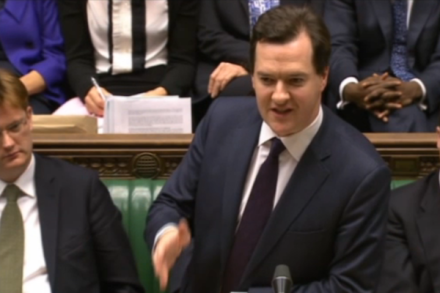
Ministers aren't just getting ready for March's Budget: they're also trying to work out a 'budget setting process' for 2015/16. The content of that slimmed-down departmental spending review formed the discussion at today's Cabinet meeting, with George Osborne and Danny Alexander leading. It's not clear when this spending review will be announced, other than that it will take place in the first half of 2013. But the discussion centred around that old chestnut, the 'difficult decisions'. The Prime Minister's official spokesman said: 'They set out that there was going to be a budget setting process for 15/16 in the first half of this year that the treasury will set out more on that process in due course.

Andrew Mitchell and Morgen Schmorgen

From our UK edition

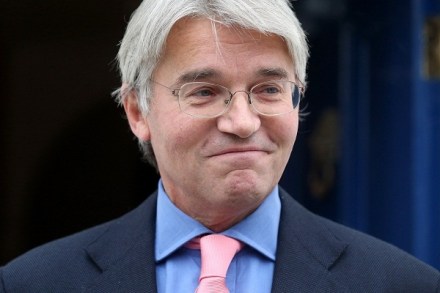
Another week, another former Tory cabinet minister working a room. Last week I brought you news of Liam Fox entertaining the great and good of the Tory party. Now I hear that Andrew Mitchell has been making an extra special effort to be nice to absolutely everyone. The former chief whip was being very friendly to the commentariat at a drinks party at a recently opened hotel in Westminster. He shunned sceptical news journalists, but made determined passes at those with influential column inches. Whatever could he want them to say? George Osborne was at the same private party, pressing flesh like a coiffured madam in a brothel.

The Fox pulls in a crowd

From our UK edition

An impressive turnout in the Churchill Room of the Carlton Club last night for Liam Fox’s New Year drinks. My eyes in the room reports that a smiling Liam claimed he had ‘invited 180 people’ and 162 had turned up. Interestingly, the big beasts came out for the former Defence Secretary, who is said to be eyeing a political comeback. Chancellor George Osborne stopped by, as did Party Chairman Grant Shapps, and Chris Grayling joined the party together with ‘a smattering of Whips’. Though he was left high and dry by colleagues during the scandal that ended his frontbench career in October 2011, his friends were back for the free bar and mini fish and chips.

Ed Balls reverses over his own progress on fiscal responsibility

From our UK edition

The battle-lines over the Welfare Benefits Up-rating Bill — which faces its second reading in the Commons this afternoon — have been drawn. Labour has tied its opposition to the Resolution Foundation's analysis showing that the bulk of the policy will hit working families. As Ed Balls put it last week, 'Two-thirds of people who will be hit by David Cameron and George Osborne’s real terms cuts to tax credits and benefits are in work.' They've labelled the move a 'strivers' tax', a continuation of the divisive rhetoric from both them and the Conservatives that seeks to pit 'hardworking families' against 'people who won't work' (as a recent Tory ad put it).

Fisking the coalition’s deficit-reduction boast

From our UK edition

'We have reduced the deficit by a quarter in just two years' — the coalition's mid-term review. True. But when Gordon Brown proposed to do precisely the same in Labour's last budget, George Osborne criticised him for not moving fast enough and endangering the economy. The ONS shows that public sector net borrowing was down 24 per cent from 2009-10 to 2011-12. But George Osborne cannot claim to have stuck to his deficit reduction plan. That has been torn up. The below graph shows Brown's plan (in the middle), Osborne's original plan (at the bottom) and his current plan (at the top): As you can see, Osborne is now cutting the deficit more slowly than Alistair Darling proposed in 2010. Darling planned to cut the deficit by 33.9 per cent by this year, compared to the 24.

Austerity hits home in the North East of England

From our UK edition

Have you personally suffered from George Osborne's spending cuts? Your answer depends largely on where you live. I’ve witnessed both over the past few days. This Christmas, I’m enjoying my first prolonged stay away from London in some time and the impact of austerity in the North East has really struck me. First to note is spending cuts in local government. In this part of the world, the public sector is a vast beast. The Guardian reported in 2010 34 per cent of the total employment in Newcastle upon Tyne is in the public sector, one of the top 15 councils in the country. The authorities of Sunderland, Northumberland, North Tyneside and Darlington all have above-national average employment in the public sector.

George Osborne isn’t clashing with Vince Cable: he’s starting to agree with him

From our UK edition

By this stage in the Coalition, everyone would have expected at least one major bust-up between George Osborne and Vince Cable. But his evidence to today's Treasury Select Committee suggested that the Chancellor isn't so much involved in a stand-off with the Business Secretary as he is taking on his point of view. It was significant how many times Osborne had to explain a softening in what were previously hard-and-fast economic rules, and hard-and-fast policies. His refusal to rule out replacing the Bank of England's inflation target with a growth target is the most significant sign of a coalescing between the two men.

We’ve shown forecasts are unreliable, jokes OBR chief

From our UK edition

'We've done quite a good job at demonstrating the limitations of economic forecasting,' half-joked Office for Budget Responsibility Chairman Robert Chote at the start of his Treasury Select Committee appearance this morning. And he spent a lot of his answers emphasising those limitations, while robustly defending himself against charges that the OBR is just making it up. His challenge was to explain to sceptical MPs why we should pay attention to the OBR's new forecasts, given that their previous ones have missed by so much. For the OBR's economic forecasts — rather than its forecasts for the public finances — Chote admitted that 'we don't have access to any information that other forecasters don't.

Ed Balls says Labour will oppose the Welfare Uprating Bill

From our UK edition

Ed Balls gave the clearest indication yet today that his party would vote against the government's plans to cap benefit rises to 1 per cent rather than in line with inflation. Speaking at Treasury Questions, the Shadow Chancellor said: 'It's important for members on both sides of the House know the answers to the questions I asked the Chancellor. First of all, 60 per cent of families hit by his tax and benefit changes are in work. And according to the IFS, as a result of the Autumn Statement measures, a working family, the average one earner couple will be £534 a year worse off by 2015, a working family worse off.

Citi: Osborne “no longer has credible plans” to tackle debt

From our UK edition

Britain will lose its AAA rating within 18 months because George Osborne 'no longer has credible plans to put the debt/GDP ratio on a stable or declining path' according to Citi. Its verdict is worth reading in full (pdf) and is important because it adds weight to the idea that — as a result of Osborne’s lack of progress on the deficit — 2013 will be the year of the British downgrade. What did it for Michael Saunders, the Citi analyst, was seeing Osborne take what James Forsyth refers to in this week’s political column as the St Augustine approach to deficit reduction: 'Lord, let me balance the books but not yet.' This eats away at Osborne's credibility.

The public’s verdict on the Autumn Statement

From our UK edition

We've only had two days to digest it, but the early signs from YouGov are that George Osborne's Autumn Statement has gone down a lot better than his March Budget. The Chancellor's personal ratings are still dire – just 24 per cent think he's doing a good job — but that's a lot better than 15 per cent five months ago. His approval rating had tanked after the Budget, but Osborne does seem to have turned that around: And the government's approval rating on the economy similarly seems to have been helped by the Autumn Statement, and is back up to pre-Budget levels: Though a 35 per cent approval rating on the economy is not exactly great, it's notably better than the government's overall approval rating, which is currently just 26 per cent.

Osborne’s ghost of Christmas future

From our UK edition

There was plenty to welcome in George Osborne’s budget, from the proposed corporation tax cut to scrapping the 3p fuel duty rise. But to read Jonathan’s seven-graph summary is to realise that Osborne's 2010 plan is not now enough. I look at this in my Telegraph column today. Here's a festive summary of my pain points:- Osbrownism - the ghost of Christmas Present  Osborne’s words – tough on deficit, dealing with debt – are very encouraging. The figures: not so much. The main features of Osborne’s plan are identical to the Brown plan he inherited.

How George Osborne took on Ed Miliband on the cost of living

From our UK edition

In addition to his effective attack on Labour's welfare policy, George Osborne used the Autumn Statement to take on Ed Miliband on another key electoral battleground. Over the past few months, the Labour leader has been trying to convince voters that he has the solution to their cost of living woes. His biggest offer so far has been the Living Wage, which sounds lovely to voters because it involves them being paid more money, but actually doesn't work (something Miliband is clearly sufficiently aware of to stop him pledging to make a living wage mandatory). The coalition already had its own offer in the form of the rise in the personal tax allowance announced in March's budget, but that got little airtime as everyone was upset about pasties and caravans.

A budget for the squeezed middle

From our UK edition

Ed Miliband may have coined the term, but it seems George Osborne has the squeezed middle on his mind too. The overall effect of yesterday's budget* was to take from the rich, take from the poor and give to the middle. The IFS has crunched the numbers and produced the latest in its series of decile charts: The bottom half of households lose out mainly due to the Chancellor's decision to increase most working-age benefits by only 1 per cent a year for the next three years, and hence cutting them in real terms. The rich, meanwhile, have been hit mainly by the cut in the tax-free allowance for pension contributions and the below-inflation 1 per cent increase in the point where the 40p income tax rate kicks in.

The strivers vs scroungers battleground

From our UK edition

Welfare will be one of the key battlegrounds at the next general election, and George Osborne's Welfare Uprating Bill will certainly be one way the Conservative party can prod Labour on what is a hugely awkward policy issue for the party. It accelerates the internal debate about how Labour can appeal to the electorate on the issue of welfare while staying true to its own core beliefs, and, Tory strategists hope, will cause some ructions. While the party appeared united in Manchester at its autumn conference in September, it faces hard times ahead as it tries to answer some of the big questions about what a Labour welfare state would look like.

If Britain loses its AAA rating, Osborne will lose one of his key attack lines

From our UK edition

George Osborne's admission that he will not meet his target to have debt as a percentage of GDP falling by 2015/16 has serious consequences for one of his central messages. The Autumn Statement has led credit ratings agency Fitch to warn of a possible downgrade. The agency said: 'Missing the target weakens the credibility of the fiscal framework, which is one of the factors supporting the rating.' Ratings agencies aren't the be-all-and-end-all by any means, and Osborne could quite easily point to just how wrong they were before the crash, giving collateralised debt obligations high ratings. But the problem is that the Chancellor tends to wheel out their approval to shore up his own position, pointing to the UK's AAA rating as a sign that he is pursuing the right economic policy.

Autumn Statement sketch: Sub-arctic Chancellor warms up the Commons

From our UK edition

From our sub-arctic chancellor this was a rip-roaring performance. Using all the arts perfected by Gordon Brown, he dazzled the house with his Autumn Statement. A chancellor should never be entirely candid. His job is to blame others for failure, to take credit for all successes, (no matter what their true origin), to engender confidence in the future and to attract cautious applause. George Osborne did all this. The bad news came out first. There were sharp intakes of breath as he revealed that the economy had shrunk by 6.9 per cent during the credit crunch. And he offered a personal confession which, in accordance with tradition, was masked in flowery statistical language.

Autumn Statement: George Osborne moves into a stronger position

From our UK edition

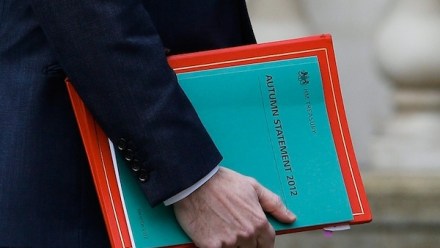
There’s a sense of satisfaction among Tories, and Osborne allies in particular, this afternoon. First, the Autumn Statement didn’t all leak out in advance. Instead, the Chancellor had some news to make on the day—notably the cancelling of the 3p fuel duty rise and a further increase in the personal allowance. Second, it has drawn political battle-lines that they believe favour them. Labour now has to decide whether to accept the coalition decision to up-rate most working age benefits by only 1 per cent for the next three years. This saves more than two billion pounds by 2015-16 and will, judging from previous polling on welfare, be popular. But Labour MPs don’t like it, and even Ed Balls himself could be seen shaking his head when Osborne announced it.

Leaked Autumn Statement briefing for Tory MPs focuses on ‘global race’ and spending switch

From our UK edition

I've been passed the Tory 'lines to take' for MPs to use in media interviews for the Autumn Statement today. As I blogged a little earlier, the words 'global race' will be cropping up a lot over the next couple of years as a key Conservative phrase, and it looks as though today will be no exception, with the Chancellor using the image in his autumn statement. I note that MPs will also be expected to use it. The lines also focus on the decision to switch revenue to capital spending: 'Today the Chancellor and Chief Secretary have told Cabinet that they will announce at the Autumn Statement over £5 billion of capital investment to invest in the economy and equip Britain for the global race.