George osborne

Autumn statement 2012: as it happened

From our UK edition

Key points from the Autumn statement Working-age benefits: will only rise by 1 per cent in each of the next three years rather than by inflation Corporation tax cut: Extra percentage point cut: down to 21 per cent in 2014 compared to 28 per cent when George Osborne took office Income tax threshold: will rise by £235 more than planned, to £9,440 in April 2013, saving basic-rate taxpayers an extra £47 next year Fuel duty: the 3p per litre rise planned for January 2013 has been scrapped Tax-free allowance: Reduction in tax-free allowance on pension contributions: from £50,000 a year to £40,000 and £1.5 million lifetime pot to £1.25 million.
George Osborne’s race to persuade voters and colleagues to back his plan

From our UK edition

George Osborne has managed, so far, to manage the run-up to the Autumn Statement far better than he did the Budget. There have been no cat fights across the pages of the newspapers, and the briefing over the past few days has been disciplined. After being told about the £5bn of Whitehall spending cuts to fund 'shovel-ready' projects including new schools and investment in skills, science and transport yesterday, one hack jokingly asked whether 'this means that tomorrow's statement is going to be horrendous' given the news so far had been relatively positive.

Autumn Statement: What Osborne will say

From our UK edition

Lower growth, bigger deficits, targets missed — that'll be the backdrop to George Osborne's Autumn Statement tomorrow. So what medicine will he prescribe to make it all better? As usual, many of the policies have been leaked already: More capital spending, paid for by extra cuts elsewhere This was announced by Number 10 this morning: £5 billion extra spending on schools, science and transport over the next three years. That'll include an extra £1 billion for Michael Gove's academies and free schools programmes, to provide 50,000 new school places. It'll all be paid for by extra cuts in departments' resource budgets: 1 per cent more than planned next year and 2 per cent the year after (though Health, Education and International Development will be protected).

Autumn Statement: Downgrades R Us

From our UK edition

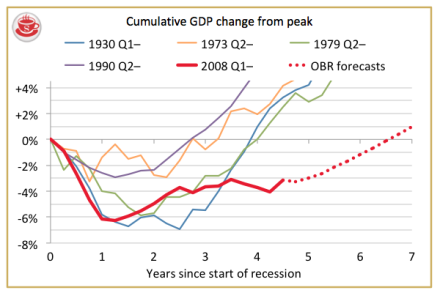
How much trouble is George Osborne in? We don’t need to wait until his mini-Budget tomorrow, we already know most of it. And we’ll enter that peculiar Budget game, where the already-known is restated and treated like news. CoffeeHousers might like to get ahead of the curve. Growth evaporating The Office for Budget Responsibility will have to follow the other economic forecasters and downgrade its growth forecasts for 2012 and 2013 (again). The Treasury collects independent forecasts monthly, and here's how the picture has deteriorated since March: Although the OBR significantly downgraded its forecasts for 2012 and 2013 last year, it hasn't ever done so for its longer-term forecasts for 2014-16. But it will have to now, probably from around 3 per cent to 2 per cent.

Osborne to back fracking and 30 new gas power stations

From our UK edition

Coalition tensions over energy won't relax with George Osborne's gas strategy, which he will launch alongside the Autumn Statement tomorrow. The Financial Times reports that the Chancellor's strategy will approve as many as 30 gas-fired power stations and - in a move that will delight those in his own party - a regulatory regime for shale gas exploitation. Fraser extolled the virtues of shale gas in his Telegraph column in September, describing it as 'the greatest single opportunity' facing the government, with the potential to transform energy supply. But Energy Secretary Ed Davey is less enthusiastic, arguing in May that Tory support for shale gas exploitation - known as fracking - was a means of undermining renewable energy generation.

Inside the mind of George Osborne’s newest adviser

From our UK edition

Neil O'Brien's appointment as a new special adviser for George Osborne has gone down very well in the Westminster bubble, partly because of the Policy Exchange director's ability to look beyond that bubble. He has written a number of times for the Spectator, and as an insight into the man who will be advising the Chancellor, here are some of his key pieces: In this week's magazine, O'Brien points to the North's growing detachment from Westminster, with 'an almighty 83 per cent of northern voters' believing that politicians do not understand the real world. He writes: 'Westminster politicians have repeatedly promised to close the North-South gap, but failed because they ignored economic reality, and flushed our money away on stupid gimmicks.

George Osborne hires head of leading centre-right think tank to push through new Tory agenda

From our UK edition

George Osborne has recruited Neil O’Brien, the director of the leading centre-right think tank Policy Exchange, as an adviser. O’Brien will start work in the New Year with a particular focus on the next phase of coalition policy development. I also suspect that O’Brien will have a major influence on Tory thinking heading to 2015 and beyond. The Northern Lights report he commissioned at Policy Exchange is regarded in Tory circles as one of the most important assessments of the challenge facing the party in trying to win a majority. I understand that Osborne has been impressed by the work that O’Brien has produced at Policy Exchange. At Policy Exchange, O’Brien has sought to craft a more economically focused centre-right agenda.

Like the Mounties, Osborne gets his man

From our UK edition

George Osborne pulled off one of those bits of political theatre that he so enjoys today. Watching his statement in the Commons, one sensed something was up as Osborne delighted in delaying naming the new bank governor. It was an indication that, like the Mounties, the Chancellor had got his man. Moments later, a clearly delighted Osborne announced that Mark Carney, the Canadian Central Bank Governor, would be the new governor of the Bank of England. This is quite a coup for Osborne as Carney is widely regarded as the best central bank governor in the world. It also marks a clear break with all that has gone wrong in the City in the last dozen years or so. It was an open secret in Westminster that Carney was the preferred candidate of the Chancellor and his circle.

Osborne’s coup: Mark Carney is the new Bank of England Governor

From our UK edition

Hiring Mark Carney may just be George Osborne’s best move since becoming Chancellor. Britain badly needed a break from the failed economic consensus which still hangs around the Bank of England like a bad smell. In August, The Spectator implored the Chancellor to mount a global search. When Carney ruled himself out, I gave up hope and resigned myself to Paul Tucker, who would be likely to keep Britain on its current Faustian monetary path paved with freshly-minted banknotes. Instead, Osborne has succeeded in hiring one of the best-qualified of all the Queen’s 137 million subjects — from a country that knows a thing or two about economic crises and how to handle them.

IFS warns Osborne: don’t cook the books, like Brown

From our UK edition

The Institute for Fiscal Studies has today published its attempt to predict what the OBR forecasts will show when they're released as George Osborne sits down after delivering his Autumn Statement next week. They put forward two possible scenarios: a ‘pessimistic’ one where the economy's recent weakness is largely permanent, and an ‘optimistic’ one where it is largely temporary. In both scenarios, they show Osborne missing his ‘supplementary target’: to have the debt-to-GDP ratio falling by 2015-16. But these forecasts exclude the effect of transferring of the interest on the Bank of England's Quantitative Easing purchases to the Treasury.

The great British wind scam: the government responds

From our UK edition

Even the most ardent supporters of renewable energy would agree that wind turbines should be erected only when the output is worthwhile. If a huge rotating beast is to blot a corner of the British countryside, then it must produce as much energy as is feasibly possible. However, this does not appear always to be the case.

George Osborne might meet his debt target after all

From our UK edition

When George Osborne gives his Autumn Statement on 5 December, the OBR will publish its new forecasts for growth, deficit and debt. For the last few weeks, the consensus has been that the OBR would declare that Osborne will miss the debt target he set himself in 2010: to have the debt-to-GDP ratio falling in 2015-16. The logic behind this, as I set out in September, is pretty straightforward: the OBR will have to lower its growth forecasts, which will in turn mean lower tax revenues, higher deficits and more debt. But it now looks like Osborne might narrowly avoid failure, though not because the outlook for the economy or the government finances is any brighter.

Labour underestimated Osborne’s deficit

From our UK edition

As Fraser reported at the time, Labour put up a deficit clock on its website last month, claiming that the government was borrowing £277 million more during Tory conference than in the same four days last year. It based this on the borrowing figures available at the time, which were for the period April to August. In that period, the government had borrowed £802 a second more than in the same five months of 2011, so Labour assumed it would continue to do so in October. But new figures out yesterday show that this was not the case. In fact, looking just at borrowing in October, Labour was lowballing it by about £67 million. The ONS says the government borrowed £8.6 billion in October 2012, £2.7 billion more than the £5.

George Osborne, balancing the budget on the backs of the rich

From our UK edition

George Osborne has a dilemma to answer in his autumn statement (which must be finalised by 28 November, when it will be submitted to the Office of Budget Responsibility). He has promised to offset politically welfare cuts worth £10bn with tax increases on the wealthy. There is an added complication in that Osborne cannot afford (literally) to choke recovery by imposing levies on sources of wealth creation. This leads him, logically, to pensions and property. The FT reports that the chancellor is considering reducing the maximum level of tax relief on annual pension contributions from £50,000 to either £40,000 or £30,000. It is estimated that these changes would net the Treasury an extra £600 million or £1.8bn a year respectively.

The gap between what David Cameron says and what he does

From our UK edition

David Cameron (and a host of other politicians, including Ed Miliband, Vince Cable and Boris Johnson) will address the CBI’s annual conference this morning. Cameron’s widely trailed speech is a call to arms; indeed, he wants to put the public sector on a war-footing. The speech will contain the usual spiel about Britain being in a ‘global race to succeed’ and the need for innovation and cutting red tape, faster decision making etc, etc, etc. You’ll know, of course, that these urgent words come from the man who feels that the decision on a third Heathrow runway cannot be made until after the next election. This fact mocks Cameron’s claim that 'the Cabinet I chair is now a Growth Cabinet...

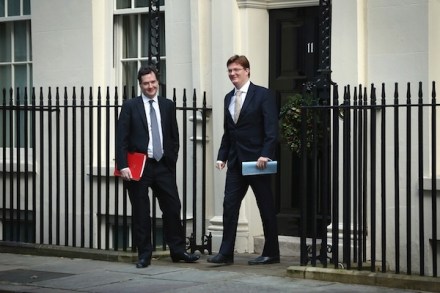
Comings and goings at Number 11 Downing Street

From our UK edition

Few politicians have put as much thought in to the team around them as George Osborne. He is a collector of talented people. Unlike most Tories, he has gone outside of CCHQ and parliament for nearly every senior appointment he’s made. But I understand that after Christmas he’ll be losing one of the most important members of his operation, Poppy Mitchell-Rose. Mitchell-Rose has acted as Osborne’s fixer and gatekeeper since he first became shadow Chancellor. On the long—and sometimes bumpy—road from opposition to government, she has been a calm sherpa who has dealt with a host of problems before they have even arisen. But she is now moving to Washington, DC, before starting a career in the private sector. I suspect that she’ll not be short of job offers.

Will Osborne have the luck of the Irish with his 4G auction?

From our UK edition

Could George Osborne be in line for a genuine windfall? The Chancellor is getting quite good at conjuring fake ones (Post Office pensions, raiding £35 billion from the Bank of England) but he has yet to sell the 4G licenses. This could be more significant than next month's mini-Budget. The stunning success of Ireland's 4G auction (here) suggests that the UK auction may yield a lot more than is currently expected. A decade ago, governments world over pocketed massive windfalls auctioning the 3G licenses to mobile operators. This time Ofcom has put a reserve of £1.3 billion. But the Irish government expected to get just €170 million from its licenses. In the end, it raised €482 million in upfront fees with €373 million more to come by the end of the next decade.

Lord Ashdown: Get out of Afghanistan quickly

From our UK edition

The headline on Lord Ashdown’s piece on Afghanistan in today’s Times (£) will please Lib Dem strategists. ‘This awful mistake mustn’t claim more lives.’ It allows the Lib Dems to play the anti-war card: we are the party that will bring Our Boys (and Girls) home. The strategists could take plenty of other lines from Ashdown’s quotable article. ‘All that we can achieve has been achieved. All that we might have achieved if we had done things differently, has been lost… Our failure in Afghanistan has not been military. It has been political.

George Osborne’s combination of austerity and social libertarianism is repellent

From our UK edition

George Osborne’s spirited bid in The Times (£) earlier this week  to appropriate the Obama victory for the Tories is a curious mirror image of the Labour Party’s arguments to the same effect. Both ignore the reality that the US is the US, not us, and Obama is Obama; formulas for election success aren’t a peel-off/stick-on tattoo, to be transferred between one body politic and another. But the article was interesting for what it told us about the Chancellor himself, quite apart from a slightly nerdy obsession with American elections. The fifth and decisive point in his piece was all about how social liberalism plus fiscal conservatism was the key to electoral success.

Delingpolegate?

From our UK edition

What's wrong with supporting James Delingpole? Ask the Guardian: it has had a tremendous amount of fun exposing the Tories’ campaign manager for the Corby by-election, Chris Heaton Harris MP, appearing to support The Spectator's very own James Delingpole. The paper has obtained video recorded by what it describes as an ‘undercover Greenpeace reporter’ of Heaton-Harris telling an audience at the Tory conference that he encouraged James Delingpole to stand as the anti-wind farm candidate in Corby. He says that he has made ‘a handful of people’ available to Delingpole, including the deputy chairman of his constituency. Finally, he adds, more in jest than complete seriousness it seems to me: ‘Please don’t tell anyone ever’.