Gardening

My wild success

From our UK edition

I’ve just tripped over the damned hedgehog for the second time in as many days. He has retreated into the greenhouse and is glaring out at me from under the workbench, rigid with indignation. I suspect he has learnt this expression from my cats. Truth be told, after 14 months’ acquaintance, with time out for hibernation, we’ve got each other’s measure by now. My two elderly rescue moggies barely spare the drama king a second glance. I’ve worked hard to acquire a hedgehog. And a great spotted woodpecker, goldfinches, greenfinches, chaffinches, grey squirrels, dunnocks, tits of every persuasion — you get the picture. But Mr Hog is my triumph to date, proof of a project that is nearing fruition.

What wasps do for us

From our UK edition

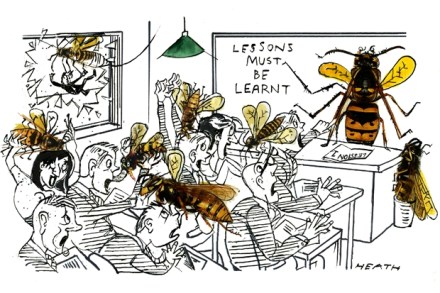
Dom Perignon, Pimms, Carling Black Label, Coca-Cola — one’s as good as the other, so far as they’re concerned. Even if they don’t manage to drown in the stuff, they spoil the taste for drinkers by creating panic out of all proportion to their size. They destroy the ardour of al-fresco lovers in an instant. They are the joy-killers: the destroyers of summer, determined to prove that the wild world is a plot against humanity. Is there anything good about wasps? Is their sole purpose in life to harass humans seeking the fleeting joys of summer? Does this black-and-yellow air force exist only to ruin the few fine days reluctantly given to us? If you garden, wasps are among your best friends.

The gardens of Ninfa

From our UK edition

I’ve just been given a personal tour of Ninfa by Monty Don. True, I had to share the thinking woman’s TV gardener with a number of others, but I’m convinced his attention was focused solely on me. The occasion was a visit to three outstanding gardens outside Rome — Ninfa, Villa d’Este and Landriana — to celebrate a quarter-century of Gardeners’ World magazine in the company of its editor, Lucy Hall. Monty was an added inducement for the tour of Ninfa, after which he was to give a talk on the evolution of Italian gardens. Rather like a gentleman’s club, Ninfa satisfies one’s inner snob. The eight--hectare garden, within 105 hectares of parkland 40 miles south-east of Rome, is open to the public for a handful of days each year.

The axeman next door

From our UK edition

When I moved to London, my husband Henry gave me a copy of Kate Fox’s Watching the English: The Hidden Rules of English Behaviour. He was hoping the gift would avoid an awkward conversation about our cultural differences. As an American, I cannot think of anything more English than that. Fox’s chapter about introductions bothered me. The brash American approach: ‘Hi, I’m Bill from Iowa,’ particularly if accompanied by an outstretched hand and a beaming smile, makes the English wince and cringe. I had never known friendliness to be cringeworthy. I felt sorry for Bill from Iowa. I pictured him arriving in my neighbourhood and being scorned for enthusiastically introducing himself to strangers. Henry tried to explain. ‘We don’t talk to neighbours.

Indoor gardening

From our UK edition

A year or so ago, I inherited a cardboard box filled with plants. It was an offshoot from an enormous collection that belonged to a young botanist from Stockwell. He was about to be turfed out of the derelict building he lived in and hundreds of plants were being spread across London. I offered to rehome a few. My only outdoor space is a window box, so most of the plants had to face life indoors. Some were happy; others withered. I enjoyed having them, though, so I replaced the dead and began a collection. My one-bed flat now contains more than 20 plants. The window box is bursting with herbs — parsley, sage, rosemary and thyme. I’ve also added some mint. More knowledgeable friends tell me that it has aggressive roots and will soon turn into a despotic ruler.

The real gardeners’ questions answered

From our UK edition

Why is it that gardening in the public prints is so often treated as a fluffy subject for fluffy people? Writing that a plant is ‘incredibly beautiful’ or that everyone is ‘really passionate’ about their allotment/community garden/windowbox doesn’t seem to me to be an adequate substitute for telling thoughtful gardeners something they didn’t know already. The trouble is that there is a shortage of trained gardeners and horticultural scientists who both have something interesting to say and can write engagingly, and of these only one can make me laugh out loud. His name is Ken Thompson, and he was for many years a lecturer in the Plant and Animal Sciences faculty at the University of Sheffield.

Top tips for gardeners — from stroking seedlings to stacking logs

From our UK edition

I spent the summer of 1976 working as a trainee gardener at the Arboretum Kalmthout in Belgium. My employer was charming and kind, but I could not suppress a prickle of shame-faced irritation every time she mentioned a former student called Susan Dickinson. Whenever I leant on my hoe for a moment in the pelting heat, I was reminded how accomplished and hardworking this horticultural superheroine had been. For the past 25 years, Sue Dickinson has been head gardener at Eythrope in Buckinghamshire, owned by Lord Rothschild, and she is widely acknowledged to be the finest gardener in the country. I need never have wasted finite energy on envy. The four-acre walled garden at Eythrope is the subject of Paradise and Plenty, published by Pimpernel Press (£50).

Moving pictures | 21 May 2015

From our UK edition

About six years ago the first section of the now celebrated High Line was opened in New York and made a palpable hit both locally and internationally. Locally it revealed what one might have guessed, that the inhabitants of Manhattan’s downtown suffered a severe lack of amenity. Every place to walk or run or ride a bike, every place to exercise the dog, is valuable and well used. This new and unusual park, restoring and converting the tracks of a disused overhead railway, was reserved neither for running nor biking nor walking the dog, but rather for strolling, sitting and sunbathing, and for the novelty of looking in on buildings old and new, from unusual angles and with an unusual degree of impertinence.

Cold frames

From our UK edition

A Little Chaos is a period drama directed by Alan Rickman and starring Kate Winslet as a woman charged to design and build a grand fountain garden for Louis XIV at Versailles. The film is, I noted from the poster, ‘the official film of RHS Gardening Week’, which may or may not be a hotly contested title, I just don’t know. All I can tell you is that it is, in fact, more of a love story than a horticultural story, and while it has occasional pleasing moments, and is lavishly costumed, it manages to do what I do whenever I try my hand at gardening. That is, despite my best intentions, and slogging my guts out, I somehow kill everything stone dead.

Why would someone pay hundreds of pounds for one snowdrop bulb? I think I know

From our UK edition

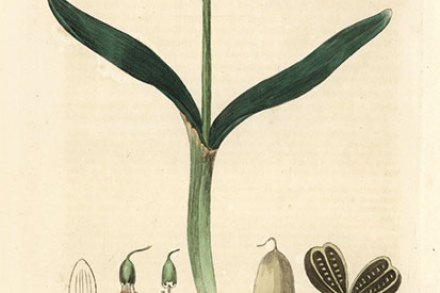
I think I’m coming down with galanthomania. It’s a rare affliction, but one that’s hard to shake, and it’s affecting more people every year. Galanthus are snowdrops, and galanthomania is a 21st-century version of that 17th-century craze for tulips which began in the Dutch golden age. At the height of the tulip mania some bulbs were selling at 3,000 or 4,000 florins, almost ten times a craftsman’s annual wage. Snowdrop bulbs aren’t there yet, but collectors spend hundreds of pounds on some rare bulbs, and seed company Thompson and Morgan broke records in 2012 by paying £725 for a single specimen.

Vita in her ivory tower: a portrait of a lonely, lovelorn aristocrat who yearned to be mistress of her own ancestral home

From our UK edition

Visitors to the National Trust’s Sissinghurst — the decayed Elizabethan castle transformed by Vita Sackville-West in the early 1930s — are regaled by picturesque extracts from Vita’s landscape poems, and moving professions of love to and from her husband Harold Nicolson. Matthew Dennison’s title, Behind the Mask, indicates his ambition to get beyond such projections to something more real. But the metaphor is unfortunate. There was no single image that Vita adopted or which others imposed on her — nor a single real self which has been concealed until now. Dennison knows this.

Tread carefully! Your garden is saturated with racial meaning – and so is Ikea

From our UK edition

Is your life saturated with racial meaning? The most common answer to this question, when I ask friends and acquaintances, and sometimes people in the street going about their business, is: ‘Your inquiry makes no sense whatsoever. It sounds like the sort of pretentious and thoroughly bogus question dreamed up by some idiotic sociology lecturer in a third-rate polytechnic. Now go away, I have lost my place in the queue at Burger King and will have to wait ages for a bacon double cheeseburger.’ The correct answer, however, is ‘yes’. Our lives are saturated with racial meaning — I have it on good authority. I don’t know what it means, but nonetheless we are all soaking wet with racial meaning, all of us. You especially, probably.

The gardener-soldiers of the First World War

From our UK edition

First, a confession. Even an ardent radio addict can enjoy a fortnight away from the airwaves, disconnected, switched off, unlistening. On return even the programmes that are usually ignored because they’ve become so familiar catch your attention. I grew up with Gardeners’ Question Time as a regular weekly slot on Sunday afternoons, snooze time for my overworked Dad, but stopped listening after the great schism of 1994, when the entire panel abandoned the BBC and moved over to the new Classic FM station because they didn’t like the way the BBC was handing over its production to an independent company. The illusion that the programme was a bit otherworldly, not part of the hard-bitten news and current affairs schedules or the argy-bargy of commerce, was shattered.

My application to be chairman of the BBC

From our UK edition

To: Karen Moran, HR Director, BBC Dear Ms Moran, I have decided to give up on the gardening this year, after a number of dispiriting setbacks. Last year I invested a fairly large amount of money, and about four hours per week, in trying to grow vegetables. But despite the fence and the pellets and the presence of a large plastic falcon called ‘Mr Roberts’, almost all of my crop was eaten by wild things. Woodpigeons, rabbits, caterpillars, slugs etc. I once saw a woodpigeon eating some of my kale while perched on Mr Roberts’s head, a terrible indignity for such a proud and fierce bird. In the end I had about 20 courgettes, and nobody in my family is fond of courgettes. So henceforth I will go to Morrisons for my vegetables, like I used to do.

Beauty in beastly surroundings

From our UK edition

The vast majority of books written about British gardens and their histories are concerned with large ones, made and maintained, sometimes over several centuries, by people with money. ’Twas ever thus. In this country, recognisable gardens began in monasteries, as well as the surroundings of palaces and noblemen’s houses, and it is only in the last couple of centuries that the middle classes have got into the act. As for the poor and dispossessed, theirs has been a very different story, too rarely told.

Jacqueline Wilson: ‘The first book that made me cry’

From our UK edition

I’m not sure if Rumer Godden wrote An Episode of Sparrows for children or adults. It was originally published on an adult list but I read it when I was about ten, Lovejoy’s age. She’s the heroine of this book, a small, strong-willed girl with the tenacity and determination of 20 adults. She’s got a feckless mother, no father at all, and scarcely any friends. It’s not perhaps surprising. Lovejoy is fierce and selfish because she had to learn to be tough to survive. She snatches, she steals, she’s witheringly scornful if she doesn’t like anyone. I knew as I read the book that I’d be very wary of Lovejoy in real life — but even so, I cared about her passionately.

The most important gardening book of the year

From our UK edition

I’ll own up at once. Tim Richardson and Andrew Lawson, the author and photographer of The New English Garden (Frances Lincoln, £40, Spectator Bookshop, £30), are friends of mine — no very unusual circumstance in the small world of garden writing. Moreover, I wrote this book’s forerunner, The English Garden, also in collaboration with Andrew Lawson. However, my reputation would falter if I sold you an expensive pup so, if I tell you that The New English Garden is one of the more important and interesting gardening books published this year, you may believe me. The book looks at 25 innovative gardens or public spaces that have either been made, or re-made, since 2000.

Dear Mary: The rules of wearing a dressing gown

From our UK edition

Q. What to do when you are an unwilling eavesdropper in a train carriage in which people you know assume they are alone and start talking very indiscreetly about someone else you know and you have left it too late to alert them to your presence? — Name and address withheld A. Ideally you will have access to earphones and some sort of electronic device and can walk through the carriage dopily, as though looking for a newspaper. Wrench out the headphones theatrically on seeing the talkers. In the absence of headphones, duck your head down, walk backwards to the nearest connecting doors and, when they wheeze open, walk through them with the momentum of someone who has just re-entered the carriage. Q.

Dear Mary: What must I do to reclaim the best poolside chair?

From our UK edition

Q. I know this seems petty but last year, on our villa holiday, my brother-in-law always took the best chair at the pool. This was a teak lounger with flat armrests on which books or drinks could be rested, and an adjustable section to prop up the knees. Everyone else was on plastic numbers. If anyone deserved the best chair, it should have been me, his host, who he knows has two dodgy knees. My sister is sensitive about him, so direct criticism or even teasing are out of the question as the whole topic is too combustible. Any suggestions, Mary? We are taking the same villa again this year. —Name and address withheld A. The villa managers are at fault here.

Folly de Grandeur, by Nicky Haslam- review

From our UK edition

Nicky Haslam is one of our best interior designers, a charmed and charming agent of style, a tastemaker for the sometimes directionless rich, a brighter star than most of his astronomically stellar client list. Considering a joint project, I asked him over lunch to tell me all the amazing people he had met. He demurred, but later that afternoon I got a 20-page handwritten document and on page one the names included John Kennedy, Svetlana Stalin, Picasso and Elvis. But Nicky is perhaps better known to Spectator readers as a contributor of meticulous, gossipy, beautifully crafted, super-well-informed and often rather saucy accounts of what used to be called high society. But how to describe the man to a reader who has not met him?