France

It’s a mistake to compare our Covid death toll with Spain and France

From our UK edition

Covid statistics are like complex machinery; if you don’t read the instructions you won’t operate them properly. Which is why the claim by some media outlets that the UK now has the second highest number of Covid deaths in Europe, should be handled with caution. It is true that on Wednesday the official UK Covid-19 death toll increased by 4,419 to 26,097 after the government included deaths outside hospitals for the first time. The figures were revised respectively by Public Health England since the first UK death in March. According to the Guardian, ‘The change comes after weeks of criticism of the way that the UK had been reporting its coronavirus death toll, which made effective comparisons with other European countries impossible.

How the French view their weekly clap for carers

From our UK edition

Once a week we break French emergency law and have a friend round for drinks on the terrace. The terrace overlooks the village rooftops as if it were a box at the theatre. Two weeks ago we were pleasantly lit up, when, at one minute to eight, the villagers below came out on to their terraces or stood at their windows and front doors to make a noise in support of the ‘essential’ workers: nurses, doctors, carers, postmen, shopkeepers, council workers, and so on. Some banged saucepans together or beat them with wooden spoons. Some blew horns of one kind or another, including what sounded to me like one of those long prayer horns blown by Tibetan monks from monastery rooftops.

Paris’s banlieues are burning once again

From our UK edition

One of the persistent misconceptions of the riots that swept through France in the autumn of 2005 is that they were solely the result of the deaths of two youths as they ran from the police. The deaths of the teenagers on October 27 in Clichy-Montfermeil provoked unrest in the north-eastern Parisian suburb but it was what happened three days later that led to three weeks of nationwide riots and the declaration of a state of emergency by the then president of France, Jacques Chirac. According to Gilles Kepel in his 2015 book, Terror in France: genesis of the French Jihad, it was a stray tear gas grenade fired by police that landed close to the entrance of a mosque that lit the touch paper.

Don’t bank on a V-shaped recovery

From our UK edition

Last week, Britain and France were treated to an avalanche of financial statistics jostling with the macabre daily litany of Covid casualty numbers. All are premised on a V-shaped recovery in which the severity and rapidity of the Covid recession is matched by a rapid bounce back. But the French above all should be aware of a historical parallel that suggests caution regarding the V-shaped recovery. But first the size of the problem. In Britain, the Office for Budget Responsibility produced the most pessimistic scenario for the British economy compared to those of KPMG, Morgan Stanley and the OECD. Based on a three-month lockdown it projects a 2020/21 budget deficit of 14 per cent falling back to a 2.

France’s citizens’ climate convention has come back to bite Macron

From our UK edition

Those of us who are sceptical about the worth of citizens’ assemblies have been noting with interest the upshot of the French citizens’ convention for the climate which delivered its recommendations this week. The thing about these assemblies of randomly selected citizens mulling over thorny issues is that they’re a brilliant way for elected politicians to shift the responsibility for really unpopular policies onto someone else. Except they can go horribly wrong. President Macron used this device to deal with the threat from the gilets jaune, back in those distant days when citizens could actually assemble in France.

Didier Raoult — leader of the hydroxychloroquine cult

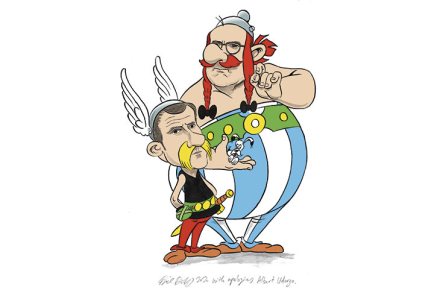
Professors of medicine do not usually look as if they have emerged from the pages of Asterix, or alternatively as if they were the drummer of a 1960s rock band just emerged from drug rehabilitation for the 17th time: but that is how Prof Didier Raoult, recently elevated to the rank of the most famous infectious disease doctor in the world, looks. If you type 'Didier' in your search engine, up comes Raoult, before even the soccer player, 'Drogba'. When infectious disease doctors are more famous than footballers, you know that an epidemic is serious.  Raoult says that he adopted his appearance to irritate his colleagues, which is another specialization of his, one at which he is undoubtedly very good.

didier raoult hydroxychloroquine

I was relishing the lockdown a week ago, but now I need urgent hospital treatment

From our UK edition

In France the rule for going for a walk stipulates an hour in duration or a kilometre in distance. We are fortunate here in having a 40-minute circular walk that starts at the front door, most of it on a footpath, though beginning with a steep climb that makes me pant like a greyhound after a course. Then the path levels and runs pleasantly through olive groves and vineyards. One is never out of sight of houses and at three points along the route house dogs — in order: a pair of Weimaraners, a Jack Russell and a pedigree sheepdog — enjoy intimidating passers-by by throwing themselves in a frenzy of barking at the wire boundary fences containing them. Otherwise the route is bucolic and quiet enough to quieten the mind and exhaust the frail old mongrel.

Coronavirus is straining an already fractured EU

From our UK edition

When EU finance ministers ended their crisis meeting this morning, they had spent 16 hours trying to establish what collective help, if any, they wish to offer to the countries most affected by the epidemic: Spain and Italy. They agreed on not a thing. Instead, the meeting broke up acrimoniously with Italy, Spain and France demanding that the European Central Bank issue ‘coronabonds’ to help finance economic recovery – while Germany, the Netherlands and others resisted. So we see the EU split along the same lines as did the 2008/09 crisis, and indeed along the same fault lines that have been growing ever wider over the past three decades.

Annie Ernaux looks back at her teenage self – and sees a stranger

From our UK edition

How can you recover the teenage girl you were? Not just recall the memories and recount the events — this dress worn at that party, the taste of that alcohol on this boy’s mouth — but restore the world in which these things took place, and the self who acted and was acted upon. Is it possible to be your own Orpheus and yank the Eurydice of your former self from the underworld of forgetting? This is the problem that Annie Ernaux sets herself in this slim, transfixing memoir of young adulthood and first sexual experience. It’s 2014 and Ernaux is looking at a picture. The picture was taken in 1958 and the girl in it is 17. The girl is Ernaux, and also she isn’t.

Could coronavirus lead to Frexit?

From our UK edition

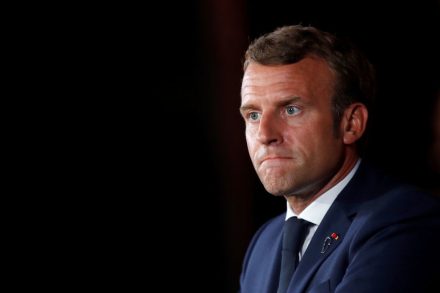
Is France flirting with the idea of Frexit again? Coronavirus is currently provoking a chorus of ‘reprendre le contrôle’ (take back control) across the political spectrum. The epidemic is laying bare France’s dependence on outside states for essentials such as masks, medicines, test kits and ventilators. Even arch-Europhile Emmanuel Macron visiting a French mask manufacturer declared this week: ‘We have to produce more in France, on our territory, from now on to reduce our dependency… we must rebuild our national and European sovereignty’. His reference to Europe is not unusual, but highlighting national sovereignty is. The second ‘take back control’ stimulant comes from growing irritation with the European Union.

Had the entire village population been wiped out since last week?

From our UK edition

With my signed and dated laissez-passer in my pocket, I trotted down to the village to see if I could buy anything to eat, drink or smoke. A sensation of being out and about in the world was also high on the agenda. Cycling and jogging earns you a fine, of which a quarter of a million have been doled out in a fortnight. But we are permitted to walk the dog for one kilometre, or 546 yards there and 546 yards back. We cheat a bit, Catriona and I, by taking the dog separately, meaning she gets two walks a day. She’s elderly and frail, the poor bewildered thing, and completely knackered. And if we tick the box on the laissez-passer we can also go out to the nearest grocery shop and tobacconist. Nevertheless confinement is beginning to chafe a bit.

Liberté, égalité and fraternité are being put to the test in France

From our UK edition

When I left my apartment for my morning run today I saw that someone had scrawled on the courtyard in large chalk letters 'Tenez Bon, Les Voisins' (Hang in there, neighbours). It could have been a message for the whole country. France is flagging after two and a half weeks of complete lockdown and the fact that today is the start of the official Easter holidays will only fray nerves further. To make matters worse, the country will be treated to a taste of summer this weekend with temperatures from Paris to the Pyrenees forecast to touch 23C on Sunday. In an interview today the Minister of the Interior, Christophe Castaner, revealed that since France went into lockdown on March 17 there have been 6.

Macron’s updated coronavirus statistics will test French morale

From our UK edition

On Saturday night France’s Prime Minister spoke to the French people flanked by the Health Minister, the Director General of Health (DGS) and three epidemiologists, to reassure the public that the government would be more transparent about the spread of coronavirus. Despite President Macron’s increasing media appearances in the ‘war on corona’ a 25 March opinion poll showed 90 per cent of the French public are anxious, 39 points more than on 11 March before the lockdown. Although 64 per cent claimed their morale was holding up, 56 per cent said they had lost faith in the executive’s management of the crisis.

Is France being pushed to breaking point?

From our UK edition

As France prepares to enter its third week of confinement the Prime Minister, Edouard Philippe, has warned that ‘the fight has only just begun’. Coronavirus has claimed 2,606 French lives to date, but at a press conference on Saturday evening Philippe said: ‘The first 15 days of April will be even more difficult than the last 15 days.’ Earlier in the week Philippe had praised the resolve of the vast majority for respecting the lockdown, and he urged France to hold the course while announcing that the confinement will continue until at least April 15. ‘This struggle will last,’ he said. ‘We will only win by being disciplined and observing lockdown measures.’ But how long can the French hold out?

France’s downward spiral of coronavirus repression

From our UK edition

In France there is a palpable sense of administrative and political panic in how to deal with the coronavirus epidemic. As I write from Perpignan on the French-Spanish border on the morning of 24 March, France has 19,856 coronavirus cases and 860 deaths; Britain 6,650 and 335. After Italy and Spain, France is the third worst affected country in Europe (Germany has more cases because it tests more, but only 123 deaths), but it has imposed and enforced the most severe lockdown. France went into lockdown on 17 March. The administrative state immediately generated an array of bureaucratic forms: a certificate to leave your house to walk the dog or go shopping; a certificate justifying your attendance at work rather than working from home.

My life as a French prisoner of coronavirus ‘war’

From our UK edition

Seventeen per cent of Parisians have fled the city since President Macron ordered France to be confined, as part of his ‘war’ strategy to defeat coronavirus. The lockdown, which began on Tuesday, is for two weeks but on Friday the government indicated that it will likely be extended into April as France struggles to contain a pandemic that has now claimed 674 lives. Police are rigorously enforcing the regulations forbidding people to leave home except to buy provisions or briefly stretch their legs. Thousands have been fined for breaking the rules of confinement and there are reports that in future people will be jailed for up to six months if they're repeat offenders.

My love affair with Hannah Arendt

From our UK edition

The three of us — me, Catriona and her daughter Skye — were having a wash and brush-up before going out for a meal ata restaurant in the village, when we learnt that President Macron’s smooth dishonest face had just addressed the nation on TV and told it that he had ordered bars, cafés and restaurants and all places of entertainment to be closed until further notice. The news both exhilarated and disappointed: real life had begun in earnest but the bars were shut. Skye assembled a round of gin and tonics and we three settled down in a row with our feet on the coffee table to make our own evening’s entertainment, the first perhaps of many.

Catherine Deneuve at her most Deneuve-ish: The Truth reviewed

From our UK edition

To tell you the truth about The Truth, even though it stars Catherine Deneuve at her most Catherine Deneuve-ish (i.e. campily grand) and I was so looking forward it — it’s the first non-Japanese production from Hirokazu Kore-eda, who made the very lovely Shoplifters — it is now quite hard to concentrate on anything in films beyond the fact that they already feel like social history. My God, there was a time when people just went out and about willy-nilly? And they hugged and kissed and weren’t always washing their hands while singing ‘Happy Birthday’? So that gets in the way, as does having to watch films at home rather than on a big screen, now that cinemas have closed. But we will try our best — here to serve and what have you.

The arrogance of France’s coronavirus rhetoric

From our UK edition

‘At the beginning of a pestilence and when it ends, there’s always a propensity for rhetoric. In the first case, habits have not yet been lost; in the second, they’re returning. It is in the thick of a calamity that one gets hardened to the truth – in other words to silence.’ Albert Camus, The Plague. Faced with Covid-19, France has not yet reached that moment of silence when one gets hardened to the truth. Rhetoric still has the upper hand as President Macron’s address to the nation on Monday night revealed.

Shrieks, shots and broken china: a visit to my rural French GP

From our UK edition

On a hard chair next to the waiting-room door, I sat for an hour defusing thoughts of my own demise, if all else failed employing conscious untruths. As is the custom here in the hot sweet south, a person entering a room greets it. Being nearest to the door, and the first encountered face, I felt responsible for setting the tone of the waiting room’s responses. Interrupting my morbid sophistries, I returned each new entrant’s greeting in a spirited, democratic, welcoming manner. In this I failed as usual to sound that exact native demotic note and suspect I came across rather as a psychotic waiting for his monthly depot injection. There were five before me waiting to see the doctor.