Film

Grim and glorious

Tick, tock. Tick, tock. Stay too long in the Lee Miller exhibition at the Hepworth Wakefield and the metronome might drive you mad. Considerate curators will only set it swinging in stints to spare the gallery guards. Man Ray, who made the metronome ‘Object of Destruction’ (1923), meant it to infuriate. His assembled sculpture came with instructions. ‘Cut the eye from a photograph of one who has been loved but is seen no more. Attach the eye to the pendulum of a metronome and regulate the weight to suit the tempo desired. Keep going to the limit of endurance. With a hammer well-aimed, try to destroy the whole at a single blow.’ Tick, tock. Tick, tock. Smash. The eye on Man Ray’s metronome was Lee Miller’s, beautiful, blue, bewitching.

Losing his religion

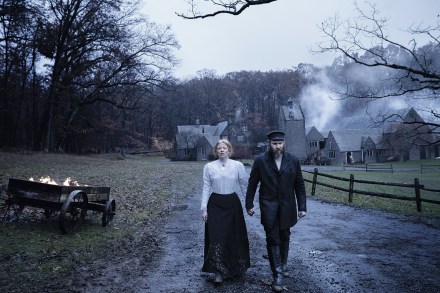
Paul Schrader’s First Reformed is slow, churchy, cerebral, bleak, difficult, tormented and puzzling, which is always a blow. So exhausting when a film’s meaning isn’t laid out clearly and neatly before you. But it is, at least, powerfully puzzling and grippingly puzzling. You may not understand it (completely), but you will come away with the feeling that something was being said, whatever that something may have been. Ethan Hawke stars as the Revd Ernst Toller, leader of First Reformed Church somewhere in upstate New York. The church, which dates from 1767, is built in the Dutch style, and is white and clapboard, pretty as a picture. But right from our first sight of Toller we understand that he is a darker proposition, and is suffering in some way.

Too much information | 12 July 2018

When Kasper Holten’s production of Don Giovanni was first staged at the Royal Opera in 2014, I disliked it intensely, even more than I have disliked most of his other productions, or for that matter most productions of Don Giovanni. I missed the first revival, but when I saw it this time round my reactions were more complex, though I still think there is a lot wrong with it. In the meantime, I have watched the 2014 production on Blu-ray. Holten and Es Devlin the set designer give a commentary throughout, which at least helped me to understand what was intended, even if it didn’t convince me that most of the producer’s ideas are helpful or even realisable.

Between a rock and a hard place

According to the opening captions in Picnic at Hanging Rock (BBC2, Wednesday), ‘the infamous events’ it depicts ‘began whena mysterious widow purchased a mansion out in the Australian bush’. The first few scenes, set in the late 19th century, were then dedicated to proving quite how mysterious she was: Hester Appleyard (Natalie Dormer) wasn’t merely veiled, but also filmed largely from behind and — just to be on the safe side — in the dark. What she might not be, though, is a widow. As she explored her new house, her voice-over dropped a series of dark hints that her mourning dress was a cunning disguise — and that she was in hiding from someone or other after doing somethingor other.

In the shallows

Swimming with Men is a British drama-comedy starring Rob Brydon as a disaffected middle-aged accountant who joins his local male synchronised-swimming team, doesn’t bond with any of his teammates, doesn’t learn about what matters in life, catches athlete’s foot plus several verrucas, then throws himself from a bridge. Of course, that isn’t this film, but if it were, it would be a film I hadn’t seen before. The fact is, familiarity is often fine — and comforting. The Full Monty, Calendar Girls, Brassed Off, Kinky Boots and all the other films of this ilk: fine, and always comforting. Plus, I’d seen the poster — Carson from Downton in Speedos! — and was a little bit excited, I have to say.

Little voice

Debra Granik, the writer-director who made quite a splash with Winter’s Bone (which launched the career of Jennifer Lawrence in 2010), has returned with Leave No Trace, which is also powerfully compelling. By rights, it shouldn’t be. By rights, this tale of a father and daughter who wish to keep themselves to themselves (essentially) should be as dull as ditchwater. It is slow. Little is said and little happens — it’s inaction-packed, if you like — yet it pulls you in and keeps you pulled in. I’m still turning it over in my mind days later. It will certainly leave a trace in you, in other words. Adapted from Peter Rock’s novel My Abandonment, the film stars Ben Foster as Will, a Vietnam vet, and Thomasin McKenzie as his teenage daughter, Tom.

No fear | 21 June 2018

Hereditary is the horror film that has been described as a ‘ride of pure terror’ and likened to The Exorcist and Rosemary’s Baby and The Shining, to which I can say only: in its dreams. Given I’m such a wuss when it comes to anything frightening — the child-catcher from Chitty Chitty Bang Bang still scares the living daylights out of me — I’m rather thankful, but I’m perplexed as to why it received such rave reviews. Ride of pure terror? I’ve had more terrifying rides on the teacups at the fair. I saw it at the paying cinema with my adult son and his girlfriend, who were also bored out of their minds and could only conclude that ‘all other critics are idiots’.

Sisters are doing it for themselves

Ocean’s 8 is the all-female spin-off of the all-male Ocean’s trilogy and it’s a sop, with a third act that drags like nothing on earth. But its success — it earned an estimated $41.5 million during its opening weekend, which is better than any of the male versions — shows the market isn’t that bothered by content, which is equality of a kind. Women can now make dull formulaic franchise films too! Hurrah! We’ve arrived! And we can do this rubbish for ourselves now! The film is a straight-up-and-down remake, where the gender swap may, in fact, be the best idea, possibly because it’s the only idea. (The Ghostbusters remake did it first anyhow.) It does not subvert the heist-caper genre in any way but instead follows the formula slavishly.

Fallen franchise

Back in the mists of prehistory, when I was eight, dinosaur films followed a set pattern. The dinosaurs themselves would be cheerfully unpalaeontological; women would wear improbable outfits; volcanoes would explode. Then, in 1993, courtesy of Steven Spielberg, came a sea-change. Jurassic Park was that cinematic rarity: a science fiction film that succeeded in influencing the science it was fictionalising. The story of a theme park populated by resurrected dinosaurs, it offered a portrayal of Mesozoic fauna that was as close to authentic as could then plausibly be achieved. For the first time, computer-generated imagery was used to portray dinosaurs as scientists had come to envisage them: agile, bird-like, smart. The impact was profound.

Box of delights | 31 May 2018

Two films this week, one that has stood the test of time, dazzlingly — it still feels as fresh as a daisy, almost 90 years on — and another that’s so tiresome it felt almost 90 years long. First, Pandora’s Box, directed by G.W. Pabst in 1929, starring Louise Brooks and her iconic hair-do. It is always described as ‘a masterpiece of silent cinema’, which, let’s admit it, can strike fear into the heart of the average cinemagoer. It’ll be primitive, vaudevillian, barely watchable. There will be exaggerated hand-flapping and over-the-top faces.

Same old story | 24 May 2018

Edie tells the story of an 84-year-old woman who wants to fulfil a girlhood ambition by climbing a Scottish mountain. It stars the wonderful Sheila Hancock who has been criminally underused cinematically down the years — ‘I wasn’t considered attractive enough,’ she recently said. As there are anyway too few films featuring older women with their own narratives, I am absolutely desperate to be generous about this. That’s the aim. It won’t always be easy, frankly, but if there is one thing this film wants you to take away it is this: you’re never too old for a challenge. At the outset, Edie is seen living under the hand of her husband.

Cannes had many strong films but only one deserves the Palme d’Or

The Italian film director Alice Rohrwacher’s rise to the top has never been more obvious than this week at the Cannes Film Festival. Her third feature film, Happy as Lazzaro, which she wrote and directed, stunned the critics gathered in Cannes for what has been a very strong 71st edition. A distinctive and yet quiet talent since her first film Corpo Celeste was selected at Cannes’ Directors Fortnight in 2011, followed three years later by her second film The Wonders, Alice Rohwacher has reached, at just 36, a maturity and force that echoes both Pier Paolo Pasolini and Ermanno Olmi. Conceived as a diptych, Happy as Lazzaro is a poetic fable which starts in an enchanted and timeless Roman countryside and finishes in the asphalt jungle of industrial Turin.

Lars von Trier’s latest film rightly resists the idea that art must be morally correct and inoffensive

Danish director Lars von Trier is back at Cannes Film Festival, proclaiming that 'it’s all good – we had a little misunderstanding for seven years' and worrying that his new serial killer movie, The House that Jack Built, isn’t divisive enough. In fact, the reception of the film has indeed revealed an divide in the mentality of contemporary culture. More than a hundred members of the audience walked out in protest at the film’s première and a similar number did the same from the press screening this week. Nonetheless, Von Trier received a lengthy standing ovation on his arrival to the première, and those who stayed till the end acknowledged the film with demonstratively insistent applause.

Award for the most right-on awards ceremony goes to Cannes

There’s nothing that screams 2018 feminism more than a bunch of celebrities holding hands on a red carpet. This year’s Cannes festival is the latest opportunity in a long string of awards ceremonies for the rich and famous to gain some brownie points. If there were an awards ceremony for the most right-on awards ceremony (please no one take me up on that), Cannes might well win. This year’s tote bags contained a flier emblazoned with #NeRienLaisserPasser (or, roughly, don’t let anything happen). ‘Let’s not ruin the party’ it said in French, warning attendees to watch their behaviour.

Mourning glory | 17 May 2018

They enter two by two. Grannies, mainly. Headscarved, mainly. Some locking arms. A bit glum. Like rejects from Noah’s ark. Passing through two vertical beams of light, they appear then disappear, shuffling into the darkness. From concrete caves, they begin to wail for the dead. We’re witnessing Artangel’s latest extraordinary commission, ‘An Occupation of Loss’, by Taryn Simon. The piece draws together professional mourners from all corners of the earth — China, Armenia, Ghana, Ecuador — and deposits them under a block of flats in Islington High Street. The Azerbaijanis wallop their thighs as they wail. The Venezuelans sob behind full face veils, the fabric vibrating in sympathy. Some pace in circles, nervously fingering bits of cloth.

This will end badly

On Chesil Beach is an adaptation of the Ian McEwen novella set in 1962 when ‘conversation about sexual difficulties was plainly impossible’ and a young couple suffer a disastrous wedding night from which there will be no return. This is surefooted, mostly, and literary and tasteful and sad and English, and it also stars the ever-remarkable Saoirse Ronan. But it does take a giant misstep at the end — the ending is plainly horrible — plus the book’s frustrations don’t magically disappear. One crap shag and that’s it, it’s over? It worried you then and it will worry you now.

On another planet

How to Talk to Girls at Parties is set in the 1970s and has punk as the backdrop and an excellent cast (Nicole Kidman, Ruth Wilson, Elle Fanning). It also features what could be a decent premise (boy who treats girls as if from another planet meets actual girl from another planet). But everything it has going for it is undone by what it doesn’t have going for it, which is substantial. This could, in fact, have been titled How to Stay Awake Once You’ve Lost All Patience because, I now know, staying awake once you’ve lost all patience makes talking to girls at parties look like a walk in the park, frankly.

Tokyo through the lens

In 1975, the 24-year-old Ian Buruma (now an award-winning essayist and historian, and the editor of the New York Review of Books) left his native Holland to study film at the Nihon University College of Art in Tokyo. It was a bold move. The 1970s was a wild, tumultuous decade in Japan, often known as the Showa Genroku, after the hedonistic period at the end of the 17th century, and Tokyo came as a shock to the few Westerners who went there: a teeming, neon-strafed megalopolis, where the trappings of hypermodernity jostled with elements of a sublime tradition, and the whole culture was drenched in eroticism.

The horse and his boy

Andrew Haigh makes inaction films. Weekend (2011) tells of two young homosexuals getting to know each other in Nottingham. In the wintry marital drama 45 Years (2015) two old heterosexuals get to unknow each other in Norfolk. The canvases are miniature, the resonances crevasse-deep. His third film, Lean on Pete, brings a change of scene and scope. And volume. Hooves thunder. A fatal gunshot goes off. Ornery men bawl and holler. There is a devastating road accident, and a climactic act of hideous violence. It’s as if Haigh has contracted ’roid rage. What he’s actually done is get on a plane to Oregon to adapt a novel by Willy Vlautin. Haigh is intrigued by the often silent space between two characters.

Animal magnetism | 26 April 2018

When I first read that Beast is a serial-killer thriller my heart sank like a stone — yet more women raped, butchered, murdered; splendid, bring it on. But it is, in fact, fascinating and brilliant, and not like any serial-killer thriller you’ve seen before. This is because a woman owns it. Psychologically and emotionally. Not because she’s the actual killer, although if she were the killer would she need to work four times as hard to achieve the same notoriety as a man? Kill eight to his two? But we mustn’t allow that to hold us up. Beast is a feature-length debut for writer/director Michael Pearce and it stars Jessie Buckley, who is phenomenal.