Family

What could possibly explain my poor Uber rating?

From our UK edition

This is not happening, I thought, as I jabbed at my phone to magic up a hybrid to convey me noiselessly to a central London studio. But my Uber app had vanished and wouldn’t reinstall, and was then ‘locked’. Meanwhile, no black cabs were plying their licensed trade on Upper Tooting Road, where I was soaking up the vibrant multicultural scenery when this tech glitch occurred, outside a store called Niqaab and opposite Daily Fresh Naan. I never keep drivers waiting. I almost always tip. I even sometimes make small talk over the beat of Heart FM I moved fast to resolve the problem, i.e. I channelled Andrew Neil whenever British Airways fails to remember that he’s its most important client. I sent a stiff tweet to @UberUK, informing it that my account was disabled.

What do changing emoji trends tell us about society?  

When did you, Spectator readers, last send an emoji in a text, DM or, gasp, email? I’ve just looked through the last messages I’ve sent and I sent a weeping smiley face to my wife last night while we were discussing Colin Firth’s singing in the film of Mamma Mia! (To be honest, anyone who has suffered through Firth murdering “My Last Summer” might use considerably stronger emojis than that.) Yet as a 44-year-old man, I can also concede that my own usage of emojis in my written communications is not as prevalent as that as my 10-year-old daughter Rose, who is an ardent user of them whenever she gets hold of my or her mother’s telephone.

emoji emojis

I left my heart in Lake Como

From our UK edition

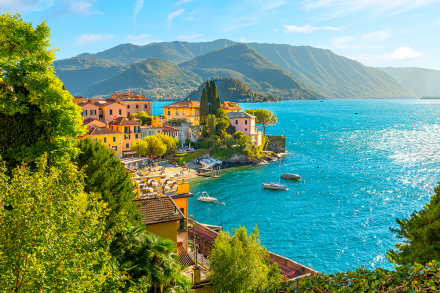
Lake Como It doesn’t take long for me to fall in love. A young Adonis with a six-pack bounced on a trampoline, his dark curls flapping like spaniels’ ears. Waiters flitted about with drinks. Ridiculously attractive couples, all with perfect bodies, lounged on the beach in front of us, rosé on ice to hand. We’d arrived by water, fetched by a barefoot beauty in an Albergo Aurora-branded white polo and batty riders, who helped our party of five out of our little launch and onto the Albergo’s riva as if not only our lives depended on it, but her job too.

A broken bond: Gaining Ground, by Joan Barfoot, reviewed

From our UK edition

When a girl turns up at an isolated cabin in Canada, unannounced and uninvited, the woman busy thinning the lettuce has no idea who the stranger is. But then the woman has trouble remembering even her own name. ‘“Are you Abra Phillips?” asks the girl. “Am I?” the woman ponders, conscious that the words “mean something” to the girl,’ writes Joan Barfoot in the opening pages of Gaining Ground, a Canadian feminist classic now republished nearly 50 years after it first appeared as a debut novel entitled Abra. ‘I think, finally, that I must be; there is no one else to connect with this name,’ continues the protagonist, who we soon learn has been alone in the cabin for the past nine years, all but living off the land after walking out on her family.

How Rio helps us Johnsons find love

From our UK edition

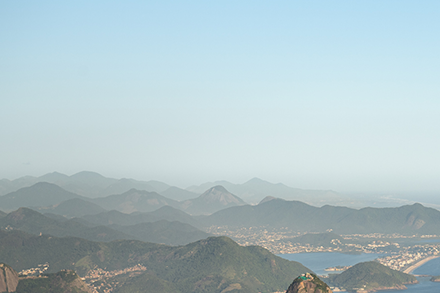
My youngest son, Oliver, has asked me to make a speech at his wedding. I am very flattered even to be invited as, given the Beckham family meltdown over the Brooklyn nuptials, you can’t take anything for granted these days. I’ve undertaken not to wear a slip dress of my own design, or dance ‘on’ Oliver to any of ‘our songs’, or speak for more than five minutes. I’ve worked out that this gives me up to 750 words to praise him and his lovely bride Lily; express what he means to me; convey my joy at his marriage to the incredible blonde bombshell who has been the apple of his eye since they first met at Manchester University; tell funny stories about his childhood and school days; and generally bring the house down without blubbing. For comparison, this column is 850 words.

My beef with Bruce Anderson

From our UK edition

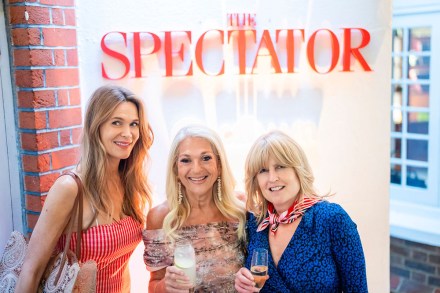
My beef with the columnist Bruce Anderson began, as beefs do, at the Spectator summer party. Not this year’s – we will come to that – but at another brilliant edition of the annual gold-plater some years ago. On that occasion, after arrival I’d gone to my usual peg outdoors by the stairs up into the garden, a liminal position from where I can bag the famous and important and am unlikely to be bed-blocked by bores. Bruce, aka ‘Brute Anderson’ – a baggy, shaggy bruiser of whom P.G. Wodehouse would doubtless have written that he looked as though he had been poured into his clothes and had forgotten to say ‘when’ – loomed. ‘Lassie,’ the Scot boomed. I mounted a step to be closer to him in height.

God save The World Tonight

From our UK edition

We were driving to the V&A summer party, windows down, scent of jasmine floating on the liquid June air, prospect of petal-strewn cocktails and pretty girls posing in their zaniest dresses with Grayson Perry ahead. My iPhone in my bag connected to Ivo’s car radio and – bear with me – started playing. We were in Kensington Church Street and it was the Radio 4 Media Show. ‘In a minute the head of BBC news on cuts announced today and former World Tonight presenter Ritula Shah on the Radio 4 programmes being axed,’ said Katie Razzall, introducing the acting bean-counter, a Mr Jonathan Munro, who explained that he had to cut 10 per cent costs, that 550 jobs were being binned to save half a billion quid, and that there was much more pain to come.

The horror of being offered a seat on the Tube

From our UK edition

It would have been my mother’s 84th birthday on 29 May. I thought about her as I clattered down the corkscrew stairs at Holland Park Underground Station, past the prissy sign warning travellers not to attempt the stairs because there were 93 of them, instead of encouraging people to use them as I would if I were in charge around here. On the platform, in the soupy tunnel, I took out my iPhone to play my little game, which is to do the Wordle before the next train arrives, which – thanks to the Central Line’s rapid peristalsis – is usually only a couple of minutes. Mission accomplished, I got onto a standing-room-only carriage. My mother died in 2021, aged 79. It was her time.

Remembering my gloriously unfiltered father

From our UK edition

Nothing can prepare you for the death of your father because, by definition, it’s a once-in-a-lifetime event. You have these ideas in your head about how it’s going to be: the children gathered at the bedside saying all the moving, important things that hitherto they’d held back; the fond paternal benison. But the reality, in my experience, is unlike the scenes in literature. My dad couldn’t wait to get rid of us. He was far too preoccupied with the intimate, difficult and very personal business of dying to indulge our let’s-pretend-everything’s-normal chit-chat. His last words to me – perhaps to anyone – were: ‘I’m feeling really buggered. Call me a nurse.

Is my plumber right about Armageddon?

From our UK edition

The plumber was shouting hysterically at me down the phone because I had asked him to install a heated towel rail. ‘Towel rail? Towel rail! Armageddon is coming! Did you fill your oil tank up? It’s tripling in price by Christmas! I’ve got 40 jobs piled up! Forty jobs!’ ‘So are you saying I can’t have a heated towel rail?’ I said. I know the plumber only too well. Many a time he has sat at my kitchen table chain-smoking while rambling about the devil, and how the world is coming to an end. If that is his default setting, you can imagine how he reacts to things going very badly on a global scale. He lives on his nerves at the best of times. Major world events are apt to put him in a particularly nihilistic mood.

How far would I go for oil?

The oil delivery man had way too much swagger and, as he waved his nozzle about, I realised that he might be expecting a little something. Oh dear, I thought, as he pushed the nozzle into my oil tank, pressed the button on his lorry and spent less than ten seconds giving me the amount of oil I could afford. Oh dear, what if the oil crisis is now at such fever pitch that desperate housewives in remote places are offering a little something on the side to get more oil? Ten seconds’ worth of oil did feel like the end of the world. Usually, I can afford to let the lorry fill the entire tank and it comes to about a grand.

A revival of Alan Bennett’s early work is long overdue

From our UK edition

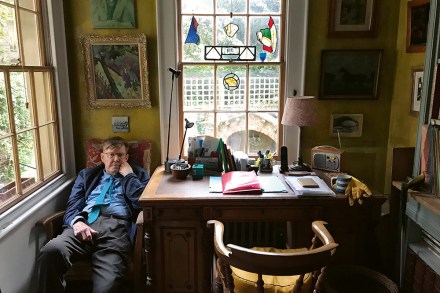
It is a curious literary form, the published diary. A surprising number of the classic diarists did write for eventual, usually posthumous, publication – Chips Channon under a 60-year embargo, A.C. Benson, Samuel Butler, in his wonderful notebooks, and surely the possibility was in the minds of Samuel Pepys and the Duc de Saint-Simon. More recently, great diaries have been published within the author’s lifetime. James Lees-Milne’s first instalment came out 30 years after the period it described. Alan Clark’s initial offering, covering 1983-92, appeared in 1993. Tony Benn’s hilariously tedious volumes emerged on a rolling programme which slowly caught up with the events they described.

I’m stuck in a house of madness

‘I want to learn Iranian,’ said my father, resolutely, as he watched the bombing on the television. ‘Farsi,’ I said, thinking I would talk to him about that very happily on the basis it was better than helping him contact the Ukrainian government so he can fight the Russians. ‘What’s that?’ he said. ‘Farsi,’ I repeated. ‘Parcel?’ he said. But it was pointless trying to explain, for he was up and looking out of the window and telling me to look in the parcel box. We were waiting for the special food I had ordered for the new cat someone irresponsibly rehomed to my parents and which already has a stress condition from living with two dementia sufferers.

Things still seem oddly disorientating without Seamus Heaney

From our UK edition

Whether you went with the two big rugby goalposts, those opposing H’s of Heaney and Hughes, or with Blake Morrison’s quondam super league of world English (or sometimes airport) poets, Brodsky, Walcott, Murray and Heaney, Heaney loomed amiably in the poetry landscape of the late 20th century. I knew him a little and liked him a lot. Enough now to appreciate that there was something endlessly consoling about being alive at the same time as an incontestably – or only rarely, foolishly contested – great, canonical poet, someone you might occasionally meet or, more regularly, see new poems or new books by; and something correspondingly harrowing and disorientating about this same poet no longer being alive. A geographical feature has been taken away, a hill, a forest, a river.

My father gave me the internet

My father went into the kitchen for a cookie, then disappeared into his home office for a phone call. He was arranging a surprise for my mother – hired waitstaff for Christmas Eve dinner, one of the biggest our family would have hosted. Then he died. It took 15 seconds. We found him within minutes. The waitstaff called back 11 times over the next two days. I thought they were debt collectors. Finally, I went into his office, where we had found him, picked up his phone, and yelled, “He’s gone! Stop calling!” That’s how I learned what he’d been doing. They were trying to confirm. And in the corner of my eye, on his bookshelf: Irish Folk and Fairy Tales by W.B. Yeats.

father internet

The quiet joy of spending Christmas alone

From our UK edition

The first thing I should tell you about my relationship with Christmas is that I’m not saturated in essence of humbug. My approach to a big family Christmas is the same as my relationship with Mexican food: if it’s put in front of me I’ll enjoy it, but I probably wouldn’t ever purposely seek it out for myself. With no family to speak of within 200 miles and with a fiancée who usually has to work on Christmas Day at her job as an NHS intensive care unit nurse, I’ve spent quite a few recent Christmas Days on my own in London. On the first year in particular, I admit I did slouch around the house with a face like a farrier’s anvil.

Say hello to your AI granny

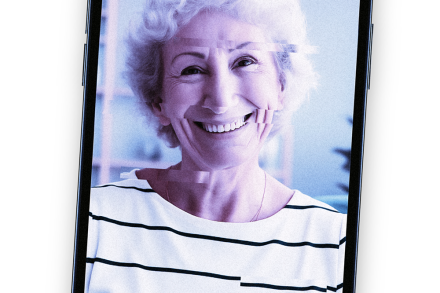
Doing the rounds on social media is the most disturbing advert I’ve ever seen. And I’m telling you about it because you need to be forewarned, just in case this Christmas a child or a grandchild happens to mention that it might be an idea to record a video for posterity, and opens the 2wai app. 2wai is the company responsible for the ad, and the service it offers is the creation of AI versions of family members so that relatives can talk to them after they’re dead. Catch ’em while they’re still alive, says 2wai; film a three-minute interview and Bob’s your AI uncle. ‘Loved ones we’ve lost can be part of our future.’ That’s its catchphrase. The 2wai advert is about ‘Baby Charlie’, and it goes like this.

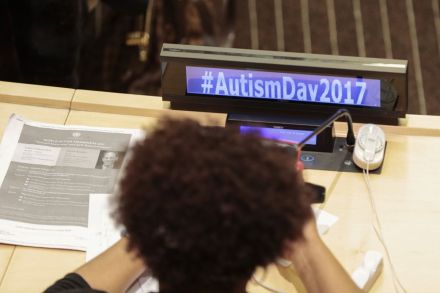
The reality of raising an autistic child

Although I disagree with Donald Trump’s and Robert F. Kennedy Jr.’s suggestion that mothers who took Tylenol during pregnancy may have caused the huge rise of children born with autism in the US, I also can’t agree with the spate of articles and interviews that have followed – several by high-functioning autistic adults, others by parents of autistic children – basically saying it is great to be autistic. I understand that they are fearful that Trump’s idea of a “cure” could result in anyone with special needs being regarded as subnormal and a second-class citizen, but it’s not helpful, either, to pretend that autism is without its many frightful drawbacks. My son, 42, was diagnosed with Asperger syndrome on his 13th birthday in 1996.

autistic

Bring back the big family

From our UK edition

As a species we are richer than we’ve ever been before. We live longer. We have more food to eat than is good for us. We have abundance in all things. And yet we are no happier than we were. In fact, many of us are downright unhappy. Among our woes is an epidemic of loneliness. Some 8.4 million of us are now living alone in Britain, and more than 3.8 million report being chronically lonely. We lock up more people in our prisons than ever and we can see for ourselves the signs of friction in our society, one which is clearly not entirely at peace with itself. So somewhere we have gone wrong. And I think I know where. It’s our families. They are simply too small. The average number of children born per woman in England and Wales has fallen to 1.

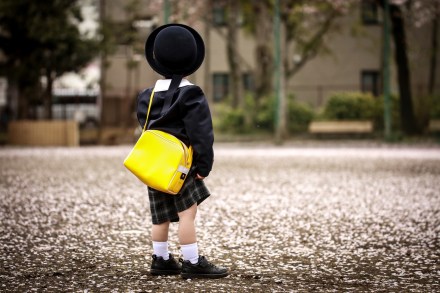
Back-to-school photos have become a vulgar wealth flex

From our UK edition

How was National Standing on Doorsteps Week for you? For most, it’s a case of grabbing a picture two or even three days after la rentrée, when you remember that you’ve missed the annual obligation to record the progress of what Mumsnetters call the ‘DCs’ (darling children). Assemble them by the front door, roar at the one who’s kicking off to SMILE and look at ME, lament that you failed to get your sons’ hair cut before they went back as overnight they’ve come to resemble Hamburg-era Beatles, press the button and then bundle them into the car.