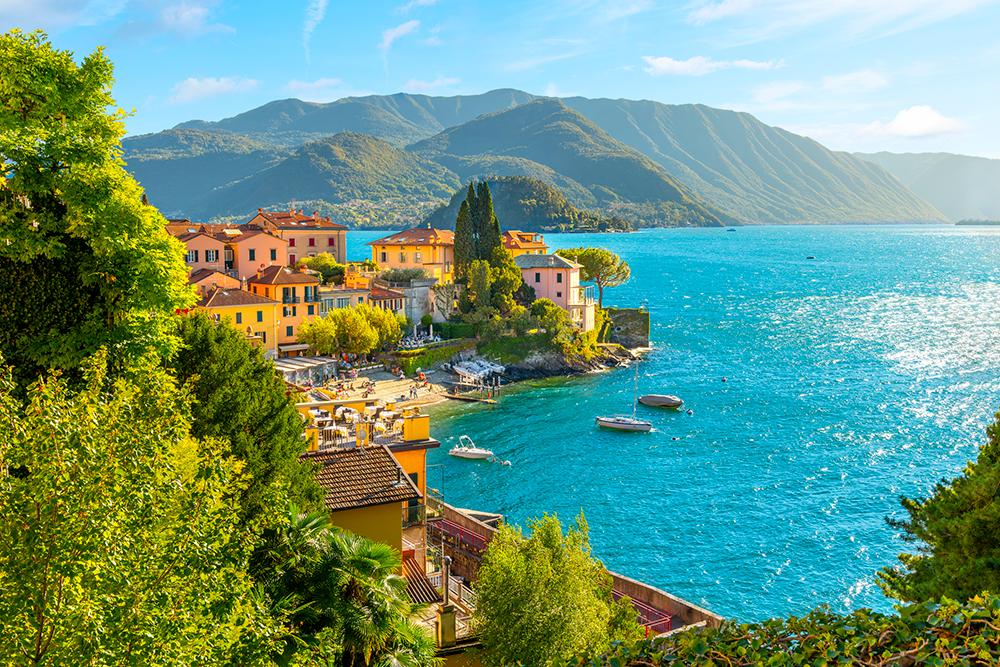
Lake Como
It doesn’t take long for me to fall in love. A young Adonis with a six-pack bounced on a trampoline, his dark curls flapping like spaniels’ ears. Waiters flitted about with drinks. Ridiculously attractive couples, all with perfect bodies, lounged on the beach in front of us, rosé on ice to hand.
We’d arrived by water, fetched by a barefoot beauty in an Albergo Aurora-branded white polo and batty riders, who helped our party of five out of our little launch and onto the Albergo’s riva as if not only our lives depended on it, but her job too.
Something about Italy, everything about Lake Como, makes one feel a teeny bit classy, a bit Grace Kelly on the Corniche, even if it’s only in those few seconds when one’s stepping onto a creaky wooden pontile in greedy expectation of a serious lakeside lunch.
There must be a word for it, a German word probably, which expresses that syndrome often experienced by serial enthusiasts with short attention spans like me. Within a day or so of meeting you’re head over heels and, suddenly, the rest of your life makes perfect sense and at last you can see the road ahead.
But I wasn’t thinking about divorcing Ivo for the young god on the trampoline. No, as I clamped my jaws around my second bruschetta, I was already planning the sale of our London house and moving to Lake Como. After lunch, I made Mr M show me by boat all the possible properties on the lake. ‘This one you have 300 steps to the road,’ he’d say, as I lusted after some terracotta treasure-house. ‘Surely,’ I said, ‘people sell up when they can’t manage all the steps?’ ‘Properties rarely come up,’ he said, as we zoomed by palazzi, Renaissance villas and 18th-century masterpieces in terraced parklands. He told me that he’d once asked an old man who lived in a modest two-bed how much he wanted for it. The man had eyed the Inglese. ‘Four million.’ That was almost ten years ago. ‘But I don’t want anything grand,’ I said unnecessarily, as if I could afford even a lock-up garage on the lake.
‘Houses almost always stay within families, but I know something that might be for sale…’ We crossed to the eastern shore, and there it was. The latest object of my desire. A stone house on the water. Four serious, black-shuttered windows gazed out at me as if to say, here I am. Pliny loved this place so much he bought several villas – what was stopping me from having one?
Then I started considering the downsides. Did I want to live in Italy when, let’s face it, I couldn’t live in Italy, thanks to the persuasive campaign to leave the EU championed ten years ago by my own brother, and Brexit constrained my sojourn in EU countries to 180 days a year?
By the time we moored up I had cycled through the next few years. I’d sell London to buy a fixer-upper on Lake Como… I’d be broke… I wouldn’t make friends as I couldn’t speak Italian. It would be like when Londoner Daisy Waugh moved to Bath only worse, I warned myself.
Out loud, I reassured my host. ‘Don’t worry, I can already see the headline on one of the very long features I’d doubtless write,’ I said, ‘Go lago and go home: how I moved to Como and it all went wrong’.
We crossed to the eastern shore and there it was. The latest object of my desire. A stone house on the water
I know there’s no fool like an old fool, but the good news is… I can fall out of love just as quickly.
A postscript on love, and loss. The news that Rod Liddle has died has cast a black cloud over the high summer of the fourth estate. He was a hero for everyone who loathes cant and fudge and loves brave, funny and razor-sharp writing.
He could make any subject intoxicating. He was a journalist of unmatched dash, had the biggest balls in the business and no subject was too delicate or dangerous for him to flay with his verbal scalpel. As well as being a compulsive writer, he was a wildly funny speaker and broadcaster, and had a sort of X-ray vision when it came to people. He knew the wrong ’uns and he was never shy of letting people know who they were.
I had the absolute privilege of working for Rod for a spell at the BBC when he was my editor at the World Tonight. He knew better than I did that I’d file a much finer report if he sent me off to stay in a yurt with an eco warrior named Shane than if I went to a press conference at the Institution of Mechanical Engineers, and he was the first to tell me, I’m afraid, that I needed to ‘put more of myself into my reporting’.
So I blame Rod for everything that followed as a freelancer after I left the impartiality and impersonality and security of a staff job at the BBC. And, yes, everyone on the team was in love with him, male or female, in some way, too. He was like pure oxygen in our stuffy office where most reporters were delegated to make ten-minute packages on who cares for the carers, or fairground safety.
As well as a hero, he was a heroic leader, an Alcibiades of the BBC, with star quality and charisma oozing from every nicotine-stained pore.
I know Rod was 66 but, as Rimbaud said, those whom the gods love die young. The world of newspapers and The Spectator is a poorer, sadder, greyer place without him. No, the world is. He is irreplaceable.



Comments