Facebook

My lesson in misery from an anti-AI march

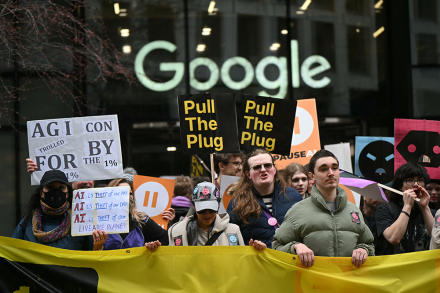
Automation is about to take over the world, apparently. But the fightback has begun. On a cold, blowy day a few weeks ago, I joined a stop-the-bots demonstration that marched through the Knowledge Quarter of King’s Cross where Facebook and Google have their headquarters. A group of 100 activists gathered on Pentonville Road for a warm-up rally addressed by a charismatic young woman in a leather skirt. ‘Can we trust the tech bros with our data?’ she cried into the mic. ‘No! Do we need regulation now? Yes we do!’ She congratulated us for ‘making history by joining the largest anti-robot march ever’. And she promised us a hot meal afterwards. ‘Who doesn’t like free food? No one. Am I right?’ The crowd didn’t reply.

Why is it impossible to make good coffee at home?

It was when I was staying recently with the Frums in D.C. that, for a dizzying moment, I thought my life-long quest had ended. Nasa can fly us a quarter of a million miles to circumnavigate the moon but nobody has yet, to my knowledge, fixed the perennial problem of making an even half-decent cup of coffee at home. Back to the Frum residence in Georgetown, known inside the beltway as ‘the best hotel in Washington’. It is 8.30 a.m. There is no sign of Danielle, my hostess, but David is at large on the landing, perhaps as he had heard his house guest stir.  ‘Coffee?’ he asked. To my amazement, he flung open some doors outside his master bedroom suite to reveal an entire separate walk-in closet complete with serried rows of glass mugs and a space-age espresso machine.

Petty, malicious and tremendous fun – the Facebook office drama

Careless People, Sarah Wynn-Williams’s account of her time at Facebook, has landed top of the New York Times’s bestseller charts and fourth in the UK’s Sunday Times equivalent. It owes its success in large part to a ferocious campaign that Meta – Facebook’s parent company – waged against it on publication. When Meta faces a barrage of public criticism, which it often does, it typically stays quiet and gets on with things. And that approach works – its share price has continued to soar despite scandal after scandal. So when the company not only published a series of furious denials but also had staffers post about the book on their personal social media feeds, and even launched a legal action to prevent Wynn-Williams promoting it, people started to take notice.

Who trusts their savings with the government?

Working out the Kinks American singer and vegan activist Moby called the Kinks’ song ‘Lola’ ‘transphobic’ and ‘unevolved’. According to the band, the song was based on a real incident when their manager, Robert Wace, spent the night dancing with a cross-dressing man in a bar in Paris, was alerted to the stubble on his dancing partner’s chin but replied that he was ‘too drunk to care’. The band admitted they did attract such attention because of their name, which was supposedly inspired by their dress sense. As for the name Lola, it had different connotations at the time, as the name of a racing car marque which featured in motor races during the 1960s.

Have we all become slaves to algorithms?

Here I am, a human, recommending Kyle Chayka’s book about the negative impact of algorithms on our culture. Hopefully that will calm him down a bit, because he worries a lot, possibly far too much, at least as it seems to someone who is less online. Chayka is a staff writer at the New Yorker and he is concerned about the effect of the Filterworld, his word for the ‘network of algorithms that influence our lives today, which has had a particularly dramatic impact on culture and the ways it is distributed and consumed’. He is referring to the songs Spotify cues up, the films Netflix suggests, the stories Facebook feeds its users, the broken flush of TikTok videos.

Zuckerberg’s curious confession

Well, there you have it. Mark Zuckerberg, CEO of Meta, has confirmed that Facebook did indeed censor news of the New York Post’s 2020 Hunter Biden laptop story. But The Zuck had a rather curious tale to tell. Appearing on The Joe Rogan Experience, Zuckerberg was questioned by Rogan on Facebook’s approach to fake news and misinformation. In the discussion, the question of Hunter Biden’s laptop arose.

I’ve been bitten by the TikTok bug

In theory TikTok knows nothing about me. I have posted two videos: one of my grandsons kicking a football in a garden, the other of their much younger selves running through the dry desert house at Paignton zoo. They are the most unremarkable clips imaginable. The last time I looked, the football being kicked in the garden had been watched 3,700 times and ‘liked’ by 650 people. Astonishing. Apart from those two videos, I haven’t posted. My grandsons love TikTok. They are on it every day. They post videos of football cards they have collected and the ones they want to swap. Except when my grandsons post one, I never press the red heart to ‘like’ a video that appears on my daily feed.

Boris is about to give Silicon Valley censors more power than ever

Four years in the making, the Online Safety Bill has now been sent to senior ministers for review — a process that allows them to protest, to shout if anything obvious that has been missed. In this case, the process is invaluable because something huge has been missed. The Bill, if passed, would empower the Silicon Valley firms it’s designed to suborn. It would formalise and usher in a new era of censorship of UK news — run from San Francisco. This Bill would backfire in a way that its Tory advocates have so far proven unable to understand let alone address. That’s why it needs to be halted, and a rethink ordered. The original aim is to make Facebook, YouTube, Twitter and others liable for any genuine filth promoted online.

Why windfall taxes are a rotten idea

Annual profits of £9.5 billion at BP this week followed a £20 billion jackpot at Shell last week, thanks to soaring global wholesale energy prices that BP boss Bernard Looney recently said had turned his company into a ‘cash machine’. For the very same reason, Ofgem has announced a 54 per cent (roughly £700) increase in the energy price cap for 22 million UK customers, while the Chancellor is scrabbling to keep at least some of those households out of ‘fuel poverty’ by offsetting half the rise with a £200 energy discount, to be recouped over five years, plus a £150 council tax rebate.

The good and bad news about the Online Safety Bill

If you care about free speech, the just-published report of the Joint Committee on the Online Safety Bill – a cross-party parliamentary committee composed of six MPs and six peers – is a mixed bag. This is the Bill which began life as a White Paper under Theresa May. Its aim? To make the UK the safest place in the world to go online. It will achieve this by subjecting social media platforms and internet search engines to state regulation, empowering Ofcom to impose swingeing fines on companies that fail to observe a new ‘duty of care’. Let’s start with the good news.

Don’t let China’s climate sins cloak its crushing of Hong Kong

China’s failure to bring anything new to COP26 surprised no one. The world’s worst carbon emitter offered no advance on President Xi Jinping’s earlier promise to reduce coal use after 2025 and bring overall emissions to a peak in 2030 — thereby negating for at least a decade much of the rest of the world’s efforts to clean up the planet. But spotlighting China as a climate sinner should not be allowed to cloak its other villainhood, as an abuser of human rights: so let’s not forget Hong Kong. The fate of the once-British enclave and its future as an international business centre have been much on my mind lately.

Are we ready for the metaverse?

Facebook has rebranded itself as Meta and last month chief executive Mark Zuckerberg announced the creation of 10,000 jobs to help build the ‘metaverse’ — a concept so radical nobody yet knows what it really is. People in the media tend to describe it as ‘a 3D version of the internet’. Facebook describes it rather vaguely as a network of ‘virtual spaces where you can create and explore with other people who aren’t in the same physical space as you’. Some suspect it might actually be hell. The term metaverse first appeared in Neal Stephenson’s 1992 novel Snow Crash, in which future humans distract themselves from economic collapse by submerging themselves in a parallel virtual reality world.

The tragic embarrassment of Sir Nick Clegg

If you thought Nick Clegg's career reached its nadir with the 'I'm sorry' video then think again. The former Deputy Prime Minister is re-enacting the stunning success of his political career out in Silicon Valley where he's paid £2.7 million a year to sell his soul to Mark Zuckerberg, Sheryl Sandberg and the rest of the Facebook – today rebranding as Meta – cabal. Whereas Sir Nick is all too familiar for us here in Britain, Americans were not au fait with the former Lib Dem leader when he was appointed as vice president of the social media behemoth back in 2018. But all that has changed in the last month, with Clegg becoming a familiar face to millions stateside thanks to his near-constant cringing appearances on American networks.

Frances Haugen: a very convenient whistleblower

Facebook wants to move its business model towards the metaverse, that virtual future in which we will all hang out online through headsets and pretend it isn’t weird. The trouble is, we already appear to live in an alternate reality created by communications specialists with highly political agendas. Just look at the clearly PR-orchestrated Online Safety vs Facebook story which the media is playing out before our non-digital eyes. This week’s protagonist is Frances Haugen, the former Facebook employee who appeared yesterday in parliament to give evidence to MPs scrutinising the Online Harms Bill. That is the bill through which the government says it intends to regulate social media companies to stop online hate, bullying, terrorist radicalisation and so on.

A new name isn’t enough to save Facebook

Mark Zuckerberg emerged from his walk-in T-shirt closet last week to make a stunning announcement: Facebook will be changing its name. And while we don't yet know what the new name will be, I think I may be able to help here. How about this: Boomerware? Or in keeping with Silicon Valley's penchant for trendy misspellings: LyfeSuck? Or instead of a name, there's just the sound of Rome burning? The reason that ‘Facebook’ is getting retired, per Zuck, is that he wants to ‘transition from people seeing us as primarily being a social media company to being a metaverse company.’ What that means is that he's trying to distance himself from Facebook and Instagram, the very brands he owns.

Nick Clegg’s Facebook nightmare

There have been many ironic fates for the lead actors in the Coalition government. For David Cameron, the premier who pledged to 'clean up' the 'culture of excessive lobbying' there was the Greensill scandal. For George Osborne, the austerity Chancellor who decimated the culture sector, there was a smorgasbord of jobs and the chairmanship of the British Museum.  Chris Huhne was jailed, Oliver Letwin lost the whip while Danny Alexander, the Chief Secretary to the Treasury, now works at the Asian Infrastructure Investment Bank – an institution used to front China's 'Belt and Road Initiative.' But none of these have been as both paradoxically high-profile and humiliating as Sir Nick Clegg's strange parliamentary after-life as vice-president of Facebook.

Facebook’s empire is beginning to crumble

When empires crumble they slide slowly at first, then the temple walls come crashing down. Facebook is not quite at the latter stage yet, but you can hear the creaking in the pillars and lintels. This week, the social media giant suffered two blows: an outage which took down its platform, along with Instagram and WhatsApp, and an expose by a disillusioned ex-employee who accuses the company of saying one thing about social responsibility in public – while behaving quite differently in private. Many of us might not notice if Facebook suddenly wasn’t there. But it is a different story for the many businesses which have built their model on the back of selling via Facebook or Instagram.

WhatsApp collapse throws Tory plots into chaos

The world’s oldest democratic party has had a few problems with technology in recent years. Famously it was the 2018 Tory conference which saw a security breach where the official party app allowed anyone to access the private phone numbers of members of the Cabinet – or in the case of Boris Johnson change his profile picture to that of a pig. Once again, tech issues are plaguing Tory conference, with three of the world’s most popular apps – Facebook, Instagram and WhatsApp – all being offline since 4:30 p.m. today. The last of these is the favoured platform for disloyal backbenchers and scheming hacks to conspire mischievously to make life harder for long-suffering Tory whips.

The rise of Taliban Twitter

The Taliban takeover of Afghanistan was swift, but this victory wasn't won overnight. For years, the Taliban has been waging a softer fight: one on social media. Since it was removed from power, the Taliban has dedicated enormous resources to developing its presence online.  As it successfully recaptured Afghanistan, the propaganda opportunities which it put to use on Twitter as the eyes of the world watched suggested these efforts have paid off. Images and videos of Taliban forces easily gaining ground and advancing into Afghanistan’s cities – picking up military hardware left by the Americans along the way – spread like wildfire online. Islamists around the world were delighted.

Beware Boris’s sinister crackdown on free speech

A Conservative government that boasts it is a defender of free speech against the attacks of 'the woke' is about to impose the severest censorship this country has seen in peacetime since parliament abolished press controls in the 1690s. In an extraordinary power grab – which is all the more extraordinary for the absence of opposition – ministers want to silence views that carry no criminal penalty. This is more than a much-needed crackdown on racial attacks on black footballers or incitements to violent crime or any other crime; it is an unmerited attack on free speech. The government’s draft Online Safety bill imposes a ‘duty of care’ on internet companies to remove content that may cause ‘psychological harm’.