Eno

Pole position | 5 October 2017

From our UK edition

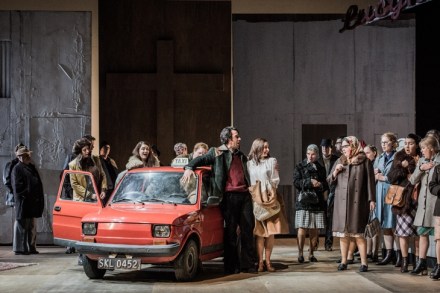
Did you know that they used to make the Fiat 126 in the Eastern bloc? They did, apparently. There was a plant at Bielsko-Biala, and the car was widely driven throughout Poland in the 1970s, when you only had to wait a couple of years to buy one. It became an emblem of personal freedom, and Poles even gave it a nickname: Maluch, or ‘little one’. That’s the principal insight that I gleaned from director Karolina Sofulak’s decision to set Cavalleria rusticana in communist Poland. She explains her thinking in the programme book: essentially, 19th-century Sicily was Catholic and repressive, and 1970s Poland was Catholic and repressive, so why not? Cue the latest one-size-fits-all operatic design cliché — fastidiously rendered depictions of 1970s squalor.
Denial has rarely looked so good

From our UK edition

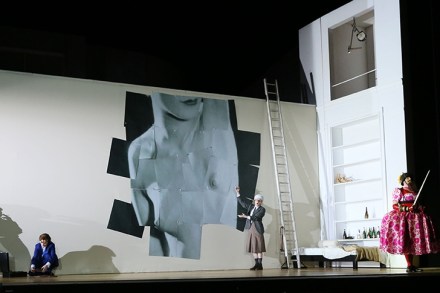
Ceci n’est pas une Partenope. Forget the warring classical kingdoms of Naples and Cumae: this is surrealist Paris in the 1930s and imminent invasion is the stuff of conversational parenthesis, barely worth interrupting a rubber of bridge for, let alone an embrace. Man Ray, Lee Miller and their androgynous associates slink and affect their way around a monochrome salon with its suggestively curved central staircase, offering up the performance of themselves as a living exhortation to make art, not war. As a response to Handel’s most Shakespearean of comedies, Christopher Alden’s production is inspired — more now, if anything, than in 2008 when it was new.

Fatal distraction

From our UK edition

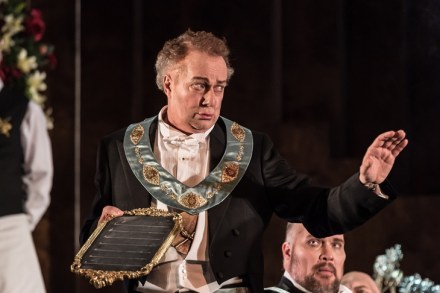
I don’t think that I have left a theatre many times feeling as depressed and irritated as after the Royal Opera’s Die Meistersinger, in the new production by Kasper Holten. The run of the Royal Opera’s recent productions of Wagner — appalling Tristans, a dire succession of Parsifals, mediocre Rings — hadn’t prepared me for so deep an abyss of irrelevant idiocy as this. I thought I had reached the stage where, having seen so many fearful operatic productions of works I love, I was able to enjoy myself purely on account of the music, almost inured to what I was seeing.

Statue-esque

From our UK edition

Why set a supremely great play to music? The Winter’s Tale, the play of Shakespeare’s that I love most, has much of his most beautiful and intelligent poetry, as well as some of his most condensed and puzzling lines. Ryan Wigglesworth, in several of the innumerable interviews about his new opera, says he has been obsessed by the play for decades. So have I, but if I were a composer I think that would be a reason for leaving well alone. Wigglesworth has made his own libretto by using snippets of Shakespeare, enough to remind one of the original, but frustrating, most of the time, in producing a strip-cartoon version of the text. The idea, presumably, is to amplify this telegrammatic digest with the music.

British sea power

From our UK edition

The story so far: in 1986 English National Opera hired Jonathan Miller to direct Gilbert and Sullivan’s The Mikado. The result was so fresh and funny that it’s been a mainstay of the ENO schedule for more than three decades, to the indignation of hardcore opera fans who can’t understand why audiences keep flocking to hummable melodies and humour instead of, say, Berg’s Lulu. Attempting to repeat the formula, ENO then made the rookie error of engaging Ken Russell who, being Ken Russell, promptly updated Princess Ida to the 21st century and set it in a futuristic sushi bar. Finally, in 2015 they entrusted The Pirates of Penzance to Mike Leigh, whose G&S biopic Topsy-Turvy seemed to guarantee a safe pair of hands. Good call.

Death rattle

From our UK edition

The Barbican website warns us that Ligeti’s opera Le grand macabre ‘contains very strong language and adult themes’. The strong language consists of the four-letter words that are known to everyone and used by most people, and the adult themes are sex/love and death, which this opera has in common with almost any non-comic opera you can think of, and without which the genre would certainly never have been conceived or added to over more than four centuries. But while love and sex have often also provided the stuff of comedy, death is another matter, and presumably it is Ligeti and Michael Meschke’s robust treatment of this (superbly translated into English by Geoffrey Skelton) that we might need to be warned about.

Safe and sound

From our UK edition

This week the Southbank Centre began its ‘Belief and Beyond Belief’ festival — a series of concerts and talks claiming to explore the influence of religious inspiration on music. Last summer, after reading its miserably right-on publicity material, I wrote in this column that ‘Beyond Parody’ might be a better title. Jude Kelly, the Southbank’s artistic director, accused me of jumping to conclusions before the programme had been finalised. Well, now it has. In addition to concerts with no discernible connection to their composers’ faith, we’ll be treated to ‘How to be a Shaman’, ‘Mindfulness’, ‘What If God Was A Woman?’ and ‘Right to Die?’.

Giving it both barrels

From our UK edition

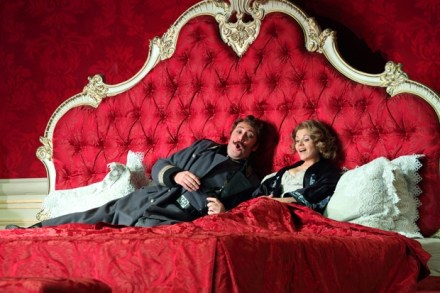
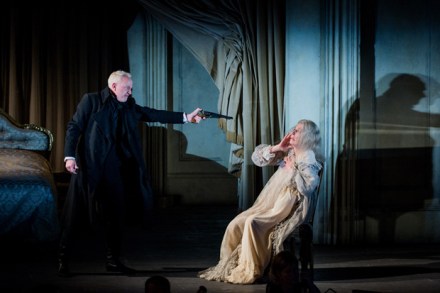
In Joseph Roth’s The Radetzky March, the ageing Emperor Franz Joseph regrets the drab field-grey that has replaced his army’s once-colourful uniforms, seeing in it a premonition of an empire — a world — soon to be defeated and broken up. Franz Joseph is present in Act One of Robert Carsen’s new production of Der Rosenkavalier, right there in the Marschallin’s boudoir: I counted at least four portraits of the old man, gazing phlegmatically down on the sexually charged capers below. And the men in grey are there too. In Carsen’s conception, Baron Ochs and his yobbish retinue are cavalry officers, plotting on one side of the room, while on the other gorgeously dressed fashion models resembling drawings by Erté parade and pose.

Sinful treat

From our UK edition

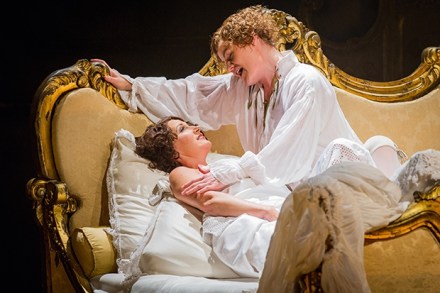
Shiny swags of gold cloth hang in front of the curtain before David McVicar’s production of Der Rosenkavalier, and that’s good. You want a touch of luxury in a Rosenkavalier. This is 20th-century opera’s great sinful, indulgent treat. Think of it and you think of Karajan and Schwarzkopf: huge creamy voices, silken Viennese strings, and New York Met production budgets. In truth, when Der Rosenkavalier gets under your skin, none of that matters. It’s not the glittering set pieces that turn out to be the real heart of the thing; not even the final Trio or the justly famous sequences in which the Marschallin ponders the transience of youth.

Hole in the heart | 6 October 2016

From our UK edition

Richard Jones’s new production of Don Giovanni at ENO bears some passing resemblances to the opera as envisaged by its librettist and composer. Mainly, however, it goes its own way, refusing most of the time, especially at key moments, to listen to the music Mozart wrote, with consequences that Jones no doubt regards as ‘creative infidelity’. When we enter the auditorium we see a contemporary streetlight and a phone booth, straight out of Jones’s production of Siegfried at the Royal Opera 20 years ago. The curtain rises on a huge ‘Wanted’ poster of Christopher Purves, followed by a depressing series of bleak rooms, in one of which the Commendatore is bedding a prostitute and wearing white boxers, signifiers of nudity at ENO.

Pole apart

From our UK edition

Alas, poor André Tchaikowsky. A survivor of the Warsaw Ghetto, with an assumed name that probably did his musical career as much harm as good (he was born Robert Andrzej Krauthammer), he died of cancer in 1982 shortly after his only opera, The Merchant of Venice, was rejected by ENO. He’s remembered today principally for bequeathing his skull to the Royal Shakespeare Company for use as a prop, in which capacity he starred alongside David Tennant in Hamlet in 2008. That skull had a tongue in it and could sing once.

What’s love got to do with it?

From our UK edition

Tchaikovsky’s The Queen of Spades is probably his greatest opera, certainly the one in which his characteristic strengths are on display. Pondering on them inevitably leads one to think about what the operas lack, too, and it turns out be quite a lot. Unlike the finest opera composers, of whom there are regrettably few, he can’t create complete characters: what he is interested in is characteristics, especially — or perhaps only — obsessions, even if the obsession, as with Eugene Onegin, is with not being obsessed with anything, until close to the end.

Wardrobe malfunction

From our UK edition

It is at the Coliseum that I have seen the most wonderful Tristan and Isoldes of my life, both of them under Reginald Goodall, in 1981 and, even more inspired, in 1985. Neither was particularly well produced, but nothing stood in the way of the musical realisation, as complete as I can ever imagine its being. After last year’s quite glorious Mastersingers, I had the highest hopes of Edward Gardner’s conducting of this new production, but they were dashed — in the case of the music, not drastically; but the idiocy of the costumes and the production is so gross that no performance could survive it. The settings are fashionably by Anish Kapoor, but though they aren’t repulsive they do nothing to help our understanding of the drama.

Divine comedy | 12 May 2016

From our UK edition

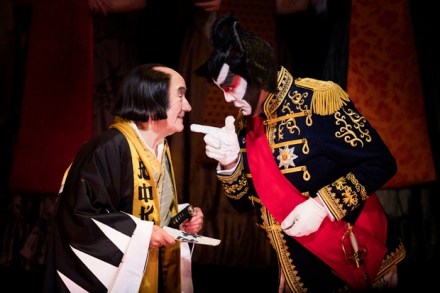
You have to be quite silly to take Gilbert and Sullivan seriously. But even sillier not to. G&S is still a litmus test for a particularly British type of operatic snobbery: ‘Is there a place for Gilbert and Sullivan in the 21st century?’ asked a Radio 3 presenter last year, about the time that ENO’s new Pirates of Penzance broke all audience records for live cinema relays in the UK. The Royal Opera, of course, won’t touch it. Which, considering how comprehensively it botched Chabrier’s L’Étoile, is probably just as well. Scottish Opera’s new Mikado is very silly indeed. Nanki-Poo (Nicholas Sharratt) simpers and lisps like Gussie Fink-Nottle. A puppet bird flaps its wings to ‘Willow, titwillow’.

Close encounter | 7 April 2016

From our UK edition

Sunset Boulevard is a tale of fractured glory with Homeric dimensions. The movie presents Hollywood as a never-ending Trojan War that attracts fresh generations of dreamy youths in search of conquest and treasure. The lead characters have retired from battle, wounded. Joe Gillis, like Odysseus, is a vagrant warrior ensnared in the island-mansion of Norma Desmond, who plays the role of broken-queen-turned-sorceress. These fabulous elements are preserved in Andrew Lloyd Webber’s musical version. So is the Norma-Joe affair, with its distasteful emotional template: mother-son, boss-slave, mistress-poodle, crone-toyboy. The lovers are linked by nothing but neediness and failure, and each desires the mirage that the other represents.

Round-up of new opera

From our UK edition

A mixed year so far for new opera. A few really dismal things have appeared from people who should know better. Did the world really need an operatic treatment of Dante’s Divine Comedy for orchestra and chorus? Louis Andriessen thought so; his La Commedia (2004–8) luckily only reared its drab head for one night at the Barbican. If you’re going to splurge as much money as opera often has to splurge, you have to ask yourself why. If you don’t, you create a situation in which operas come about merely because they can, often just to continue the tradition in the most inoffensive way possible. ‘Don’t mind me!’ says this kind of zombie opera.

…Long live ENO!

From our UK edition

The three most moving, transporting death scenes in 19th-century opera all involve the respective heroines mounting a funeral pyre — partly, no doubt, a matter of operatic convention and fashion, but also recalling opera to its duty as a rite of purification. Berlioz’s Didon in Les Troyens, like her creator, is so relentless in her grasp of the truth that she fails to achieve anything but a vision of Carthage overcome by Rome, and ends in despair and execration. Brünnhilde in Götterdämmerung rides into Siegfried’s pyre in a state of ecstasy, imparted to the audience with all Wagner’s unlimited capacity for exaltation.

ENO must go…

From our UK edition

Last week Darren Henley, chief executive of Arts Council England, revealed that opera receives just under a fifth of the Arts Council’s total investment in our arts organisations, which amounts to many millions of pounds. Yet it accounts for ‘between 3 and 4 per cent of live audiences in theatres’. How can these figures possibly be justified? Especially when the art form is so obviously a plaything of the wealthy. Once upon a time there was an organisation that had the intention of providing opera at reasonable prices to the less well-off. It was based in a poor part of London, where it pursued its ideals by presenting everything in English and emphasising the dramatic aspect of its chosen repertoire.

Mozart magic | 11 February 2016

From our UK edition

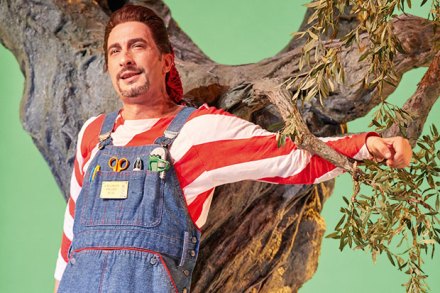
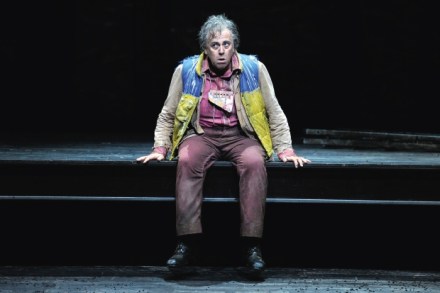
Centre stage, there’s an industrial-looking black platform, secured by cables. The Three Ladies snap the unconscious Tamino on a mobile phone. The Three Boys look like Gollum in a fright wig. And Papageno, dressed as an ageing vagrant, simulates urination (at least I hope that’s what it was) into an empty wine bottle. Simon McBurney’s production of The Magic Flute could have been designed to raise the collective blood pressure of Against Modern Opera Productions, the Zeffirelli-worshipping Facebook group that’s opera’s equivalent of the Mail on Sunday letters page.

Barometer | 11 February 2016

From our UK edition

Matters of life and death Lord Lucan is now officially presumed dead. How do you have someone declared dead? In England and Wales, under the Presumption of Death Act 2013… — Anyone can apply to have anyone else declared dead, but if the applicant is not a spouse, civil partner, parent, child or sibling of the presumed deceased they must show they have a significant interest. — The person should have been missing for at least seven years, but it is possible to have someone declared dead earlier if the court is convinced they have died. — It costs £480. — An order can be revoked if the person later turns up alive, but that will not reinstate a marriage or civil partnership. — The act cannot be used in the instance of a missing monarch.