Energy

Whatever Chris Huhne says, Durban hasn't changed anything

This morning the Department of Energy and Climate Change (DECC) told us that the climate summit in Durban, which concluded over the weekend, has been ‘heralded a success’. As they say, the ‘talks resulted in a decision to adopt the second commitment period of the Kyoto Protocol next year in return for a roadmap to a global legal agreement covering all parties for the first time’. Should anyone be heralding that as some kind of step forward? Was I wrong to be sceptical last week? As it happens, the various parties were actually trying to secure that ‘global legal agreement’, covering all of them, two years ago in Copenhagen —

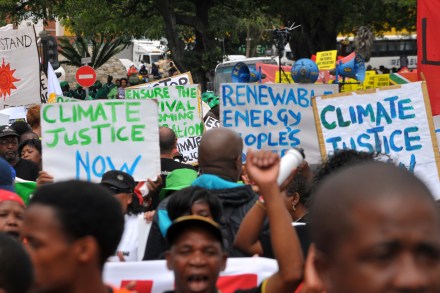
Disappointment in Durban

Will Durban break the cycle of climate change meetings that repeatedly disappoint those hoping to replace Kyoto with an upgraded model? With so much else on, most people seem to be ignoring the latest summit entirely. Scanning the major newspaper websites, only the Guardian and the Independent mention “Durban” on their homepages.    First Copenhagen failed to live up to the massive hype. Then Cancun continued the stalemate on the big picture and negotiators contented themselves with addressing some relatively minor points. But Kyoto’s commitment period ends at the end of 2012, so those hoping for new mandatory targets can’t content themselves with stalling forever.   Despite the scale of

An open letter to Chris Huhne

Earlier this year, the former head of the civil service, Lord Turnbull, wrote a pamphlet on climate change entitled The Really Inconvenient Truth or “It Ain’t Necessarily So”. It was praised by Nigel Lawson, writing its foreword, as a ‘dispassionate but devastating critique’ of global warming alarmism — and it is a critique that Chris Huhne saw fit to respond to earlier this week, in a letter to the ennobled pair. Well, now they’ve responded in turn, via the open letter below, and we thought CoffeeHousers might care to see it: Dear Secretary of State, We are pleased that you have decided that a public response to growing criticism of

What does the ‘carbon floor price’ mean? More emissions and fewer jobs

After the Conservative Party Conference, Fraser described this statement in George Osborne’s speech as the Osborne Doctrine: ‘Let’s at the very least resolve that we’re going to cut our carbon emissions no slower but also no faster than our fellow countries in Europe.’ The Government’s current climate policy clearly fails that test, as I set out for this site at the time, and there is no more egregious violation than the carbon floor price. It is one of those policies that can sound reasonable in theory: the EU Emissions Trading System creates a carbon market. That market produces a carbon price that is supposed to encourage business to invest in

The policies behind your energy bills

It may be a week old, but last Monday’s episode of Panorama really is worth putting half-an-hour aside for, if you haven’t seen it already. Its subject was energy prices, and it raised some very urgent concerns about the government’s policies in that area. You can watch it on the BBC site, but here’s a brief summary in the meantime. All in all, switching our dependence away from coal and oil is going to be enormously expensive. Some £200 billion of taxpayers’ money is to be spent on increasing renewable energy output from seven to thirty percent by 2020. And, because sources like offshore wind costs almost £100 an hour

Why is Huhne still shunning shale?

Chris Huhne’s article in the Telegraph this morning attacking those who think that shale gas can solve Britain’s energy needs is built around a straw man of an argument. Huhne claims that, ‘Some therefore argue that we should abandon everything else and devote ourselves wholly to shale.’ This is, to put it mildly, a dubious claim. Advocates of shale gas don’t want to abandon all other forms of energy, they just want Britain to properly exploit an energy resource which could be as significant for Britain as North Sea oil has been. The Energy Secretary’s aversion to shale is even more puzzling when you consider how keen he is for

The coming world oil order

Following on from Daniel’s post this morning about a more inward looking America, Daniel Yergin has a very interesting essay in the Washington Post about how the changing balance of the US’s energy supplies are going to change its geo-strategic priorities. Yergin makes the point that by 2020, Canada could be a bigger oil producer than Iran and Brazil could be producing more than half of what Saudi Arabia is currently pumping out. Put these developments together with increased domestic energy production in the States itself and the fact that China is on its way to overtaking the US as the world’s largest oil consumer, and the geo-politics of energy

When will MPs wake up to Shale?

It’s just baffling. The House of Commons committee on energy has today published a report entitled “UK Energy Supply: Security or Independence?” with hardly a mention of the 200 trillion cubic feet of Shale gas recently found outside Blackpool. As Matt Ridley wrote recently in his definitive Spectator piece, these reserves – if exploited – are “enough to keep the entire British economy going for many decades. And it’s just the first field to have been drilled.” It may well be that just a fifth of this are exploitable, but there is no mention of this potentially game-changing discovery in the committee’s report today. Instead, we are told that “is

Miliband’s challenge

One of the striking things about politics at the moment is that Ed Miliband is proving adept at spotting issues that are going to become big — think the squeezed middle, energy prices — but is failing to drive home this advantage. There’s scant evidence that, for instance, the voters regard Miliband as the solution to the problem of rising energy bills. I suspect that the coalition’s plans to make it easier for people to switch tariff and supplier will cut through with the public more than Miliband’s speeches on the issue. In part, this is the natural advantage of incumbency — governments can actually do things. But the challenge

The poverty of Britain’s energy debate

How big does Shale have to get before our policymakers wake up to its implications? There is an Energy Summit in No.10 today where Chris Huhne wants to focus on the need “to help consumers save money on their gas and electricity bills”. A preview interview on the Today programme underlined the dire situation. First, Huhne was not asked about how his own green regulations have massively contributed to the problem. Then, the managing director of British Gas was invited on to say that “unless someone discovers huge amounts of gas and imports it into the UK…”. And, yet, one of BG’s rivals recently discovered 200 trillion cubic feet of gas

The green threat to growth

Luciana Berger is a frequent speaker at this year’s conference and her creed is simple: tax energy use to tackle climate change. But, journey along the Mersey, from the glamorous fringe events held on Liverpool’s well rejuvenated quays to the post-industrial wasteland that lies beyond and you discover a different breed of Labour MP. ‘Is the green economy a threat to growth?’ asked Ellesmere MP, Andrew Miller at a seminar earlier this afternoon. Along with his panel – comprised of representatives from the chemical industry, the unions and of Michael Connarty, the MP for East Falkirk and a long-term advocate of the chemical industry – he reached the following conclusion: the current incarnation

Tories hit back at Huhne and his policies

Chris Huhne can always be guaranteed to grate. Several Conservatives have cracked wry smiles at the energy secretary’s comments about the “Tory Tea Party tendency”. Mark Pritchard quipped that plenty of senior Lib Dems would soon be at leisure to throw their own tea parties and John Redwood dismissed Huhne’s cant as conference high-jinks. Redwood went on to challenge Huhne’s policies. Speaking to Sky News, he said he was “happy to hear ideas” about “promoting more competition”, pointing out that competition might reduce prices. Then he added that Huhne “has also got to understand it is his policies that are driving costs of electricity up in Britain because we are

Huhne, the Lib Dems' black comedian

Today we got the black comedy follow up to Sarah Teather’s stand-up routine.  Chris Huhne is going to drive down our energy bills! For those of us wondering how families and businesses can afford his expensive climate policies, it is a bit of a joke. The basic issue – as I set out in the new book Let them eat carbon – is that we need to invest an absolute fortune to meet the range of environmental targets that the government has put in place. Citigroup estimated last September that we need to invest about €229 billion (about £200 billion) in the energy sector this decade.  That is far more

Cameron's energy price headache

The list of things that will be Big Politics when Parliament returns from its summer break is growing all the time: growth, the post-riot clean-up, the undeserving rich, multiple squeezes, and so on. But few will have has much everyday resonance as another item on the list: rising energy prices. This has been a problem for some time, of course, thanks to a toxic combination of trickle-down green measures, oil price spikes, and financial effrontery from the energy companies. But it looks only to get worse. This morning’s Telegraph reports on an internal Downing Street document — entitled “Impact of our energy and climate policies on consumer energy bills” —

Why energy bills will be one of the big issues of the autumn

One of the big political issues of the autumn is going to be energy bills. Among Tory MPs, there’s mounting concern that the coalition’s green policies are driving up the price of energy rather than helping to bring it down. They fear that this is both acting as a drag on the economy and adding to the squeeze on family budgets. So, today’s story in The Times about how a carbon trading scheme—started under the last government—has led to households being charged, on average, £120 more than they should have been in utility bills is going to turn up the political heat on this subject. The paper alleges that: “Energy

Huhne pooh-poohs rising energy bills as ‘nonsense’

Chris Huhne was on the Andrew Marr show this morning. As you might expect on a day when the Sunday Telegraph broke the news that fuel bills will boom by 30 per cent as a result of green taxes, the Energy Secretary was asked to ruminate at length on all matters Murdoch. Eventually, though, Huhne had to answer searching questions pertaining to his brief. Confronted with the Sunday Telegraph’s story, Huhne described it as ‘nonsense’ because it did not take potential savings into account. Huhne also pledged to introduce more competition to shatter the grip that the ‘Big Six’ utility companies have on 90 per cent of the UK’s energy market. Greater

The bear and the euro

Wen Jibao’s comments to the BBC about the euro crisis dramatise the shift in economic power from west to east. Jibao remarked that: “Trust is more important than currency and gold and now, during the debt crisis, we again bring trust to Europe. I have total trust in Europe’s economic development”. But China’s role in the euro crisis is far less problematic than Russia’s. As Stratfor has highlighted, if Russia — or one of its effectively state controlled companies — were to buy a considerable stake in Greece’s gas company DEPA when it is privatised (as it will be as part of the bailout package)  it could render irrelevant the

The green consensus in action

A couple of days ago, I wrote about the deleterious effects of political consensus on energy policy. A good example of this has emerged today. According to Politics Home, Luciana Berger and Caroline Lucas are seeking an amendment to the Green Deal to impose a target for domestic carbon reduction. A number of salient points emerge from this. First, it’s a fine instance of the obsession with targets; itself an indication that this area of policy is largely a top down initiative – driven by targets, taxes and penalties. The Green Deal, as it currently stands, is one of the few areas that put incentive before directive. The idea was

In England's green and pleasant land

What do the TUC, heavy industry and the European Commission have in common? This is not the start of a bad joke; the answer is that they all oppose the government’s energy policy. Ten days ago, Tata (formerly British Steel) announced that it was to cut more than 1,500 jobs at plants in Scunthorpe and on Teeside. The directors later confirmed that their decision was influenced, in part, by the introduction of a costly carbon floor price at the last Budget. The floor price, which exists on top of levies imposed by the EU, has increased the burden of taxation on energy consumption to subsidise renewable energy research. In last week’s

Monbiot’s mission

George Monbiot is undergoing an astounding and very public transformation. Last week he overcame the habit of a lifetime and fully endorsed nuclear power as a safe energy source. He went further this week, attacking the anti-nuclear movement for perpetuating lies and ignoring the consensus around scientific facts. He levels special criticism at the allegedly lax scholarship of Dr Helen Caldicott, a decorated primate of the anti-nuclear communion.  He also debunks the myths surrounding the disaster at Chernobyl and laments that campaigners have abused that tragedy by exaggerating its consequences. Monbiot’s tone is neither arch nor righteous. Rather, he’s disappointed and the piece has a dignified poignancy. He concludes: