Energy crisis

What Trump’s executive orders will do

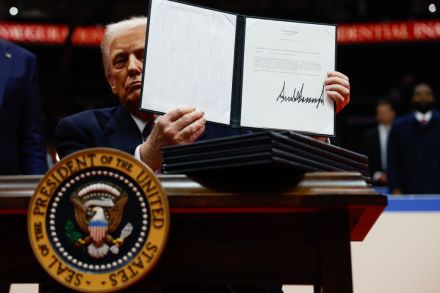
The newly sworn-in President Trump had a busy inaugural day. Between swearing into office and waving a saber around while dancing to “YMCA” at an inaugural ball, he also signed several executive orders and proclamations. After signing his cabinet and other nominations, President Trump’s first order of business was to proclaim that all flags should be flown at full staff for this and all future inauguration days. Following the inaugural parade, President Trump signed a bevy of additional executive documents as thousands of his supporters cheered.
The coming turbulent times in the oil market

When the Wall Street Journal reported on November 21 that OPEC, the oil cartel dominated by Saudi Arabia, was planning to increase production by 500,000 barrels per day in December, the crude market immediately reacted. Oil prices plunged by 6 percent, bringing the Brent benchmark close to $80 a barrel. Saudi energy minister Prince Abdulaziz bin Salman, the older brother of king-in-waiting Mohammed bin Salman, immediately went to work disputing the report. No decisions at OPEC had been made, he said, and it was possible the cartel could even proceed with further production cuts if needed to maintain balance in the market (for the Saudis, "balance" is usually defined as padding the kingdom’s balance sheet). Abdulaziz’s intervention helped make up most of those earlier losses.

oil

WATCH: Germans are dancing to stay warm this winter

The world's eyes have been on America this week, thanks to the midterms. Cockburn, however has been gazing across the Atlantic with amusement. A new dance class is being offered in Germany called "Let’s Move — Tanzt Euch Warm," or "dance yourselves warm," to combat rising energy costs as the temperature falls. https://twitter.com/reuters/status/1590588816716242944 Watching the footage of the chilly krauts cha-cha-cha-ing, Cockburn can’t help but recall former president Donald Trump’s speech to the United Nations back in 2018, where he warned that "Germany will become totally dependent on Russian energy." At the time, the German delegation laughed and shook their heads at what they considered yet another absurd broadside from the American president. https://twitter.

tanzt euch warm

The lesson of 2022: energy is our lifeblood

This has, so far, been a year of hard lessons. Spiraling inflation has given households an expensive economic refresher course. A land war in Europe has offered an unwelcome reminder of old geopolitical and military truths. But arguably the most important lesson of 2022 concerns the point at which these economic, military and geopolitical considerations converge: energy. On this vital issue, the West has suffered from an epidemic of amnesia in recent years. Too often energy security has either been taken for granted by policymakers and voters, for whom the last energy crisis had become a distant memory, or actively disparaged by an environmental movement whose hardline hostility to fossil fuels has become received wisdom in polite circles.

How long can Europe’s support for Ukraine last?

Can Ukraine sustain a war effort that is proceeding far better than most military analysts ever expected? Part of that answer, of course, depends on the extent to which the Ukrainian army can keep their troops in the field equipped, supplied, and motivated. That challenge comes as the Russian military increasingly relies on so-called “kamikaze drones” to strike deep into Ukrainian territory (on October 17, a Russian drone attack killed four people in Kyiv during the morning rush hour). But another factor that will determine success or failure is whether Europe remains onboard — or, more to the point, whether Europe’s support to Kyiv will continue as the war enters a dreary, unforgiving winter.

Democrats pick a bad time to punish the energy industry

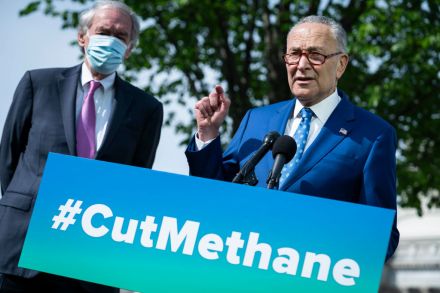
With its new Inflation Reduction Act (IRA), the government is pulling one of those infomercial tricks where they throw in a third bottle of OxiClean ABSOLUTELY FREE! Acting as if the cost of everything hasn’t already been calculated and passed onto the consumer. The IRA, you see, contains a “Methane Emissions Charge” that will impose a $900-a-ton tax on oil and gas producers that will increase to $1,500 after two years. The left is patting itself on the back for their valiant work to cut greenhouse gas emissions drastically by 2030. But here’s the thing: the energy industry is already working hard to cut emissions; it’s in their interest to do so. And when the government fines them for not capturing enough methane, guess who gets to foot the bill?

Biden’s energy policy is sending us toward recession

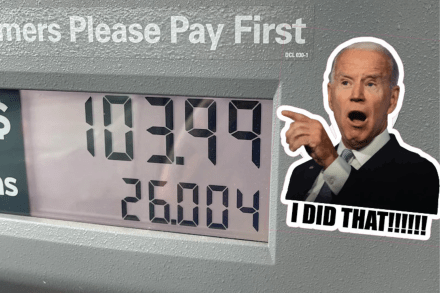
With the travel-heavy Memorial Day weekend upon us, the fast-rising cost of gasoline is getting a lot of attention. Last week, gasoline rose above $4 a gallon in all fifty states. That’s the first time that has happened. Some are predicting gas could reach $6 a gallon this summer. If that comes to pass, the average American family could see a major impact on their budgets. (It might be noted as well, that the price of home heating oil has nearly doubled this year. If that continues, the economic impact next winter, especially in the northeast, where a high percentage of homes are heated by oil, will be considerable.) The threat of a recession is rising thanks to fuel shortages. Why has the price of gasoline risen so far so fast?

gas

Going out on a fossil fuel bender

Covid rates are abating just in time for surging gas prices to eclipse the pandemic as our crisis du jour, and people from both sides of the political aisle are crying out in unison: something must be done! The current energy crisis debate consists of a few camps: one group professes that they can’t abide fossil fuels being used at all, while another can’t imagine living without them. The third group makes up the middle of the Venn diagram, and though a paradoxical state of mind, it contains the most members. Choosing a winner from among the prevailing arguments is no simple task.

oil

Energy is the most important issue in the world

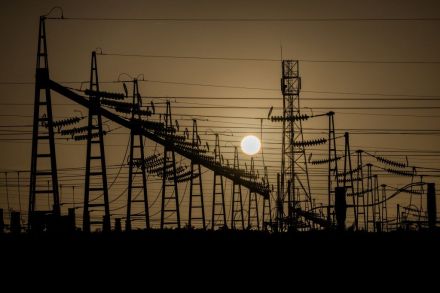
One issue more than any other will dominate airtime and influence policy in 2022: energy. Americans are seeing the highest prices at the pump in seven years. Since Biden took office, average gas prices are up by more than $1 a gallon. In November, gas prices in Mono County, California hit more than $6 per gallon, forcing some residents to drive to Nevada (where gas taxes are lower) to buy fuel. The price of natural gas in the US is at its highest in seven years, and up more than 180 percent in the last year alone. In Europe, the situation is even worse. Europe’s gas reserves are at record lows. In Germany, which already had the EU’s highest energy prices, bills are up 30 percent in a year.

energy