Education

Summer vacation fatigue

Alexandria, Virginia I entered summer with the following list of tasks: convert the shed into an office; discard several tons of debris from the storage room; assemble that Amish treehouse that’s been sitting in the yard; chop down the ash tree. A gust of wind took down the crabapple tree right before the Memorial Day barbecue. On the guest list: my younger brother, who moonlights as an unlicensed contractor; my wife’s cousin who built his own home; and Terry Schilling, who constructed a luxury treehouse. A normal man would have leaned on such a guest list to get the work done for him. A writer self-conscious about his manliness would make a show of chopping the tree up with the dull blade of a cheap chainsaw.


summer
disinformation

Disinfo-nation: the new censorship is here to stay

Lying is the great American pastime. We’ve been at it ever since some of the Pilgrim fathers shined on some of the folks back home with tales of the Eden they had found on the barren coast of Massachusetts: For fish and fowl, we have great abundance; fresh cod in the summer is but coarse meat with us; our bay is full of lobsters all the summer and affordeth variety of other fish; in September we can take a hogshead of eels in a night, with small labor, and can dig them out of their beds all the winter; we have mussels; and ... As the American Socrates, P.T. Barnum, may once have said, “There’s a sucker born every minute.” Or he may have not said. The Fort Wayne Weekly Sentinel in 1894 said he said it, but P.T. denied it.

The great sociology con

From our UK edition

My default mood at the moment is bleak despair, although it can sometimes be triggered into nihilistic loathing, which I think I mildly prefer. The most recent occasion this happened was last Monday when I drove through torrential rain to three retail parks in search of an item which – as I found out later – didn’t actually exist. While turning the car around to drive home I switched on the radio and Stephen Fry was bashfully admitting to some fawning sap of an interviewer how bloody brilliant he was. Triggered, right there, at the roundabout where you enter the old coal-mining village of Pity Me. It took ages for the bleak despair to re-establish itself.

Ancient lessons in oracy

From our UK edition

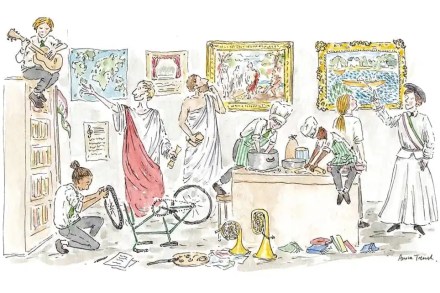
It is encouraging to see Sir Keir Starmer taking a leaf out of the ancients’ book by putting oracy (from Latin orator) on the curriculum. Indeed, on the ancient curriculum, there was little else of such importance. State education did not exist. It was an entirely private operation, designed to supply the elite with the skills necessary to win arguments in political and legal forums. (They alone had the time for such an activity; our ‘school’ derives from scholê, the Greek for ‘leisure’). It began with the young relentlessly analysing language in minute technical detail, e.g.

A better way to go to college: at sea

I have been pondering ways to rescue young Americans from the trouble and often the waste of the four-year undergraduate college education. Many young people as I recently pointed out are looking for alternatives. But there aren’t very many good ones. In what follows, I propose we put some of these discontented souls in a ship and sail them around the world. It is not entirely a new idea, and before I turn my rudder in that direction, I’d like to survey the horizon. Once, long ago, I was asked by the senior administration of my university to look after the playboy son of a wealthy European family who had decided to enroll in an undergraduate degree program. He was handsome, smooth, reckless and not very bright.

semester sea
glenn youngkin winsome sears

The Youngkin-Sears playbook for 2024

“I don’t think parents should be telling schools what to teach,” Virginia Democratic gubernatorial candidate Terry McAuliffe infamously said at the second debate in September 2021. His comments opened an opportunity for Republican upstarts Glenn Youngkin and Winsome Earle-Sears, running for governor and lieutenant governor, respectively, to seize control of the educational debate. “In our poll, we were showing that we were hitting, like, a 45” percent polling average before McAuliffe’s debate comments," Sears admitted to me in an interview. But McAuliffe’s comments (and the campaign materials printed about them) opened the spigot, and the votes for Youngkin came pouring out.

Singapore should serve as a model for how to fix racial disparities

In theory, the SCOTUS decision to strike down affirmative action in higher education should be considered as part of the post-George Floyd racial reckoning to “dismantle systematic racism.” But judging by the hysteria going on over at MSNBC and condemnations from President Biden, it’s clear that the activist class and American intelligentsia have a very different conception of what exactly constitutes racial justice. Two and a half years on, this racial reckoning has instead produced higher murder rates, generational declines in basic literacy among students — with the sharpest declines among black and Latino kids — and a massive transfer of wealth to an ever-growing DEI bureaucracy, BLM grifters and gurus like Ibram X.

singapore

Why civics test scores are falling in American schools

Twenty years ago, one of the most popular bits on late-night television was “Jaywalking,” where Tonight Show host Jay Leno quizzed passersby on world events, geography, history and more. He would ask random people on the street about literature, who the vice president was, or who we fought in World War Two. The clips that made the cut inevitably involved embarrassingly ignorant answers. Today, America is a nation of Jaywalking Allstars; whereas it was once a punchline for someone to be that ignorant, ignorance is now the norm. In early May, news emerged about record low scores for history and civics for eighth grade students nationwide.

test scores

Britain’s schools are facing an epidemic of bad behaviour

From our UK edition

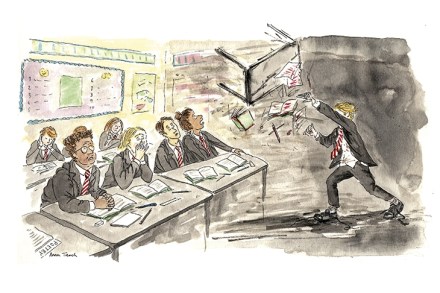
Something troubling is happening in Britain’s schools. This week, the government released its findings from the first national survey into pupil behaviour in classrooms. The results are a hard lesson to learn. But, as a teacher who has witnessed chairs being thrown and pupils urinating on teachers’ cars, it doesn’t come as a surprise. Over 40 per cent of students say that they feel unsafe each week because of poor behaviour, according to the survey. Students have the lowest perception of how well behaviour is going in school. This suggests that teachers and school leaders have normalised lower standards and expectations, to the point that roughly six weeks of lesson time is lost due to disruption a year. Poor behaviour also seems to have worsened in recent years.

Progress is coming to our remote corner of Kenya

From our UK edition

Laikipia The principal of the local polytechnic was waiting for me in the kitchen. Frequently in the kitchen there is a chief or a surveyor, or geese, or the cats Omar and Bernini, the dogs Jock, Sasi and Potatoes, foundling lambs or calves gambolling about hoping for milk, or stockmen with news of a sick cow, or armed askaris clumping in after a hard night to lay assault rifles down on the counter before slurping mugs of sugar-loaded tea. Bees try to swarm behind the fridge and one day Milka, the cook, primly announced there was a big snake coiled on the shelf of pots and pans. In her Cold Comfort Farm Miss Stella Gibbons talked of ‘clettering’ the dishes.

Why are my son’s teachers constantly on strike?

From our UK edition

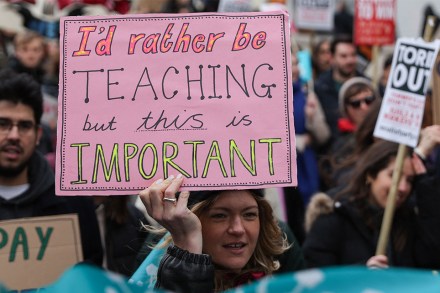
It is a bright Wednesday morning in May. My son, T, a Year 8 pupil, should be at school and I should be working, but instead we are playing tennis. We are also listening to ‘Romeo and Juliet’ by Dire Straits because he’s supposed to be studying the play in class so I figure I can cover both PE and English literature in the next half an hour before we head home and I start the work I’m meant to be doing. For them academies are a Tory ruse designed to hand over control of schools to nasty capitalists My son isn’t ill and isn’t playing truant. His school, along with five others in Lewisham, south London, is in the middle of 13 days of strike action called by the National Education Union (NEU).

The dangers of faux-education

François-Marie d’Arouet (1694-1778), commonly known as Voltaire, devoted his life to waging intellectual warfare against Christianity — the Catholic Church and Catholic culture in particular — along with its historic political and social allies, royalty and monarchy, which he condemned as a monstrous entity in his famous battle cry“Écrasez l’Infȃme!” Given his aims as a polemicist, a deist and a republican, Voltaire did not misconstrue the enemy whose destruction he called for.

education

Why Britain is falling behind in the global universities race

From our UK edition

Our country still excels when it comes to higher education. Britain has seven of the world’s top 50 universities. In spite of many claims that Brexit would lead to a reduction in the number of foreign students, the intake has never been higher. In 2021-22, there were 680,000 overseas students in higher education in Britain, an increase of 123,000 in just two years. That’s good news for the British economy. A report by London Economics estimated that one year’s intake of students would, by the time their courses had finished, bring in £29 billion in revenue from tuition fees and other income. Importantly, the benefits are spread all over the country: the University of Manchester and the University of Edinburgh each have around 18,000 overseas students.

British universities are beyond redemption

From our UK edition

There’s no doubt that the government has the best of intentions when it comes to clearing up the Augean stables of UK higher education: witness its setting up of the Office for Students to protect students’ interests against ever-more monolithic university management, and more recently this year’s Higher Education (Freedom of Speech) Act aimed at safeguarding the interests of both students and staff. However, all this leaves a much more awkward issue: what are we actually promoting? True, it’s the done thing for middle-class 18-year-olds to be sent away to university. True too that you still need a degree to obtain certain kinds of well-paid jobs.

How to succeed in exams

From our UK edition

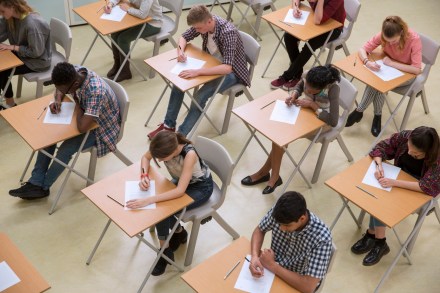
Exams start on Monday. Thousands of A-level and GCSE pupils will be swotting hard for them right now. Some will do well; others won’t. Knowledge and ability are the two obvious keys to success. But there’s another factor that’s often overlooked: exam technique. Having taught thousands of students of all abilities at several leading schools, I know this is a vital reason why some teenagers are more successful than others: they use the right exam techniques under pressure. So what are these techniques?  First and foremost, arrive early. Exams need a clear head and turning up at the last minute is certain to be stressful.

The China influence puzzle

A “Chinese puzzle” in its classic version is a game where you must fit a variety of ill-assorted boxes inside other boxes. The term came to mean any intricate problem, especially one in which what looks like the way forward leads only to new obstacles.   These days, in which we are warned not to use ethnonyms for fear of giving offense, it might be safer to say something like “brainteaser.” But the efforts of the Chinese Communist Party (CCP) to manipulate American society genuinely deserve the old term. The news this past week adds a few curious details to those efforts. Details first; explanations to follow.

china ccp

The death of the Western literary tradition

A regular reader of Le Figaro for some years, I have been noting the frequency with which the editors print articles relating to the Académie française, founded by Cardinal Richelieu in 1634 for the purpose of acting as the protector and patron of the French language, fixing its usage and giving it exact rules to make it competent to deal clearly and elegantly with the arts and sciences. It was decreed that the academy should consist of precisely forty members, and that upon the death of any one of them the candidate to replace him should pay court to the remaining thirty-nine to be selected to fill his numbered seat. The sitting forty were known as “les Immortels.

literary

Will school choice destroy the Democratic Party?

Only occasionally in American history does an issue surface that challenges not only the values of an established political party but the party’s ability to function. If any such issue has emerged in our own time, it's clearly school choice. The evolution of such a diverse educational marketplace — private schooling, homeschooling and tutoring, among other options — will severely reduce the Democratic Party’s election workforce, squeeze its finances and even discredit its basic philosophy. Consider first the workforce. If nothing else, the widespread subsidy of K-12 grade schooling in venues not run by teachers' unions would deplete the enormous army of campaign workers that Democrats have come to depend upon during every election cycle.

school choice

Homeschooling is having a moment

A public school teacher for three decades, my mother kept me out of them for nearly a third of that time. Her refusal to allow me to partake of the public education system that paid her bills echoed a memorable quote of G.K. Chesterton’s: “Everyone goes to the elementary schools except the few people who tell them to go there.”  If the recent numbers are any indication, more people have followed her example. In 2019, about 2.8 percent of US students were homeschooled. By 2020, that number had jumped to 5.4 percent. And in 2021, it was up to 11.1 percent. Research from Stanford and the Associated Press places the overall increase in enrollment since the beginning of the pandemic at 30 percent.  Around the country, red-state politicians are taking notice.

homeschooling

How teachers’ unions could unwittingly usher in school choice

In a surprise development, teachers' unions in eight states recently announced drives to pass legislation that would establish so-called “wealth taxes.” Working with progressive legislators in California, Connecticut, Hawaii, Illinois, Maryland, Minnesota, New York, and Washington, the unions have devised what they believe are the best ways to tap, not just the incomes, but the assets of the most successful earners. Under the bill proposed in California, for example, residents with both financial and illiquid assets would be required to file yearly reports on their holdings, obligating those worth more than a certain amount to pay 1 to 1.5 percent of the total to Sacramento, even if they move out.