Education

The corpse of Black Wednesday has been exhumed, and the demon exorcised 

From our UK edition

Cameron clearly doesn’t rate Ed Miliband. That may be a mistake in the long run but it worked fine today. The opposition leader returned to PMQs after a fortnight’s paternity leave and Cameron welcomed him with some warm ceremonial waffle about the new baby. Then came a joke. ‘I know what it’s like,’ said Cameron, ‘the noise; the mess; the chaos; trying to get the children to shut up,’ [Beat], ‘I’m sure he’s glad to have had two weeks away from it.’ This densely worded, carefully crafted, neatly timed quip had obviously been rehearsed at the Tory gag-conference this morning. The fact that Cameron had time to polish it suggests that he anticipated no trouble from Miliband today.
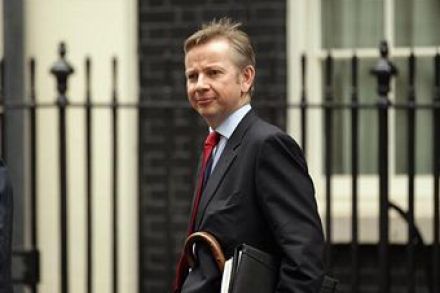
Gove starts the revolution

From our UK edition

The Spectator has been a long-term fan of Michael Gove – indeed, we named him the single best reason to vote Tory at the last election. His ‘free school’ reforms are laudable and the emphasis on improving standards is imperative. Under the previous government, Britain slid down the international rankings of educational attainment. A tide of politically correct initiatives robbed teachers of their classrooms and discipline suffered. The post code lottery under which state education operates sentences the poorest and most vulnerable in society to rot in under-funded sink schools. Reform is both a moral crusade and a necessity if Britain is to continuing punching above its weight in the future.

Gove dilutes schools funding pledge

From our UK edition

Last week, the FT revealed that Michael Gove was planning to introduce direct funding of schools, a move that weaken local authorities’ grip on education funding. Theoretically, it is a central component of Gove’s plan to free schools from local authorities’ bureaucratic control in a bid to improve standards by creating a quasi-market. It was, as Gove’s aides have been at pains to express, ‘exciting’. But Gove denied the story on Andrew Marr this morning: the legislation will contain no such clause. The FT responded this afternoon, proving that Gove has diluted the legislation.

How to prevent schools from being hijacked by extremists

From our UK edition

The coalition plan to let parents, teachers and voluntary groups set up schools and be paid by the state for every pupil they educate has the potential to transform education for the better in this country. But this policy also requires the government to prevent these freedoms from being abused by extremist groups who want to teach hate. The revelations on tomorrow night’s Panorama about weekend schools that use Saudi textbooks that ask pupils to list the “reprehensible"  qualities of Jews and teach the Protocols of Zion as fact are  a reminder of how serious this threat is.

The Gove reforms grow even more radical

From our UK edition

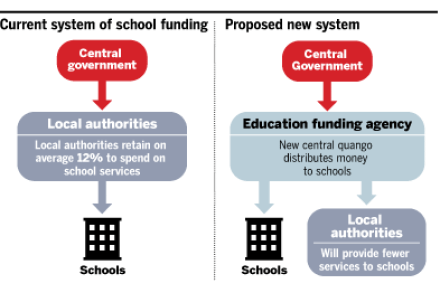
Local authorities are already doing their utmost to block the coalition's schools reforms, so just how will they respond to this story on the front of today's FT? It reveals how Michael Gove is planning to sideline local authorities from the funding of all state schools – not just free schools and academies. The idea is that state schools will get cash directly from the state, without any need for the council middlemen that currently control the system. Here's an FT graphic that captures the change: The money would be allocated to schools in proportion to the number of pupils they have, and headmasters would have much more freedom in how to spend it. This is the same simple but transformative dynamic that inspirits the rest of the Gove reforms.

The politics of the student protests

From our UK edition

The student protests really are throwing up some extraordinary images. Who'd have thought that they'd end up smashing their way in to the lobby of Tory HQ, setting fire to placards, hurling bricks and other objects – and all as news helicopters buzz insistently overhead? It's not Paris '68, but it's certainly not traditional British reserve either. I'd be tempted to say that this is the fury of a generation which, as I've written before, has generally been excluded from the political conversation – if, like Iain Dale, I didn't suspect that this demonstration had been overtaken by a bunch of dubious fringe groups. So, instead, I'll refer CoffeeHousers to this argument made by the Guardian's Julian Glover a few months ago, and which I've highlighted before.

What about Whig history?

From our UK edition

Simon Schama, who is advising the government on drawing up a new history section of the national curriculum, has an essay in The Guardian today setting out why and what children should learn about our ‘island story’. Schama highlights Thomas Becket’s clash with Henry II, the Black Death and the Peasants' Revolt, Charles the First’s execution, the establishment of the British Raj in India, the opium wars and the Irish question, as things that every school kid should be taught about. But at the risk of being too crudely Whiggish, the most important thing is surely that pupils learn how Britain became a democracy. It will help people understand the importance of their democratic rights, if they know how they were won.

Gove the bully?

From our UK edition

There has been a telling development in the resistance against ‘free schools’ this morning. The Evening Standard reports that Brian Lloyd, the headmaster of a school in Bromley, claims he is being ‘bullied’ by Michael Gove into adopting academy status. In a matter of weeks then, Gove has morphed from ‘miserable pipsqueak’ into Judd Nelson in The Breakfast Club – an odd transformation even in caricature. But depicting Gove’s schools revolution as the agent of draconian central government is a cunning ploy by local education establishments.   However, test Lloyd’s case and the real picture emerges.

Diversity is the name of the game: different pupils have different needs

From our UK edition

The Times has a spread on free schools (p20-p21) today (£), focusing on the model of Kunskapskolan, one of the largest Swedish chains, who are setting up shop in Britain. "Pupils set their own homework, decide their timetables, set themselves targets and work at their own speed - oh, and they clock off at 2pm," says Greg Hurst, the paper's education editor. He visits one of their schools in Twickenham. "At the heart of the personalised learning", he says, lies a "one-on-one tutorial with a teacher for 15 minutes to review progress, weekly and long-term targets and timetables to meet them." A pupil, Lisa, is quoted saying: "You talk to the teacher and you cannot embarrass yourself. If you want to say something personal, you can say it to her.

The importance of teaching British values in schools

From our UK edition

One of the websites that the young Muslim woman, Roshonara Choudhry who stabbed Stephen Timms MP mentioned in her police interview was RevolutionMuslim, which now appears to have been taken down. Charles Moore turns his attention to the site in his column today: 'After Choudhry’s conviction, I had a look at RevolutionMuslim. It has put up a list of all MPs who voted for the Iraq war, details of their surgeries and even a link to a supermarket website where you can buy knives. I watched its video, in which a young man praised Choudhry for “taking the matter into her own hands”, and attacked Muslims who collaborate with the infidel. A similar-looking young man featured in press pictures of demonstrators outside the Old Bailey.

The tuition fees compromise

From our UK edition

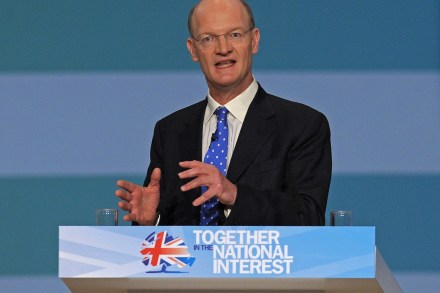
Away from the mid-terms, we have the little issue of tuition fees. David Willetts will today set out the government's response to the Browne Review, and it's expected to look something like this: a £9,000 cap on fees, but universities will have to show that they are making extra provisions for poorer students if they charge over £6,000. Students would effectively be loaned the money by the state, and would start paying it back once they earn £21,000 after graduation. It's certainly a compromise arrangement, constructed with one eye on the Lib Dems and another on the universities. For Clegg's backbenchers, there's a rejection of the unlimited fees advocated by Browne, and an overall emphasis on "fairness" and on helping the less well-off into university.

Free schools: good for all schools

From our UK edition

Free schools are all well and good – but what about the schools that remain? Some CoffeeHousers raise this question in response to my earlier blog, and it’s important enough to deserve a post in itself. Because introducing new schools to compete with council schools is the best way of raising standards for all – and studies around the world prove this. The ‘free schools’ agenda is not some Govian brainwave, but a simple reform that is being enacted from Chile to Obama's charter schools. The fullest example of this has been in Sweden, which the Gove system is modelled on, where about 13 percent of upper secondary kids are now in free schools.

Which side are you on? | 26 October 2010

From our UK edition

At last, The Guardian is reporting the grassroots rebellion in education. It has picked up on the story of Fiona Murphy who blogged on Coffee House yesterday about her trouble with the Tory-run council in Bromley. But hang on... the "grassroots revolt" of which the Guardian speaks is the councils, trying to protect their monopoly control over state schools. Here is the extract: "A flagship government policy has provoked a grassroots revolt against the coalition, with senior Conservative and Liberal Democrat councillors lining up to attack the introduction of free schools, one of education secretary Michael Gove's most cherished projects...

Reading between Laws’ lines

From our UK edition

In The Guardian today, David Laws argues for increasing funding for the pupil premium to £5 billion in the next parliament. But, revealingly, rather than talking about achieving this through the Liberal Democrat manifesto, Laws want to secure the increase this side of the next election and so writes about how it relies on persuading George Osborne of the premiums’ worth. Laws appears to be putting down a marker that increased funding for the premium needs to be part of Osborne’s pre-election spending review which should be in autumn 2014. If everything goes according to the coalition’s economic plan, the coalition will be able to announce plans to cut taxes and increase spending in the months before the next election.

A Conservative council joins the secret war against England’s schools

From our UK edition

For the parents where I live who are campaigning for a better local school, the Spectator's expose on 'the secret war over England's schools' - with its description of how groups like the National Union of Teachers are attempting to stymie Michael Gove's plans for making education better - was familiar territory. The only difference here in Bromley is that it isn't left wing activists who are standing in the way of Mr Gove's reforms for better schools: it is our Conservative-run Council.   Having said earlier this year that they wanted our local school, Kelsey Park Sports College, to become an Academy - a decision that was a welcome relief for many local families - the Council is now backpedaling like crazy.

Sticking up for free schools

From our UK edition

I'm on the train back from doing Radio Four's Any Questions – broadcast live from Derby, repeated at 1.10pm tomorrow – where I had a bust-up with Christine Blower of the NUT. CoffeeHousers may recall she was the star of a cover story we ran a few weeks back, about the campaign of bullying and intimidation levelled against headteachers who are trying to seek Academy status. She raised that article during recording, and things kinda kicked off. I told her she should be ashamed of the way her union thugs try to intimidate young teachers who seek to break away from local authority control and reach independence. She denied writing the words ascribed to her, I sought to read them to her – and things descended from there. Anyway, a few thoughts... 1.

Labour’s Kill Clegg strategy

From our UK edition

One question swirling through the sea of British politics is this: how will Ed Miliband act towards the Lib Dems? The Labour leader certainly didn't flinch from attacking the yellow brigade during the leadership contest, at one point calling them a "disgrace to the traditions of liberalism." But surely he'll have to soften that rhetoric in case the next election delivers another bout of frenzied coalition negotiations. Which is why Andy Burnham's article in the Guardian today is worth noting down. In making his point – that the Lib Dems haven't won the pupil premium they sought – he does all he can to force a wedge between Nick Clegg and his party. It's "Clegg's failure". It's "Clegg's ideological journey". It's a "problem for Clegg," and so on.

Osborne blunts the axe – slightly

From our UK edition

As expected, the Chancellor announced reductions in public spending – though not quite as severe as indicated in the Emergency Budget last June.  Government expenditure will fall by 3.3 percent over four years rather than 3.6 percent as expected, leading George Osborne to state – correctly – that departmental budgets will be higher than those pencilled in by Labour – an outcome many may not regard as desirable.  In fact, Osborne will be spending 2 percent more in 2014/15 than Gordon Brown was in 2008/9. Departmental spending will fall 10 percent rather than 13 percent - largely paid for by more optimistic assumptions about savings on welfare and debt interest payments.  Capital spend was hit the hardest - being cut by 28 percent.

Doing things right, but in the wrong way

From our UK edition

In today’s spending review, George Osborne was absolutely right to hold the line on eliminating the structural deficit within one parliamentary term. In the Emergency Budget released earlier this year the coalition won fiscal credibility (and breathing space from international financial markets) by setting that goal. Failing to follow through on this goal at the first sign of difficulty would have damaged the government’s credibility and reputation in the eyes of international markets.   The Chancellor was also absolutely right to highlight the need for public service reform and to look to the welfare budget to provide some large and early savings.

The slog starts today

From our UK edition

Welcome to Stage Two of the government's life. The first stage was the Budget, which established the size of the fiscal mountain looming over the coalition. The third stage will be the difficult, four-year slog up to the top. But today – the Spending Review – is all about determining the route for that ascent. In just a few hours we will know when, where and why the pain will come. Don't forget to pack sandwiches. Of course, with this roadmap being drawn out in Westminster, we already know some of the details. This morning's papers major on the fact – snapped from Danny Alexander's hands yesterday – that almost 500,000 public sector jobs will be lost over the next four to five years. And then there are the actual departmental settlements.