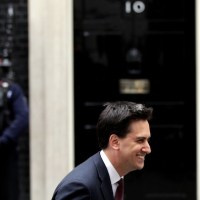
Ed miliband

Red Ed’s sponsored walk

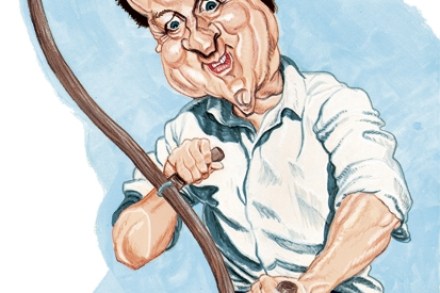
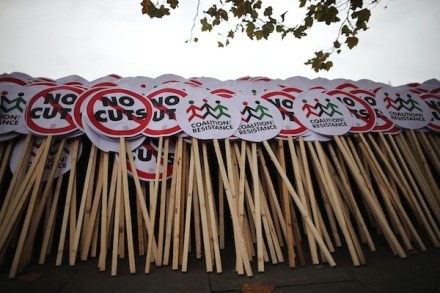
At Prime Minister's Questions this week, David Cameron referred to today's TUC rally as the ‘most expensive sponsored walk in history’, a joke that the Tories have now taken one step further. Ahead of Ed Miliband’s speech to marchers at tomorrow’s anti-cuts demo in central London the Conservatives have launched Red Ed’s Sponsored Walk, a satirical fundraising site for Ed’s charity walk, with all proceeds going - somewhat unsurprisingly - to the Labour party. His online sponsors currently include Unite, GMB and Unite, who’ve ‘sponsored’ Ed to the total price of £12.4 million, accompanied by threatening messages such as ‘Don’t let us down Ed’ and ‘Remember who got you your job’.
PMQs: Labour will be out for blood on Andrew Mitchell

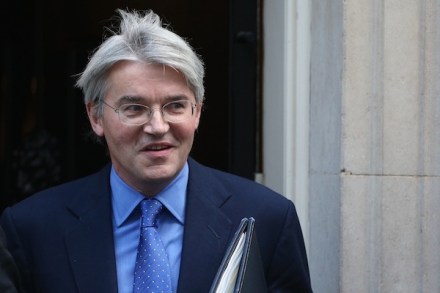
The first Prime Minister's Questions after the conference season is more important than most: the House and the press gallery are looking to see who has come back with a spring in their step. But today’s session has an added element to it: the Andrew Mitchell factor. Labour attempted to have a go at the chief whip at Home Office questions on Monday. But with the Chamber only half full, it fell a bit flat. Today, though, the House will be packed and Ed Miliband's party will be out for blood. I expect Mitchell himself will deal with it quite resolutely.

David Cameron is the leader battling inequality

The great paradox of British politics is that the left moan about inequality, but it’s the right who will remedy it. Ed Miliband is proposing the restoration of the old order, where the poor get the worst schools and the rich get the best (and the opportunities that flow from it). Labour plans to tax the rich more, and give money to the poor as if by way of compensation. The Tories want to revolutionise the system, so the poor have the same choice of schools that today only the rich can afford. Labour wants to make sure the unemployed are well looked-after. The Tories want to make sure the unemployed are rewarded — not penalised — if they seek work. It may sound perverse.

David Cameron reverses Ed Miliband’s conference bounce

Just as Ed Miliband seemed to get a poll bounce from his conference speech last week, so David Cameron seems to have got one from his on Wednesday. On YouGov's question of who would make the best Prime Minister, Cameron has extended his lead to 14 points. That more than reverses the bump Miliband got on that question from his conference (he had closed the gap from 12 points before the conferences to just four last week). In fact, it's the best result for Cameron on that crucial question since the Budget in March. On voting intention, the Tories' conference does seem to have helped them close the gap to Labour a little. YouGov's latest poll has Labour's lead at seven points (42-35), down from 14 points (45-31) last week.

We need to talk about democracy

I’ve been away from party politics for a few weeks and have watched the conferences as an interested reader rather than an active participant, so it is interesting (for me at least) to consider their aftermath this morning. It seems undeniable that, from the perspective of having gone about one’s normal working life for three weeks, the conference halls seemed very distant, almost as if they existed in a different sphere of reality. This is not to say that they are unimportant or even that the politicians found in them are out of touch, necessarily; but it is to say that there is more to our national political life than these salons for the tribal.

Conservative conference: Clear blue water

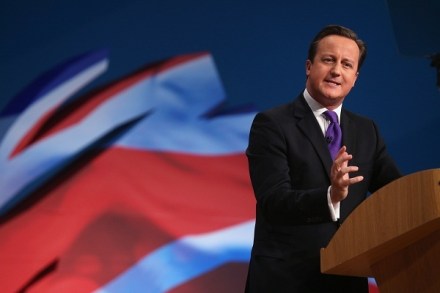
The next election is going to be a clash of ideological visions. There is now clear blue water between the Tories and Labour. Last week, Miliband set out his view of ‘one nation’. Its power came from its authenticity but it was also a distinctly left-wing vision of the world. Today, Cameron responded with one of the most Tory speeches I’ve ever heard him make. Too often, Cameron has tried to portray himself simply as a competent steward of national affairs, shying away from ideological definition. But this speech was different. It had a central argument, about the need for Britain to become more competitive. His answer was right-wing: boost enterprise, improve schools and deal with an unaffordable welfare system.

British politics returns to normal: Blue vs Red with Yellow on the touchline – Spectator Blogs

British politics is returning to normal. The two-party system is back. That, it seems to me, is the chief conclusion to be drawn from this year's conference season*. The opposition have been supplanted by Labour and we're back to the familiar sight of watching the Conservatives and Labour knock lumps out of one another. It is not just that the Lib Dem conference seems to have taken place months ago (though it's partly that) but that the guest list for the next general election has been agreed and Nick Clegg's party isn't on it. The Liberal Democrats? Who they? For a long time now, the government has been weakened by the failure to resolve the tensions at the heart of the coalition.

The real story of the 2007 ‘election that never was’

‘The election that never was’ is one of the most important events, or non-events, in recent British political history; if it had gone ahead, David Cameron might never have become Prime Minister and there might not have been a coalition at all. Equally, Gordon Brown could have seen Labour’s majority slashed and had to quit long before the financial crisis hit. The story of what happened that day has been told several times. But I don’t think I’ve read a more gripping account than Damian McBride’s. McBride did disgrace himself but he can sure as hell write. If you like the political game, you really sure read it.

Five lessons from the Labour party conference

Believe it or not, Labour's party conference has finally ground to a halt. Here are the key lessons from the past six days in Manchester: 1. Ed Miliband is no longer a joke leader of the opposition. The Labour leader's speech showed that he can now talk a good game, and even though much of that performance was no more than a good game, Miliband gave his party and voters a glimpse of the more authoritative figure that he has grown into over the past two years. It's worth watching his speech to the 2010 autumn conference where he appeared completely floored by bursts of applause to see quite how far he has come. 2.

Labour conference: Ed Miliband’s speech boosts his ratings

Labour leave Manchester today with a 14-point poll lead over the Conservatives, according to YouGov. That's their biggest lead in a YouGov poll since June, although one last week showed them 13 points ahead, so we shouldn't rush into declaring a big conference bounce for them. It does seem, though, that Ed Miliband himself did get a decent boost out of his hour-long speech on Tuesday. 10 per cent of people say they watched or listened to the whole thing, and a further 49 per cent say they've seen or heard reports about it. And it seems Ed did manage to change at least a few of their minds about him. 31 per cent now say he 'would be up to the job of Prime Minister' — still not a great number, but an improvement on the 25 per cent who said so last week.

Labour conference: Ed Miliband will attend TUC anti-austerity demo

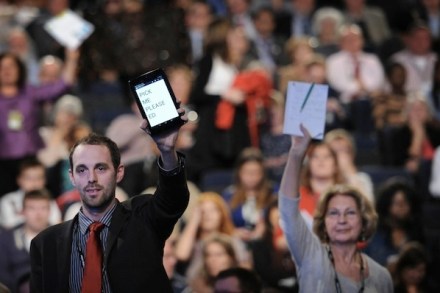
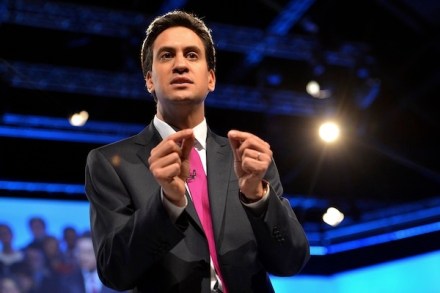
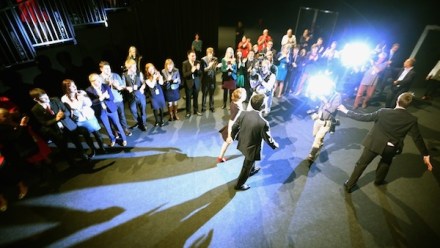
If we learnt nothing else from this afternoon's question-and-answer session that Ed Miliband held with delegates, it's that Labour delegates are quite as eccentric as Liberal Democrat members, if not more so. The junior coalition partner has long enjoyed the reputation of having an eclectic following, but those gathered in Labour's hall had bought an equally surreal selection of props with them today. They were waving Welsh flags, builder's helmets, sparkly bags, light-up handheld fans, light-up pens, scarves, crutches, something that looked strangely like a strip light, flashing lights, and open umbrellas. The idea, as well as making the conference hall look rather like a bazaar, was to catch Ed Miliband's attention by vigorously waving said strange object.

Ed Miliband’s next big test as Labour leader

The good thing for Labour about Ed Miliband's speech yesterday was that he didn't talk about the deficit, or welfare or other thorny issues which make certain sections of the party very grumpy indeed. The Labour leader made only fleeting references to cuts to public services, too. So there was little to disagree on. It is when he comes to tackle issues such as these that Miliband will see his party mood sour considerably from its cheery response yesterday. The problem is that on these issues, the party is still struggling to work out how far it should go to meet voters' demands without betraying what it sees as its core values.

The coalition take on Ed Miliband’s speech

Talking to senior Liberal Democrats and Conservatives about Ed Miliband’s speech, it is striking how similar their analyses of it are. Despite coalition, we’re entering into a period of stark government, opposition dividing lines. Pretty much everyone admits that Miliband has put to bed the question of his leadership of the Labour party and moved himself out of the IDS category. But they argue that he’s not dealt with Labour’s biggest weakness, the public’s belief that it spent and borrowed too much. One influential Liberal Democrat accused Miliband of ducking the generational challenge that is the deficit likening his speech to one in 1942 that didn't mention there was a war on.

The View from 22 – Labour conference special

Ed Miliband's speech to the Labour conference this afternoon was undoubtably his best speech yet and has revitalised the Labour cause.The Spectator team have gathered this evening in Manchester for a special podcast to discuss both Miliband's speech and the Labour conference overall: The View from 22 - 2 October 2012.

Will Philip Blond be back for more fun?

Ed Miliband's ‘One Nation’ conference speech will have put the populist cat amongst Downing Street’s toffee-nosed pigeons. Now young Dave's people will have to work out how to respond to this inspired piece of political cross-dressing, even if it is essentially diaphanous. One (alleged) Tory, though, is very happy with the direction in which the national debate seems to be travelling. Mr Steerpike found Phillip Blond, the 'Red Tory' and founder of the Respublica think-tank, cock-a-hoop after the speech: 'Ed Miliband has thrown down a blue Labour challenge to the Conservatives. No. 10 needs a Red Tory response unless they want to see Ed's One Nation politics win the next election.

Labour conference: Miliband and Balls talk inheritances

One of the more sombre passages in Ed Miliband's barnstorming speech this afternoon was when he tackled the thorny issue of what a Labour government would actually do about the cuts. While both the Labour leader and Ed Balls are keen to regain the trust of the British public on the economy, they are also trying to introduce a counter-narrative to the 'are you ready to trust Labour with your money again?' line that Nick Clegg produced last week. Just as George Osborne and colleagues have spent the first two and a half years selling the line that they are 'clearing up the mess' of the last Labour government, Miliband and Balls are now increasingly talking about the economic inheritance that a Labour government might receive in 2015.

Ed Miliband Makes a Pitch for One Nation Progressivism – Spectator Blogs

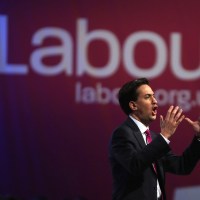
The first thing to remember about Ed Miliband's speech to the Labour conference today is that it's not about you, it's about us. That is, it was designed to persuade the media to give Miliband a fresh look more than it was an attempt to impress the general public, far less the Labour members gathered in Manchester. Initial impressions are that he succeeded in this aim. See Tim Shipman and Fraser Nelson, neither of whom are normally considered much of a Milibander, for good examples of this reappraisal. (John Rentoul is, of course, an exception.) Indeed, I can't recall when the British half of my twitter timeline was last quite so impressed by any speech given by any British politician, far less any intervention made by Edward Miliband Esq.

Labour conference: Polling suggests Ed Miliband is still not seen as PM material

As Ed Miliband prepares to present a carefully crafted image of 'Ed the human' to the Labour conference this afternoon, polling out today suggests the nation still does not see him as a future Prime Minister. In a ComRes poll for the Independent, just 22 per cent of voters said they agree that Ed Miliband has what it takes to be Prime Minister, compared to 33 per cent for David Cameron: On the economy, Balls and Miliband continue to rank below the public's view of Cameron and Osborne.