Ed miliband

PMQs: A rather grumpy, unedifying session

Talking about energy bills week in, week out might be good politics for both parties, but it sure does make for a grumpy PMQs session. David Cameron was still rather ratty this week, but he managed some better attacks on Miliband than he's done in the past few weeks of the great energy debate. He tried to pin the blame for the current state of the energy market on Miliband, saying: 'Who gave us the Big Six? Yes, when Labour first looked at this, there were almost 20, but because of his stewardship we've ended up with six players.' He also accused the party of pushing for yet more price rises now, with the Lords vote that Robert Halfon wrote about for us yesterday.

We will never save the planet on the backs of the poorest

Yesterday – in a crunch vote in the House of Lords – Labour were narrowly defeated by 216 votes to 202. The issue? Energy bills. Except, this time, the Labour Party was demanding that your bills should RISE by £125 a year. Confused? The quarrel yesterday was all about the ‘2030 decarbonisation target’ – a technocratic term, which means in essence a new carbon tax on your utility bills. It would be a tax on everything. A tax on your fridge, your kettle, your oven, your TV, and every light-bulb in your home. If Britain were to commit to this now, it would mean locking in expensive forms of electricity generation over the next 17 years. Labour voted for this to happen, and they nearly won.

The private polling behind Labour’s energy bill swagger

A select committee meeting with the Big Six firms would attract attention in any year when the companies had announced such eye-watering price rises. But it is the political frisson added by Ed Miliband's energy price freeze pledge that makes this afternoon's hearing quite so interesting. Labour had a swing in its step anyway as it feels it has successfully spooked the Coalition parties, but it carried out private polling last week, seen first by Coffee House, that underlined this. 70% of voters surveyed by YouGov for Labour thought the government should introduce a price freeze, with 17% rejecting it.

The government tries to ‘smoke Labour out’ on HS2

The government’s approach to the HS2 debate has changed. Up until recently, government sources would wave away the suggestion that Labour might withdraw its support for the project. They’d point to Andrew Adonis and his influence on Ed Miliband to explain why Ed Balls’s doubts about it didn’t matter that much. But this has now changed. They’ve now decided, in the words of one Number 10 figure, that they need to ‘smoke Labour out on the issue’. Over the next few weeks, we’ll see the Tories trying to put more and more pressure on Labour to say whether or not they’ll back it. Number 10 is acutely aware that, at the moment, Labour’s ambiguous position is simply emboldening opponents of the project, including many Tory MPs.

European Council statement: Leaders seize opportunity for economic ding dong

Why did the Prime Minister give a statement in the Commons on the outcome of last week's European Council summit? Though he is expected to report back to MPs each time one of these jamborees takes place, David Cameron didn't really have a great deal to tell them other than the tantalising suggestion that the leaders had made progress on cutting red tape and the declaration that 'the EU is changing'. It was hardly one of those statements where Cameron can wave a budget cut or some other great policy victory at MPs.

Coalition parties near a deal on energy bills

The good news for the Cameroons on energy is that it looks like they’ll get an agreement by the Autumn Statement to take at least some of the green levies off energy bill. The bad news is that this means that the debate sparked by Ed Miliband’s pledge to freeze energy prices for 20 months if elected is going to continue until, at least, December 4th. An agreement between Cameron and Clegg on energy bills does now appear to be close. The Lib Dem anger at Cameron using PMQs to try and bounce them into a set of concessions has been replaced by a fast-moving negotiation. As one senior Number 10 source says, ‘There’s lots of shouting and public posturing, but 12 hours later Clegg is signalling that he’s prepared to do business.

The View from 22 podcast: police vs liberty, health tourism and Westminster’s economic week

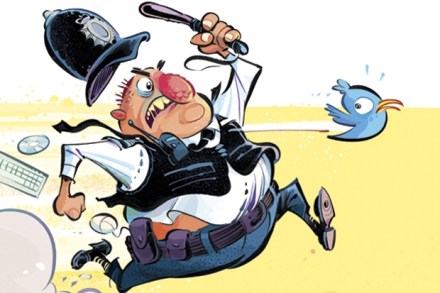
Are the police wasting too much time on Twitter instead of catching criminals? On this week's View from 22 podcast, Nick Cohen looks at what Britain's fall in crime has done to policing methods. Is the fall responsible for the police's heightened in what people say on social media? What does this mean for our civil liberties and freedom of speech? Consultant NHS surgeon J. Meirion Thomas also joins to explain how The Spectator helped blow the whistle on health tourism abuses. Will the government's plans to tackle systematic abuses by migrants work? How much effect will the levy on students and temporary visitors have? Are the figures quoted by the Department of Health on the cost of health tourism accurate?

Martin Vander Weyer: The BBC should replace Robert Peston with Grayson Perry

Prediction, as Mervyn King once observed, is ‘a stab in the dark’. Who can say with confidence where the wholesale price of electricity will be in ten years’ time, let alone 45 years hence at the end of the contract struck by Energy Secretary Ed Davey with EDF of France for the building of the £16 billion Hinkley Point nuclear station? We can be pretty sure the price will be a lot higher than today’s and it’s not mad to think it might have doubled by 2023, which is the starting assumption of the EDF deal.

PMQs sketch: Cameron is a buffoon who might as well eat his own manifesto

At PMQs today, the Tories’s energy policy went bi-polar. The Conservatives now seem to touch both extremes of the debate. For eight years they’ve presented themselves as a gang of happy tree-huggers who applaud every green subsidy going. But today David Cameron announced his plan to ‘roll back some of the green regulations and charges’. John Major started it all. Yesterday he lurched back into front-line politics by suggesting that energy companies should pay a windfall tax this winter. Otherwise, he said, the poor will have to choose between starving or freezing to death. Number 10 called this bombshell ‘interesting’. Ed Miliband asked David Cameron if John Major was now a Marxist. ‘Has he been claimed by the red peril?

Cameron ‘lost’ PMQs, but he’s moving into a better position on energy bills

David Cameron took a pasting at PMQs today. Ed Miliband, armed with a whole slew of lines from John Major’s speech yesterday, deftly mocked the Prime Minister. Cameron, faced by a Labour wall of noise, struggled to make his replies heard. At one point, he rose to his feet thinking Miliband had finished, only for the Labour leader to contemptuously signal at him to sit down. listen to ‘PMQs: Cameron v s Miliband on energy prices’ on Audioboo But Cameron did announce some policies today that might offer him a way out of the energy hole he’s currently in. First, he made clear that he wants to scale back the green taxes and levies that are pushing up bills.

Transcript: John Major calls for an emergency tax on energy companies

Sir John Major told a Westminster lunch this afternoon that the government should impose an emergency tax upon the energy companies to help families keep warm this winter. Here is a transcript of what the former Conservative Prime Minister said: I think when Ed Miliband made his suggestions about energy some weeks ago, I think his heart was in the right place but his head had gone walkabout. But he did touch on an issue that's very important. The private sector is something the Conservative party supports, but when the private sector goes wrong, or behaves badly, I think it's entirely right to make changes and put it right. Governments should exist to protect people, not institutions, and I very strongly agree with what the Archbishop of Canterbury had to say just the other day.

David Cameron should look to Harold Macmillan for political guidance

When Harold Macmillan published The Middle Way in 1938, its title at once entered the political lexicon. As he anticipated, his message that there was an alternative to socialism and political individualism received a frosty reception from right and left. Even the Macmillan family nanny said 'Mr Harold is a dangerous pink'. Yet correctives such as Friedrich Hayek's The Road to Serfdom in 1944 did not immediately dampen the impact of Macmillan's philosophy. 'In this illogical island,' Harold Nicolson wrote to Hayek, 'there exists an infinite capacity for finding middle ways'. Sixty years later, concepts such as President Clinton's 'triangulation', Anthony Giddens' 'Third Way' and the first ten years of New Labour showed the durability of the hare that Macmillan set running.

Is it still the economy, stupid?

The coalition wants this week to be all about the GDP figures, out on Friday. As I say in the Mail on Sunday, Downing Street is confident that they’ll show the economy is continuing to grow at a relatively decent clip and is already working out how to make political out of that. They have, as Simon Walters reports, already prepared a video mocking Labour’s claims that the coalition’s polices would lead to a million more people on the dole. Ed Miliband’s circle expects that the GDP numbers will again be positive. But they take the view that as long as prices are increasing faster than wages, squeezing voters’ living standards, economic growth won’t mean much politically.

What’s wrong with wearing a woolly jumper for warmth?

The moment that a Downing Street spokesman recommended wearing a jumper to reduce high energy bills, you knew that two things would happen. As sure as night follows day, the Labour leader spun a line criticising the ‘out of touch government’: Their crime policy used to be ‘hug a hoodie’. Now their energy policy appears to be ‘wear a hoodie’ - @Ed_Miliband — Labour Press Team (@labourpress) October 18, 2013 Then the internet spent Friday afternoon in stitches: Cameron heard about #jumpergate whilst in his car. Pull over!

Ed Miliband’s calculated energy price freeze

It has been pointed out (possibly by me, among many) how hypocritical Ed Miliband is in complaining about energy prices since he was responsible, as Energy Secretary, for driving them up through green levies. We critics have been slow to realise that it is exactly because of his history that Mr Miliband is pushing his price freeze so hard. He knows — because he helped preside over it — that rises in the levies are inevitable, since they are written into the law of the land and of the EU — not just for now, but for many years ahead.

Another puff piece for Ed Miliband

First Ed Miliband was papped with a teenager holding a ‘bong’ (above). Now the Labour leader is being offered dope on the street by passing fans. According to the Ham & High, little Ed and his team believed that builder Robert Quinn had offered them his ‘last Rolo’ on a walkabout in Camden. In fact, Quinn had offered his ‘last rollie’, referring to a joint. And there was Mr Steerpike thinking that they must be smoking something already.

PMQs sketch: Exaggerations, solecisms and clangers

The Clangers are back. And not just on television. At PMQs, both the party leaders tried to embarrass each other with solecisms, exaggerations – and, yes, clangers – which they’d dropped in the past. Ed Miliband led with the cost of living crisis and said ‘record numbers are now working part-time’. Cameron retaliated with a Miliband prediction from October 2010. ‘The government programme will lead to the disappearance of one million jobs,’ Wrong! A million jobs have been created. Miliband brought up his pet-policy, the energy bill freeze, and accused Cameron of supporting the Big Six fuel giants. A price con, not a price freeze, said Cameron. And why had Miliband not parked our bills in the chiller-cabinet while he was Energy Secretary?

PMQs: The cost of living versus the economy

PMQs has settled into a pattern. Ed Miliband attacks David Cameron about the cost of living and David Cameron responds by attacking Ed Miliband about the economy. With economic growth returning, Miliband needs to make the political argument about the cost of living if he’s to win. But Cameron is trying to stop Miliband from changing the subject. So, today Cameron dismissed Miliband’s energy freeze as a ‘price con’ while trying to wrench the argument back to the economy. The result: no clear winner. listen to ‘PMQs: Cameron vs Miliband’ on Audioboo Interestingly, Cameron again emphasised that the best way to help people with the cost of living was to cut taxes. The Tories do seem to be limbering up for a classic, tax cut election offer.

The energy price freeze is becoming the new 50p tax

David Cameron clearly didn't think he'd had a good PMQs by the time he'd finished with Ed Miliband. There was something irritable and tired about the Prime Minister as he took questions from backbenchers, and that weariness was compounded by the sight of Dennis Skinner limbering to his feet to deliver a long, angry and moving question about the work capability assessment. Dennis Skinner is the last thing you want floating to the top when your PMQs performance has been below par. And it was below par. I understand that Cameron was given a very detailed briefing indeed today on energy prices because it was highly likely that Ed Miliband was going to come back for round two. As James says, the session is settling into a pattern.

Len McCluskey: Miliband is brave and a genuine radical

Len McCluskey is doing Conservative HQ’s work for them. The emboldened Unite leader is welcoming the return of socialism under Red Ed. Last night at the annual Jimmy Reid lecture, McCluskey spoke passionately of Miliband’s bold new agenda: ‘Ed Miliband’s speech to the Labour conference was – some would say – the most genuinely radical we have heard from a Labour leader for nigh on 30 years.' He also welcomed the end of New Labour's ‘neo-liberal’ dogma (you know, the policies which resulted in three general election victories). In reference to Ed’s energy policy: ‘that is not just a break with the coalition’s policies, it also represents Labour turning its back on the neo-liberal dogmas which dominated the Blair-Brown years.