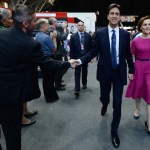
Ed miliband

‘It just wasn’t a speech that you would say if you were Prime Minister.’

Labour conference has now finished. Today was better than the others, but the delegates still struggled to show their enthusiasm when Ed Miliband reappeared on the stage this afternoon. Three people gave him a standing ovation. The mood at this conference really has been flat. At a fringe run by the Fabian Society last night, I was mildly perturbed as a Spectator journalist to be told by one member that I and other members of the panel were probably being too optimistic about the party’s prospects of getting into government. There have been a few notable moments when delegates seemed quite emotional, including during the powerful speech from 91-year old

Gareth, Ed, Hampstead Heath. What are you trying to tell us Newsnight?

Yesterday ‘Gareth’ was just the bloke from a software company, but Ed Miliband helped transform him into an internet sensation and telly star in a matter of hours after mentioning him in his lamentable conference speech. Normally politicians prefer to keep quiet about their encounters on Hampstead Heath. Hats off to Newsnight for this one…

Ed Miliband’s unlucky conference

Ed Miliband is not having much luck this conference. First, there’s the fact that it has come straight after the Scottish referendum, making it feel a bit small. Second, other stories have kept intruding on and overshadowing conference. Finally, Miliband’s managed to forget two of the most important sections of his speech, the parts on the deficit and immigration. The missing paragraphs dominated, to Miliband’s audible irritation, his interview on the Today Programme. Miliband explained that he hadn’t meant to cut them out from the speech, but that they had just got lost as he delivered it. Now, to some extent, this is a process story. But it does allow

Ed Miliband: a prophet without notes

Why does Ed Miliband think memorising a speech is more important than convincing voters that Labour really can be tough on the deficit? It wasn’t just his performance yesterday, in which the Labour leader failed to communicate key passages on the economy and immigration (James has them here), but the lack of candour from anyone on the stage about the scale of the challenge facing a Labour government if it came to power next year. Ed Balls said Labour was facing difficult, unpopular decisions, but then undermined his bad cop routine rather by announcing two relatively uncontroversial cuts. On the Today programme Miliband tried to argue that his speech had

Miliband’s people

Have you met Ed Miliband recently? Then he probably namechecked you in his speech earlier today. Unless you talked about the deficit or immigration, that is. Here’s the full list of people he met: 1. Josephine – a cleaner who hadn’t decided how she would vote in the Scottish independence referendum. I was on my way to a public meeting. I was late as politicians tend to be. And just outside the meeting I met a woman and I was supposed to be going into the meeting but I wanted to stop and ask her how she was voting. I did that to everybody on the street. One vote at

Podcast special: Miliband’s speech, the verdict

Ed Miliband has spoken – for 65 minutes – snarling at Tories, while laying out his 10-year plan and presenting himself as the man who can shake up the complacent Westminster elite. James, Isabel and I were all there in Manchester and we met up straight afterwards to compare notes. Here’s our combined verdict: listen to ‘Ed Miliband’s speech: podcast special’ on audioBoom

Ed Miliband’s speech, like the rest of this conference, was poor but just about enough

Whether or not Ed Miliband’s speech was a success depends on what sort of aim he had for it: heave Labour over the general election line using his party base, or reach out to wavering swing voters by arguing that Labour has the ability to govern in the challenging circumstances that it finds itself in after the 2015 election, that it has a vision for aspirational voters, and that it really understands why its working class voters deserted it in 2010. listen to ‘Ed Miliband’s speech: podcast special’ on audioBoom Let’s address the second aim first. It was not a good speech. It did not have a sufficiently well-crafted message.

Miliband’s speech showed he couldn’t care less about leading ‘one nation’

I think I’m about the only journalist to have watched Ed Miliband’s speech and think it wasn’t awful. Here in Manchester, the consensus seems to be that this was as bad as a speech could be. And, admittedly, even I was tweeting rude things about it all of the way through (since when does anyone need a 10-year plan? Britain won a world war in six years). You may not like the politics but his speech was intellectually coherent, even pugnacious in parts. Sure, it was about an hour too long and had some worrying lacunas. His decision not to mention the economy was wise because he has nothing to say. There was no

Miliband’s dividing lines

The more we learn about Ed Miliband’s speech (to be given later this afternoon), the clearer the dividing lines that it is drawing are. The word is that Miliband will announce more money for the NHS paid for by a combination of taxes on mansions, hedge funds and big tobacco. The message: Labour stands up for the NHS while the Tories stand up for people who live in mansions, hedge funds and tobacco companies. This might be crude politics but it will, I suspect, be quite effective. It emphasises Labour’s biggest strength, that they are the party of the NHS and social solidarity, and highlights the Tories’ biggest weakness, the

Justine Thornton becomes Justine Miliband for Labour campaign

Having spent four years sticking to a wave at the end of conference and the odd photograph together with her husband, Justine Thornton has burst onto centre stage at Labour’s conference. Mrs Miliband – and she uses her Miliband name today – has written to Labour activists pledging her commitment to getting her man into Downing Street: ‘Honestly, as a young lawyer who wanted to change the world, I never would have believed that I would become a politician’s wife. It’s not a role you apply for, nor one I’ve found easy to understand. Just after Ed won, I Googled a few terms to see if there were books I

Miliband aide: Labour has never addressed the way the economy works

What’s Ed Miliband’s vision for the economy? We’ll get the public version of that vision in a short while when Ed Balls gives his speech to the Labour conference, but last night one of Ed Miliband’s closest advisers gave us a more interesting glimpse of the underpinning of the Labour leader’s economic plan. Stewart Wood, a former aide to Gordon Brown and now a key member of Miliband’s team, gave a fringe interview to ResPublica’s Philip Blond. The two men nattered with glasses of wine in their hands (which were at one point topped up by a CCHQ suffer embedded behind enemy lines) about Wood’s values. One answer in particular,

Westminster leaders must now prove they can keep their promises

The Westminster party leaders have disagreed with much Alex Salmond has said recently. But it’s pretty difficult to fault the assessment of the aftermath of the referendum that he gave on today’s Sunday Politics. The First Minister said: ‘I am actually not surprised they are cavilling and reneging on commitments, I am only surprised by the speed at which they are doing it. They seem to be totally shameless in these matters. The Prime Minister wants to link change in Scotland to change in England. He wants to do that because he has difficulty in carrying his backbenchers on this and they are under pressure from UKIP. ‘The Labour leadership

Miliband confronted by the English Question

Ed Miliband wouldn’t have wanted to spend his big, pre-conference interview talking about English votes for English law but that’s what he had to do on Marr this morning. Miliband was prepared to concede more English scrutiny for English legislation. But it is clear he won’t back English votes for English laws. He even argued that it was hard to describe tuition fees, which don’t apply in Scotland, as an issue just for the rest of the UK. listen to ‘Ed Miliband: ‘In favour of greater scrutiny’ of English issues by English MPs’ on Audioboo Miliband was much happier when the interview turned to the minimum wage and Labour’s plan

Miliband’s carnival of constitutional tinkering

There is a certain irony in the fact that Miliband is protecting his party’s Scottish advantage by accusing the Prime Minister of allowing ‘this moment to be used for narrow party political advantage’. Rejecting Cameron’s plans for English votes for English laws, Labour have rushed out plans for ‘a full Constitutional Convention rooted in our nations and regions, to address the need for further devolution in England and political reform of Westminster.’ Form an orderly queue. Labour happily admit that this carnival of constitutional tinkering could drag on for well over a year: ‘In the coming weeks Labour will set out how this should begin before the next election with

Whoever wins Scotland’s referendum, the ‘yes’ side has emphatically won the campaign

As I left Edinburgh this morning, en route to Inverness, I passed about four ‘yes’ activists cheerily wishing me good morning, asking if I have voted and would I like a ‘yes’ sticker if I had. It worked: on the way to Waverley, people were wearing the ‘yes’ stickers with nary a ‘no’ to be seen. If I were a ‘no’ voter heading for the polling station, I may wonder if I was actually on the wrong side of history. That a party was happening in one room, and I was heading to another – but that there was still time to change my mind. You have to hand it

Yes or no, I’ll never feel the same about the Scots

I doubt I’m alone among English readers of this magazine in having felt uncomfortable with our last issue. ‘Please stay with us’ was a plea I found faintly offensive to us English. Not only did it have a plaintive ring, but there seemed to be something grovelling, almost self-abasing, in the pitch. Why beg? A great many Scots have wanted to leave the Union; and by arranging a referendum Westminster has asked Scotland to make up her mind. Let her, then. When did England become a petitioner in this affair? ‘Please stay’ implied that the Scots were minded to go and we were pleading with them to relent of their

Podcast: Stay with us, Scotland!

With only seven days to go until the referendum, urgent action is needed to help save the Union. In this week’s issue, we asked Spectator readers to write to Scottish voters, saying why they are hoping for a ‘No’ vote. The response was extraordinary. You can read some of the letters here. Fraser Nelson is joined by Tom Holland and Leah McLaren to discuss what else can be done to save the Union at this late stage. They also take a look at Canada and Quebec, and how their union managed to survive not one but two referendums. It’s safe to say that Westminster has gone into full panic mode.

How to Ed-proof your portfolio

It was 2 May 1997. Not only was most of the country celebrating the election of a bright young Kennedy-esque Prime Minister called Tony Blair, so too, perhaps more surprisingly, were the champagne-swilling Thatcherites of the City of London. As the government took office, the FTSE 100 index climbed up to 4,455, and it was to carry on rising over the next few months, reaching 5,193 by the year’s end. Indeed, for much of its first term, Britain’s last Labour government was accompanied by a raging bull market, as the dotcom bubble reached its peak. Will history repeat itself? In May, we may well see another newly elected Labour prime

Cameron and Miliband have panicked well today

While Westminster sent its own plea to Scottish voters, David Cameron and Ed Miliband were both making fine, impassioned speeches that both tried to scotch the SNP line that a ‘Yes’ vote was the only way to achieve a fairer Scotland. David Cameron had to address to specific – and quite beguiling – argument that this is Scotland’s chance to get rid of the Tories, that from independence onwards, it will never be governed by parties poorly represented within its borders. He did so by being a little attention-seeking: ‘I think the third thing that can come across in the remaining part of this campaign is the scale of the