Drugs

Will Biden’s stricter gun laws apply in his own household?

President Biden’s White House, like his jaw, is made of glass. But you have to give the 78-year-old credit: he never stops throwing stones. As he took the podium on Wednesday to introduce his new ‘anti-crime’ bill, Joe’s hypocrisy was dazzling. The man who once told his wife that if she were ever concerned for her safety, she should take a ‘double-barrel shotgun and fire two blasts outside the house’, lectured the American people on ghost guns, ‘F-15s’ and nukes. With his usual mix of slurring and smugness, Biden mocked gun owners with dismissive jokes about their right to bear arms.

hunter gun

Nicola Sturgeon and the rise of the traumocracy

From our UK edition

In March, Nicola Sturgeon was asked about her response to Scotland’s drug deaths crisis. She said failings were ‘not because we didn’t care, or because we weren’t trying to do things, but we have concluded because we couldn’t do anything else, that we didn’t get it right’. This is how she addressed the worst drugs death rate in Europe and the government failings which fuelled it. An admission of regret and some self-justification: a recognition of the harm done but little in the way of a roadmap for future prevention. Drug deaths were a matter of regret rather than a health and social problem that needs solving. It wasn’t about what ministers did but whether they ‘cared’.

Sun, sex and acid: Thom Gunn in California

From our UK edition

San Francisco is a fantastic place... it’s terribly sunny... I am having a splendid hedonistic time here... I find myself continually going to marvellous orgies where I meet unbelievably sexy people... I dropped acid for Christmas Day... had sex for SIX HOURS... Then to New York, which I’ve never enjoyed so much... Some of the people I met introduced me to cocaine (one of the people was a singer for a pop group called Looking Glass), and that is a fine drug... Life is such fun here... I had an extraordinary three-way with two guys I met in a bar... I am really pretty happy... I’ve been doing a lot of nice acid this year... It was absolutely brilliant — a five-way on my 64th birthday. Age is apparently exactly the same as youth...

Our mental health is going up in smoke

From our UK edition

As we creep back into the open, as the Covid wards empty and the mental health clinics fill up, how are we going to tell what’s driven people crazy: lockdown, or what seems to have been a favourite lockdown hobby — smoking weed? Last week Sadiq Khan, London’s goblin mayor, announced that if re-elected he’ll set up a commission to look into the case for decriminalising cannabis. It’s not in Khan’s gift to decriminalise anything — Downing Street has already issued a response which amounted to: ‘Decriminalise dope? You must be high.’ But Khan doesn’t care. This isn’t about the policy, it’s about the posturing.

Biden backs extending regulation of fentanyl ‘lookalikes’

As the pandemic accelerated, an epidemic seemed to recede from headlines. But it did not stop. More than 40 states reported an increase in opioid-related deaths, with more than 81,000 between May 2019 and May 2020, the highest one-year death toll ever reported. According to the Centers for Disease Control, one cause stood out: fentanyl overdoses spiked by nearly 40 percent. As a Schedule II controlled-substance, fentanyl is already highly regulated. The drug is several times more powerful than morphine; when used appropriately the pharmaceutical can treat severe pain post-surgery. Unauthorized use — possession, manufacturing, or distribution — is illegal. Synthesized analogue versions of the drug are just as deadly, but can skirt regulation because of chemical differences.

fentanyl

Big Dope

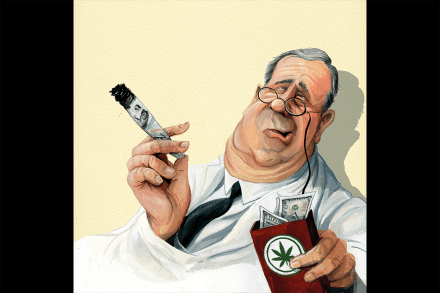
Young people are now more likely to consume marijuana than to smoke tobacco. The social acceptance of tobacco is falling, just as the popularity of weed is getting higher. A 2019 Gallup poll found that 12 percent of US adults (and 22 percent of those aged 18 to 29) said they smoke marijuana. It won’t be too long, I predict, before we look back in horror at the widespread acceptance of cannabis use. It’s easy to forget that anti-tobacco researchers had to plod on at tortoise pace for years before they were able to prove what they had long suspected to be true (and what we all now take for granted): the causal link between smoking and lung cancer. Big Tobacco was so rich and powerful that its lobbying suppressed the true dangers.

cannabis weed

The conservative appeal of drug gangs

From our UK edition

According to the Metropolitan Police Commissioner Cressida Dick, the easing of lock-down will be accompanied by a rise in crime in the capital, including the violent type associated with drug gangs. Just last week, the police recovered two zombie knives, two Rambo-style blades and a kitchen knife at the scene of an attack on a 16-year-old boy in Brixton. But it would be wrong to view this coming crimewave as a problem that just affects London’s underclass. According to Sheldon Thomas, the chief executive of an outreach organisation called Gangsline, a rising number of middle-class teenagers are being sucked into the gangster lifestyle in the wake of Covid. Thomas rather uncharitably attributes this to ‘the phenomenon of loveless middle-class homes’.

Impossibly exciting: Sky Atlantic’s ZeroZeroZero reviewed

From our UK edition

ZeroZeroZero is the impossibly exciting new drugs series from Roberto Saviano — the author who gave us perhaps my all-time favourite TV drama Gomorrah. What I love about Gomorrah is its utter ruthlessness and total artistic integrity. It’s set amid the warring drugs factions of the Neopolitan mafia (the Camorra) and never at any point do you feel that authenticity is being sacrificed for reasons of marketability or politically correct sensitivities or narrative arc. Not without reason has it been called the series ‘where characters die before they become characters’. Saviano himself has paid a terrible price for his honesty.

Japan has the answer to Scotland’s drugs crisis

From our UK edition

As a Scot, I found the news that my country had registered, by some distance, the most drug-related deaths in Europe last year profoundly depressing. But my sprits sank even lower when I saw the reaction. Rather than provoking a genuine debate about how to tackle this crisis, the dismal statistics merely set off yet another round of the Holyrood vs Westminster blame game. There were wearily predictable calls for more money, more treatment programmes, more ‘consumption rooms’, more methadone, and even, for those under the illusion that it isn’t virtually the de facto situation anyway, legalisation. It seems to be accepted as a fact now that a significant number of Scottish people will become dependent on drugs, that drug abusers, like the poor, will always be with us.

Scotland’s drug problem is a national scandal

From our UK edition

You have seen the chart and it is grim. A list of European countries ranked by annual drugs deaths, with Scotland at the top and a long red bar beside it. Scotland recorded 1,264 deaths from drug misuse in 2019, more than twice the number of HIV-related deaths in Somalia and more than double the death toll from terrorism in Iraq in the same year. Two-thirds of deaths were among Scots aged 35 to 54 but there was also an increase among the 15-to-24 demographic. More than 90 per cent involved multiple-drug cocktails, with ‘Street Valium’ cited in two-thirds of cases. The fake benzodiazepines can be bought for 50p a pop on the streets of Glasgow and Dundee.

drugs

White Christmas: the magic of the festive drugs binge

This article is in The Spectator’s December 2019 US edition. Subscribe here. An effective antidote to all this thoughtless zealotry, I find, is to go out for the evening with my friend Trevor. When despair hits total, I know it’s time to ring him up and suggest a small sherry: code for drinking and taking drugs until we’re totally out of our minds, then partying all night. Trevor is a big, strong, hard-working country boy for whom life is invariably a momentous affair. Though he’s a tolerant man, there is a point at which forbearance ceases to be a virtue, and he is an old-school puncher and the man you have to beat if you want the magnetic title of Hardest Man in Town. His catchphrase is ‘Who’s the Daddy?

When will the SNP get a grip on Scotland’s drugs death crisis?

From our UK edition

For more than twenty years, Brian was left to rot on a methadone prescription. Month-after-month of opioid replacement therapy was the best course of action, his treatment team concluded, making no effort to definitively end his debilitating drug dependency. For Brian’s parents, watching their son slowly succumb to the steely grip of addiction, it was two decades of agony. Then, in 2018, a ‘top up’ hit of street Valium proved too much, and – as they put it – he was at last ‘released from his torture’. In Scotland – which has the worst recorded drug death rate in Europe – such stories are disturbingly common. But is the SNP doing enough to tackle an epidemic which is spiralling out of control?

Gone to pot: drugs in the Pacific Northwest

It is two o’clock on an unusually mild December afternoon here in suburban Seattle, and I’m sitting on my back porch smoking marijuana.Passively smoking, I should add, lest I shock any reader by this lapse, but smoking nonetheless. Since 2012, when the voters of Washington State chose to decriminalize it, my part of town has been especially fragrant with the acrid smell of pot. A thick haze of the stuff lingers long in the air these quiet lockdown days.

drugs

Will Self’s memoir of drug addiction is a masterpiece of black humour

From our UK edition

Well, it was always going to be called Will. More than once in this terrifying, terrific book, Will Self refers to ‘nominative determinism’ — the idea that a name somehow foretells a life. That he chooses Will, not Self, is indicative and ambiguous. This memoir — not an autobiography — starts in May and ends in August 1986, but also spirals back to 1979, 1982 and 1984 in the kind of chronological fracturing that has typified his later fictions. It is a chronicle of addiction, and the ‘will’ is everything, from the insistent desire, to a futureless future, to the psychological horror of being called ‘Little Willy’ by his mother. Throughout, he normally refers to himself as Will, but this is not Caesar-style self-aggrandising.

A hard watch, but ultimately a rewarding one: County Lines reviewed

From our UK edition

County Lines is the kind of social realism that the British do so well, if not too well. In other words, a hard watch. In fact, at times it’s so unbearable you might find yourself pressing pause because you’ve suddenly remembered the fridge needs a clean, say. Or the hall: couldn’t it do with a tidy-up? But this tale of a young boy caught up in transporting drugs has to be tough. And there is sympathy, tenderness and hope, too. As for the kid, who is a sort of modern-day Billy from Kes, you will certainly take him to heart. The film is written and directed by Henry Blake, a one-time actor who was a youth worker in London for 11 years.

Is Joe Biden on drugs?

Is Joe Biden on drugs? We should hope so. Look at the state of him when he’s in what Donald Trump calls his ‘low-energy’ mode.Biden’s slurred speech, his Lebowski-like losing of the thread and his near-drooling drawl of ‘C’mon, man’ like an addict begging for a fixall suggest that he has found a leftover Mandrax prescription from the Seventies in the back of his bathroom cabinet. This Biden would be happier reclining semi-comatose in his Corvette with Blue Oyster Cult on the 8-track.Could it be possible that this Biden’s transformation from cataleptic basement dweller into the other Biden, the one who remembers his lines, is chemically enhanced?

biden drugs

‘Cocaine addiction is time-consuming’: the rise and fall of Kevin Rowland and Dexys

From our UK edition

When Dexys Midnight Runners reached No. 1 in the singles charts in spring 1980 with the song ‘Geno’, the band had to travel to London for their coronation appearance on Top of the Pops. For the first time they could afford the train fare. But Kevin Rowland — their singer, leader, creative director, boss, whatever you want to call him — insisted they continue to jump the barriers at Birmingham New Street. ‘I said, “Come on lads, we’re still going to bunk the trains.” And they went, “What?” “Come on, the inspector’s coming. We’ve got to get in the toilets.” And the drummer said, “Kev. We’re No. 1 in the charts and we’re bunking the trains…”. “GET IN!

San Francisco in decay

District Attorney Chesa Boudin personifies everything that’s wrong with San Francisco: weak on drugs, weak on crime, weak on racist assaults and weak, even, on the trafficking of minors. Some say that’s why the campaign to recall him is gaining momentum. Others counter that he doesn’t even matter.Boudin is a son of not one, not two, but four domestic terrorists. His biological parents went to prison for a Brink’s robbery when he was one, surrendering the boy to their Weather Underground bosses Bill Ayers and Bernardine Dohrn, to raise right. The Baby Underground grew up, got a Rhodes scholarship, completed a law degree at Yale, and went to work for the Venezuelan socialist dictator Hugo Chavez.

san francisco

Joyous and very, very funny: Beastie Boys Story reviewed

From our UK edition

The music of the Beastie Boys was entirely an expression of their personalities, a chance to delightedly splurge out on to record everything that amused them. And early on, in their teens-get-drunk debut album, Licensed To Ill, that resulted in obnoxiousness. But mostly they were kinetic and colourful, which is why the new Apple TV+ film about them works so well. The format suits the story. Beastie Boys Story simply documents a stage show where winningly they talk the audience through their personal history. It’s much like Netflix’s Springsteen on Broadway. But since the third Beastie, Adam Yauch, died in 2012, the band no longer perform, so where Springsteen punctuated his memories with songs, the Beasties do it with film clips.

Burnt out at 27: the tragedy of Janis Joplin

From our UK edition

Janis Joplin hated the word ‘star’, but she loved the trappings. As soon as she made serious money she bought a Porsche convertible and had it painted with psychedelic images to make it the most recognisable car in San Francisco. She also rejoiced in her lynx fur coat, courtesy of Southern Comfort. She sent them a file of all the numerous press clippings that said Southern Comfort was her favourite tipple and they responded with a cheque. ‘Oh man, that was the best hustle I ever pulled,’ she crowed to a reporter. ‘Can you imagine getting paid for passing out for two years?’ If only she’d stuck to Southern Comfort she might still be alive (she was born in 1943) instead of dying at 27, like so many rock stars, of a heroin overdose.