Donald trump

Jared Kushner’s international friendships with benefits

In 1998, the conservative intellectual and moralist Bill Bennett published a book, The Death of Outrage: Bill Clinton and the Assault on American Ideals. Bennett had to rush the book out after “I did not have sexual relations with that woman” changed to: “Indeed, I did have a relationship with Miss Lewinsky that was not appropriate.” But the Death of Outrage is almost too quaint a title to capture the age of Donald Trump, especially now that his son-in-law Jared Kushner is back as his closest foreign policy advisor. Trump told reporters who questioned Kushner’s role: “I have Jared. Find anybody more capable.

America’s free-speech war on the EU

If I were a bookie, I would be making odds now about when the European Union will finally unravel and die. Unless there is an imminent and drastic course correction, the blessed event cannot be far off.  I might need a Doomsday Clock akin to the one publicized by the Bulletin of the Atomic Scientists. Their clock hovers near midnight, which signifies nuclear Armageddon, the minute hand pushed closer or farther away from the blast depending on minatory world events. My clock would measure the EU’s proximity to implosion. Its recent decision to fine Elon Musk and his company X €120 million for “non-compliance with transparency obligations” has me nudging the minute hand closer to midnight. “Non-compliance with transparency obligations.” What do you reckon that means?

Peter Thiel predicts the future

Peter Thiel has been described variously as “America’s leading public intellectual,” the “architect of Silicon Valley’s contemporary ethos” or as an “incoherent and alarmingly super-nationalistic” malevolent force. The PayPal and Palantir founder, a prominent early supporter of Donald Trump, is one of the world’s richest and most influential men. Throughout his career, his principal concern has always been the future, so when The Spectator asked to interview him, he wanted to talk to young people. To that effect, three young members of the editorial team were sent to Los Angeles to meet him. What follows is an edited transcript of their conversation.

Epstein, like Russiagate, damns the elite

As President Trump’s first year back in office drew to a close, his enemies had high hopes they’d hit on a scandal that could do to his second term what the “Russian collusion” story had done to his first. Donald Trump didn’t have to be found guilty of any wrongdoing tied to Jeffrey Epstein’s sleaze. All that was necessary was to stain his reputation indelibly and distract his administration from its work. The Epstein weapon even had an advantage over the Russia allegations of yesteryear – it resonated with much of Trump’s own MAGA base. Trump campaigned in 2024 on releasing the Epstein files, and many in MAGA considered it a betrayal when he resisted doing so once back in the White House.

Has Donald Trump succumbed to Trump Derangement Syndrome? 

The director Rob Reiner and his wife Michelle were found dead in their Los Angeles home yesterday. The couple were discovered with their throats slit open; a knife was found nearby on the premises and their son Nick is being held as a suspect. The nation has been stunned by the brutal circumstances of the Reiners' deaths – though the requisite level of empathy is apparently yet to reach 1600 Pennsylvania Avenue.

trump derangement

What’s Trump got to do with the price of turkey?

During last week’s excruciating Oval Office make-nice between an insultingly buddy-buddy American President and a fraudulently obsequious New York City mayor-elect, the contest was over which pol was the more patronising. At one point Trump graciously granted his petitioner permission to call him a ‘fascist’ while clearly implying the guy’s OTT campaign rhetoric had been embarrassing. Donald Trump sat regally on his throne, patting Zohran Mamdani’s arm while commending ‘Attaboy!’ as if petting a golden retriever that had fetched a ball. For his part, Mamdani stood mutely by the Resolute desk with cartoonish humility, hands over crotch. This cowed performance of beta-male submission was meant to disguise who’d got a leg over whom.

The path to peace in Ukraine will be tortuous

From our UK edition

In order to impose peace terms, you first need to win the war. That fundamental principle seems, for the moment, to elude Ukraine’s European allies. Donald Trump, on the other hand, has taken the more pragmatic – some would say more cynical – view that Ukraine will never defeat Russia and therefore needs to make the best of a bad lot. Trump’s strategy for peace in Ukraine has been to browbeat Volodymyr Zelensky into approving a deal acceptable to Vladimir Putin. In fairness, Trump has also gone some way to putting the squeeze on the Kremlin too, by sanctioning the oil giants Rosneft and Lukoil, authorising the Ukrainians to use US--provided long-range weapons against Russian targets, and threatening to provide Kyiv with Tomahawk cruise missiles.

Was the BBC’s Trump edit outrageously wrong?

I should begin by making something clear. Splicing together two parts of a speech to give the impression they were one unbroken excerpt is a grave professional error, and would be viewed as such by any broadcaster in the business. The error would be egregious even if there were no suggestion it reinforced the accusation that Donald Trump was inciting riotous behaviour, simply because what viewers thought they witnessed did not occur. There is no excusing what Panorama did to Donald Trump’s 6 January 2021 speech. Nobody in the senior ranks of the BBC is to blame for not knowing about this at the time; but once it did become known, an immediate and unconditional apology should have been made.

Trump’s Epstein gamble

It is always interesting to see who the American left claims are the leaders of the American right. There was a time during President Trump’s first term when Steve Bannon fitted the role – and relished playing it. Back then most days brought another media profile of the dark genius of the MAGA movement. The Guardian, New York Times and others were obsessed. Vanity Fair would send reporters to follow Bannon as he conquered America and, er, Europe. Documentary crews were perennially in tow. Indeed one documentary following Bannon around included a scene in which they followed him to the showing of another documentary about him from a crew who had similarly followed him around. At which point you felt that we might fall into some kind of vortex.

Portrait of the week: an immigration overhaul, Budget chaos and doctors’ strikes

From our UK edition

Home Shabana Mahmood, the Home Secretary, proposed that refugees would only be granted a temporary right to stay and would be sent home if officials deemed their country safe to return to. They would not qualify for British citizenship for 20 years. To avoid drawn-out appeals, a new appeals body would be created. Article 8 of the European Convention on Human Rights, which protects migrants’ ‘right to family life’, would somehow be weakened. Digital ID was invoked for the enforcement of checks on status. Opponents seized upon the possibility that, to pay for accommodation, migrants’ jewellery would be confiscated.

The new power players running the world

From our UK edition

At the opening of The Hour of the Predator, Giuliano da Empoli describes Spain’s conquest of the Aztec empire, its doomed ruler Moctezuma II’s response (ineffective vacillation, delaying any course of action), its consequences and its relevance to politics today. It is a striking introduction to a brief, bracing and profoundly alarming book. The author argues that an alliance of tech bros and authoritarian rulers – whom he calls modern-day Borgias – are sweeping away the rules-based international order. He sees our elected leaders as comparable to the procrastinating Aztec emperor, appeasing and hesitating as the opportunity for action passes into history. Da Empoli has a peculiar vantage point.

Robert De Niro has a serious case of Trump envy

The past few weeks has seen the pleasing spectacle of beautiful female film stars (Sydney Sweeney, Keira Knightley – even the previous Trump Derangement Syndrome sufferer Jennifer Lawrence, who once said that an orange victory would be ‘the end of the world’) refusing to toe the accepted Hollywood line on politics, be it by not kowtowing to trans activists or not accepting that everything is racist. Lawrence actually said: ‘Election after election, celebrities do not make a difference whatsoever on who people vote for’ – or as I wrote here in the spring: ‘How dim would a political party need to be to understand that not only do celeb endorsements not work, but have an actual repelling effect?

This time it’s crypto: now the Bank of England bows to Trump

From our UK edition

The softening of the Bank of England’s stance on ‘stablecoins’ looks like another tugging of the British forelock towards the Trump regime. Stablecoins are virtual money akin to cryptocurrency, but theoretically safer because their value is pegged to the dollar or other conventional currencies. Often used by investors to buy into crypto, they’re claimed to offer a more efficient future for international payments – but also accused of facilitating crime. Two years ago, Governor Andrew Bailey decreed that stablecoins did not ‘meet the standards we expect of safe money’; other non-US regulators largely agreed. That well-known crypto player Donald Trump, however, called them ‘perhaps the greatest revolution in financial technology since the birth of the internet’.

How to fix the BBC

From our UK edition

Assuming the BBC is still in existence by the time you read this, the scale of the task facing the next director-general would have been evident by listening to the output on Monday, the day after Tim Davie and Deborah Turness resigned. This was an organisation in utter denial. It began with Nick Robinson, puffed up with even more pompous self-regard than normal, treating Today listeners to a psychedelic monologue in which he disappeared down several capacious rabbit holes, jabbering about a sort of palace coup at the BBC, an assault by sinister right-wing forces.

The golden thread between Donald Trump and Nero

From our UK edition

Donald Trump has knocked down the east wing of the White House and is turning it into his Golden Ballroom. Might he be tempted to go a step further and build a Golden House (Domus aurea), as Nero did? Nero was as besotted with gold as Trump is. He wrote poems in gold, preserved his first beard in a golden box, possessed a golden fishing net, had a golden box of poisons and golden chamber pot, and shod his second wife’s mules in gold. When the king of Armenia visited, he had the theatre of Pompey – the stage, the walls, everything – somehow gilded. In 64 bc a devastating fire hit Rome (was Nero complicit?). Only four out of Rome’s 14 regions were untouched.

Lord Young goes to Washington

I’m writing this from Washington, D.C., where I’ve spent the best part of a week talking to politicos and thinktankers about the state of free speech in the mother country. Don’t believe our Prime Minister when he says it’s in rude health, I’ve been telling them. It’s on life support and any pressure that can be brought to bear on His Majesty’s Government to protect it would be hugely appreciated. Once again, it’s time for the new world to come to the rescue of the old. Not that they need much convincing. The view of Britain among Washington’s political class isn’t informed by diplomatic cables or articles in the Economist, but by viral videos on X.

Portrait of the week: Train stabbing attack, Mamdani takes New York and the Andrew formerly known as prince

From our UK edition

Home The King ‘initiated a formal process to remove the Style, Titles and Honours of Prince Andrew’, who is now known as Mr Andrew Mountbatten Windsor; his lease on Royal Lodge, Windsor, was relinquished and he made a private arrangement with the King to live on the Sandringham estate. His former wife, Sarah Ferguson, will find her own accommodation. Their daughters remain Princess Eugenie and Princess Beatrice. Richard Gott, who resigned as literary editor of the Guardian in 1994 after The Spectator accused him of having been in the pay of the KGB, died aged 87. Gopichand Hinduja, the head of Britain’s richest family, died aged 85. Eleven people were taken to hospital after a stabbing attack on a train from Doncaster to London, which began after it left Peterborough.

You can’t trust the BBC

From our UK edition

You may remember that in February the BBC found itself in a spot of bother regarding a film about the conflict in Gaza which, it transpired, had been narrated by the son of a Hamas minister. Some people, not least Jewish people, wondered if such an account perhaps might accidentally stray into the realms of partisanship, and the BBC was forced to withdraw the documentary forthwith. It then commissioned an internal report into why this young lad had been chosen to front the film, rather than, say, Rylan Clark or Clare Balding. As a consequence of the investigation, the BBC’s head of news, Deborah Turness, sent a round robin email to all BBC staff. Only now, nearly nine months later, can I reveal the disturbing truth about what Ms Turness told her colleagues.

Gilded age: the lessons from Trump’s second term

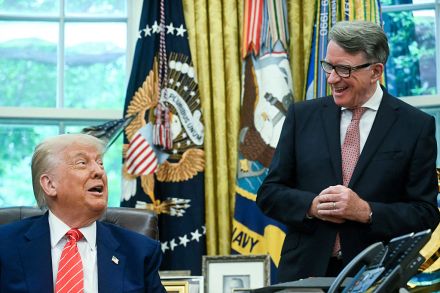
Washington, D.C. When John Swinney, the SNP leader, and Peter Mandelson visited Donald Trump in the Oval Office a few months ago, the President showed them three different models for his planned renovation of the East Wing of the White House, which he has demolished to build a new ballroom. ‘If you’re going to do it,’ Scotland’s First Minister suggested, ‘you might as well go big.’ This Wednesday marked one year since Trump’s election victory, and going big captures the essence of his second term – bold and controversial moves, which have impressed even British politicians who thought him reckless in his first term.

Who would want to be a housebuilder in Britain?

From our UK edition

In a radio discussion of the Renters’ Rights Act which passed into law this week, I heard ‘Britain’s housing emergency’ referred to as a given fact. If that’s so, then the housebuilders who create supply and feed home-owning aspirations ought to be public, political and stock-market heroes. But they’re not – and it’s worth asking why such an essential sector has fallen so far out of favour. Think back to Sir Lawrie Barratt, who built 300,000 houses and achieved fame with 1980s television ads featuring a strong-jawed actor as Barratt himself arriving by helicopter to inspect the latest show house.