Diary

I’m glad Anthony Powell didn’t take my writing advice

From our UK edition

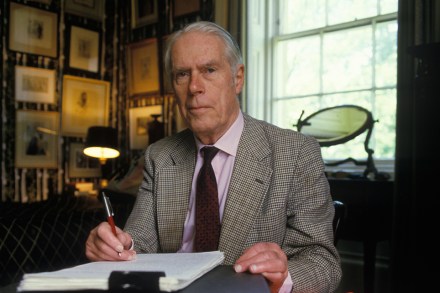
There is general excitement among the legions of fans of A Dance to the Music of Time: next week a plaque to Anthony Powell will be placed on 1 Chester Gate, the house where he started to write the many-volumed work of genius. I have a particular interest in attending, not only because Powell was married to my father’s sister Violet, but also because I took advantage of the relationship to lodge for several years in Chester Gate. This was when my parents chose to live maddeningly in Hampstead Garden Suburb and at the age of about 17 I was beginning to go to parties. Go to them? But how to return? That was the problem. No taxi would go so far. I batted my eyes in vain. Fortunately, Violet was one of the kindest and most tolerant people I have ever encountered.
Summer vacation fatigue

Alexandria, Virginia I entered summer with the following list of tasks: convert the shed into an office; discard several tons of debris from the storage room; assemble that Amish treehouse that’s been sitting in the yard; chop down the ash tree. A gust of wind took down the crabapple tree right before the Memorial Day barbecue. On the guest list: my younger brother, who moonlights as an unlicensed contractor; my wife’s cousin who built his own home; and Terry Schilling, who constructed a luxury treehouse. A normal man would have leaned on such a guest list to get the work done for him. A writer self-conscious about his manliness would make a show of chopping the tree up with the dull blade of a cheap chainsaw.

summer

The diary of a tortured man: Deceit, by Yuri Felsen, reviewed

From our UK edition

Yuri Felsen, born in St Petersburg, was an exile in Riga, Berlin and Paris and died at Auschwitz in 1943. Had his archive not been destroyed, we might find him on the same shelf as Vladimir Nabokov, Vladislav Khodasevich and Ivan Bunin – the glittering Russian literati of 1930s Paris – and Georgy Adamovich, who said that Felsen’s prose ‘left behind a light for which there is no name’. With this new translation of the 1930 novel Deceit, that light has been brought back from dim obscurity. In this first of three novels Felsen published, we follow the unnamed narrator’s tortured obsession with the ‘unequivocally irresistible’ Lyolya Heard, who drifts in and out of his life in Paris, leaving him in an intoxicating loop of ecstasy and despair.

Reminders of the Cold War in Vienna and Budapest

Apparently an acquaintance has dubbed me the “Kremlinologist of the right.” Redolent as it is of the Cold War-era drama surrounding the Kremlin, when the West was desperately trying to suss out what Winston Churchill called a riddle wrapped in a mystery inside an enigma, I could hardly object to this quip upon learning of it. Indeed, I recently traveled to two hot spots of the Cold War, Vienna and Budapest. I went full immersion in Vienna, where I attended a screening of Orson Welles’s The Third Man, a humdinger of a movie if there ever was one. Graham Greene set it in postwar Vienna, which was divided between the four occupying powers, France, Great Britain, America and the Soviet Union.

Cold War

Confessions of a media chronicler

We held the party for my new book, Traffic, at Umberto’s Clam House, by the office of our new news organization, Semafor. Umberto’s is best known as the site of a notorious 1972 mob hit — “they blew him down in a clam bar in New York,” Bob Dylan sang of Joey Gallo. I’d worried the space was too small, but it was perfectly packed and noisy, with blue oil paintings of crabs on the walls. I broke off a conversation with CNN president Chris Licht to take a call from a recently fired anchor from another network. When I came back our executive editor Gina Chua began the short program by spilling who I’d been talking to.

ben smith

I was injured covering Ukraine — but I’ll work my way back

A little over a year ago, I was gravely injured in a missile blast while covering the Ukraine-Russia war for Fox News. The severity of my injuries has made recovery a very long and arduous process. Every day I have a number of things I have to do. So in the morning, I’ve got about an hour and a half or so of facing all the problems that have popped up overnight. I do a lot of exercises, a lot of stretches. I do a lot of balance work. Everything from using rubber bands to try and get my thumb to move a little bit more to taking care of my burns because if I don’t, they break open and bleed a lot. I do that every single day. The list is honestly endless, and the beginning of every day is tough. I tell myself that the worst part of the day is finished in the morning, which is great.

recovery

The RNC should tell us who gets to make the debates

My favorite campaign moment since I announced I was running for president was at the Machine Shed, a restaurant in Urbandale, Iowa. Of course, we all love a packed house and an energetic crowd, but I thought the questions asked were really authentic and suggested to me that there was a level of trust that I have started to build in the community. One person said they liked what I was saying, but wanted to know how I could represent Americans as a Hindu when we’re founded on Judeo-Christian principles. I love that. To be in a full room with a couple hundred people and someone stands up and looks me in the face and asks me that? That’s pretty inspiring. I told them that our basic values are the same, including the emphasis on family.

campaign vivek ramaswamy

Sheila Hancock takes pride in her irascibility

From our UK edition

This book begins with Sheila Hancock wondering why she is being offered a damehood. I must say I slightly wondered too, but it seems that most actresses become dames if they live long enough: vide Joan Collins, Penelope Keith, Joanna Lumley etc. And Hancock, as well as acting and making brilliant appearances on Radio 4’s Just a Minute, also does lots of charity work. She considers refusing the honour because ‘it’s hardly in keeping with my Quaker belief in equality’, but decides ‘no, it would be dreadfully rude and ungracious’. Anyway, she admires the Queen, and also Prince Charles, who left flowers and a handwritten note on her doorstep when her husband John Thaw died in 2002. So Dame Sheila it is.

Every village needs a kebab shop

From our UK edition

‘A diary?’ said the lady in the chintzy gift shop, pronouncing the word very much as Edith Evans said ‘handbag’ in the 1952 film of The Importance of Being Earnest. ‘Yes,’ I said, ‘a diary. Do you have one?’ I was standing in the middle of a shop so like one that would sell a diary that I could not express quite adequately how obvious I thought it was that they might. This gift shop and café is on the high street of the village where I live and is easily one of the prettiest gift shop/cafés you have ever seen. It has every kind of pretty thing inside, from greetings cards and novelty books about wellbeing to china cups, shawls and rugs, lamps, pictures and doggy-themed place mats. ‘No!

The view from the Paris bus — an appreciation of everyday life

From our UK edition

Many would say the commute was one thing they didn’t miss in lockdown. But when Lauren Elkin was ‘yanked out of the public sphere and resituated, inescapably, in the private’, she felt nostalgic for the bus’s incidental intimacy. The Franco-American writer and translator revisited notes made on her iPhone between September 2014 and November 2015, after she pledged to ‘observe the world through the screen of my phone, rather than to use my phone to distract myself from the world’. The diary entries record biweekly journeys between her home in Paris’s fifth arrondissement and the university where she taught in the seventh. These private jottings take shape as No.

The tragedy of Lebanon — from safe haven to bankruptcy

From our UK edition

Mountains are humanity’s most comforting topographical feature. Wherever you find them you will also find those who have flocked to them for refuge. The Kurds, the world’s largest stateless people, span the most mountainous areas of their host states, while ‘Lebanon’ referred originally to the mountains in the eastern Mediterranean that for centuries served as a haven for all the region’s minorities. First came the Christian Maronites, fleeing the persecution of the Orthodox Byzantine Empire in the 7th century; then in the 10th and 11th centuries the Shiite Muslims, persecuted by the Sunni powers; followed by the Druze, persecuted by the Shiites.

Abandoned by Paul Theroux: the diary of a sad ex-wife who sadly can’t write

From our UK edition

When I interviewed Paul Theroux 21 years ago at his home in Hawaii, there were already rumours that his ex-wife Anne had written a book about him. In fact their son Marcel said in an interview that she had sent Paul the manuscript. Theroux denied it to me, and said breezily that he wished Anne would write a book, because then she’d have greater respect for the work involved. And: I don’t see that if she wrote a book it’s going to be an attack on me. I don’t think it’ll be ‘I discovered his lies’. So it doesn’t worry me. I’m sure she’d show it to me, but it doesn’t really matter — I’m happy to just buy it off the bookstalls. So is this the long-awaited book?

The problem with Brighton’s summer hordes

From our UK edition

I expect there are those among you who are pleased to see their home towns returning to something like normality this summer. Well, not me. Brighton and Hove was bliss during lockdown. Without the endless Southward drift of London chaff – pronounce that word anyway you feel works, hard F or soft – my adopted home regained something of the elegance that had led Noel Coward to include it and its seagulls in a list of things that have style. Now, it has become once again the Brighton that Keith Waterhouse said, had the perpetual air that of a town that is helping the police with their inquiries.

Christmas at the manor

Virginia  Christmas will be different this year. Our refrigerator’s death was like Socrates’s: it began at the bottom and moved gradually upward, eventually yielding up its Freon eide to the empyrean, or at least the ozone hole. Such a death in early November raises big questions about holiday-making, or would most years, with Thanksgiving upon us and Christmas not far behind. But with COVID rampant, we’re admonished to stay home, and will, which dovetails conveniently with the fact that because of the virus, supply chains are banjaxed and we won’t get our new fridge till Boxing Day. (And refrigerator boxes are the best boxes, so there’s the grandchildren’s Christmas taken care of.

christmas manor

Monuments and memorials in Maryland

Easton, Maryland Three weeks before the election, I went to an event here in Easton where writers of various kinds — journalists, historians, speechwriters — read texts about political rhetoric and discussed them around a seminar table. Is rhetoric a set of tricks, as Socrates said, or an art, as Aristotle would have it? Lately politicians seem so constrained by propriety that they cannot say anything at all. Barack Obama ended his speech to the Democratic National Convention in August with ‘God bless.’ Sorry, God bless what? America? Joe Biden? Or did someone sneeze? In front of the Talbot County Courthouse in Easton is a beautiful monument to the 85 ‘Talbot Boys’ who fought in the Civil War.

maryland

Blonde with a bombshell: Sasha Swire’s revelations about the Cameroons

From our UK edition

Ten years ago, reviewing Alastair Campbell’s diaries for The Spectator, I concluded as follows: Who will be the chroniclers of the Cameron government? Somewhere, unknown to his or her colleagues, a secret scribbler will already be at work, documenting the rise and, in due course, no doubt, the fall of this administration. Well, here it is. It comes from an unpredictable source deep inside that privileged little caste who governed us between 2010 and 2016: Sasha Swire, wife of Hugo, a middle-ranking minister MP for a safe seat in rural Devon and a man who, for all that he was a low-key figure, has a very sharp wit and is fabulously well-connected (he once even walked out with Jerry Hall).