Defence

Strategic differences

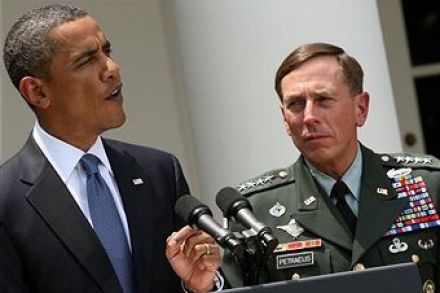
When President Obama asked General Petraeus to take over the Afghan command after General McChrystal’s Rolling Stone implosion, there was much speculation that the two men would clash over the date for America to begin withdrawing troops. Obama had set down July 2011 as the starting point but Petraeus was almost certainly going to want more time than that. In Petraeus’s Meet the Press interview on Sunday, Petraeus made clear he might argue that withdrawal cannot begin that quickly ‘MR. GREGORY:  I just want to clarify this.  Did — could you reach that point and say, “I know that the process is supposed to begin, but my assessment as the

IDS wins his battle, now the eyes turn to Fox

Iain Martin reports that IDS has secured a £3bn fund to meet the upfront costs of his benefit reform. ‘To help ensure that IDS can make the cuts which unlock his funds for welfare reform, I am informed that Number 10 and the Treasury now accept that some of the commitments made by David Cameron before polling day to protect specific benefits will have to be revisited and potentially watered down. In return, IDS is being urged by colleagues to accept that he cannot behave like a bull in a china shop. Says one: “He has been immersed in welfare reform for years. But he can’t present his solutions as

Waiting for the autumn

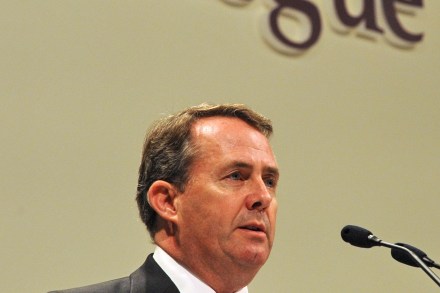
A curious, intermediate kind of speech from Liam Fox this morning. The general emphasis on streamlining the armed forces, and shifting power away from Whitehall and towards the military, was welcome. But we’re going to have to wait for a trio of reviews before we know what that will look like in practice: the Spending Review, the Strategic Defence Review and a review by the new Defence Reform Unit, chaired by Lord Levene. As Douglas Carswell points out, Levene has fought for choice and competition in defence procurement before now – so we have an idea of where his review will head – but, for the time being, it’s still

Progress in Afghanistan?

The Times (£) is reporting that ISAF has made a significant progress in pacifying the death circle around Sangin. The key, it seems, is driving a wedge between the tribal insurgents and religious insurgents foreign to Helmand: ‘British commanders believe that they are close to achieving a significant tribal uprising against the Taleban that could lead to the reintegration of hundreds of insurgents fighting around Sangin, the most dangerous place in Afghanistan. The number of violent incidents in Sangin has fallen by about 80 per cent in the past month. British commanders believe that this is partly the result of tribal leaders delivering on a promise to restrain tribal elements

"Henceforward all men everywhere will be living on the edge of a volcano"

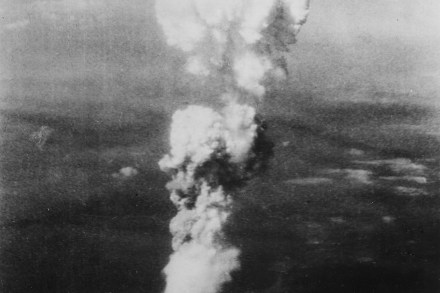
With today being the 65th anniversary of the bombing of Hiroshima, I thought I’d excavate The Spectator’s leading article from the time:    A Crisis of Civilisation, The Spectator, 10 August, 1945 In Mr Churchill’s statement about the atomic bomb issued by Mr Attlee on Sunday exultation at having anticipated the enemy gave way to awe. Mr Churchill spoke of this “revelation of the secrets of Nature” as one “long mercifully withheld from man.” So terrific a power of destruction is now known to be in the hands of the Allies that in retrospect we can see that the race between the scientists threatened to be the decisive factor in

The government could make political and fiscal gains if it reviews the Trident upgrade

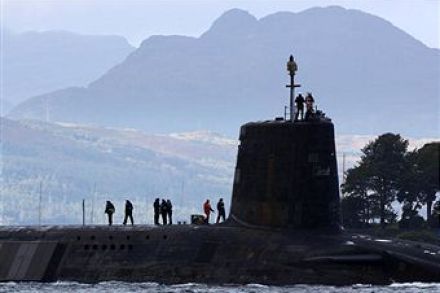
On one level, there is something admirable about the government’s uncompromising support for a Trident upgrade: senior Tories really do believe in the deterrent’s strategic importance, and are not willing to sacrifice that. But, on many other levels, that same inflexibility is looking more and more unwise. Three former senior military figures write to the Times today with a new riff on a point that they have frequently made before. Why not squeeze another 15 years out of the current system, they say – by which time, “the anachronistic and counterproductive aspect of our holding on to a nuclear deterrent would be even more obvious.” This is an argument with

Zardari drops a rhetorical bombshell

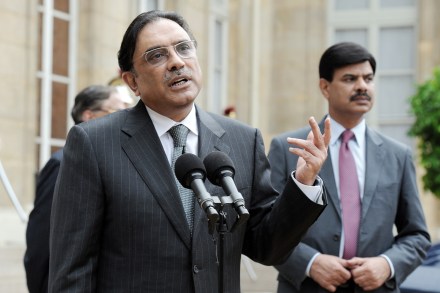
David Cameron isn’t the only world leader who can lob rhetorical hand-grenades about the struggle in Afghanistan, you know. Speaking ahead of his visit to the UK, Pakistan’s President Zardari has said that the “international community … is in the process of losing the war against the Taliban.” Adding that, “And that is, above all, because we have lost the battle for hearts and minds.” Given his pivotal, front-seat role in proceedings, it’s got to go down as one of the most significant statements on the war so far. Is this intended as a riposte to Cameron’s remark about Pakistan and terrorism? I’m not sure. In the same interview, Zardari

Dannatt's departure means one less cook stirring the defence broth

So Sir Richard Dannatt has departed the Tory fold almost as curiously as he entered it. Sure, have been no gaffes from Chris Grayling this time around – but when it was announced last October that the former head of the Army was advising David Cameron, it was widely expected that he’d graduate to become a peer and a minister in any Tory government. But today he announces his “retirement” as neither. The Tories are downplaying all this, eager to avoid a repeat of the speculation that surrounded Sir Alan Budd’s departure. And, to be fair, there are few signs, as yet, that this is a viciously unamicable split. But

The coalition's Lib Dem conundrum

Yesterday, a “source close to the Prime Minister” told the Telegraph that we shouldn’t bother much with the opinion polls as at the moment. As they put it, “we’re only a few weeks into a new Parliament and we’ve got nearly five years to go before everyone really has to worry about the polls again.” But, make no mistake, there will be Lib Dems who are deeply concerned by how their party is polling at the moment. The YouGov poll in today’s Sunday Times, which has the yellow bird of liberty stuttering along at 12 percent, only underlines a remarkable decline since the election campaign (see chart above). The pressure

The past few weeks have made the struggle in Afghanistan even more difficult

Domestically speaking, it has been an encouraging week from the coalition. Internationally speaking, less so. And today we see the first real rush of fallout from David Cameron’s appearance on the world stage, as the Pakistani intelligence agency cancels a visit to London, “in reaction to the comments made by the British Prime Minister against Pakistan.” It’s not the kind of development that we should exaggerate –after all, it still looks likely that President Zardari will visit Cameron next week, even if officials in Pakistan have been wavering on that front. But we shouldn’t underestimate it either. The main reason to worry is, largely, one of personality. The Times runs

The coalition needs to think harder about renewing Trident

What do we have here, then? Another public disagreement between Downing Street and Liam Fox? Certainly looks that way, as George Osborne assures an interviewer in India that the entire cost of Trident should be borne by the Ministry of Defence’s budget. As the Telegraph reminds us, Fox suggests that the running costs of Trident should be part of the MoD’s responsibilities (as they are currently), but the approximate £20 billion capital cost of renewing the nuclear deterrent should be paid for by central government. In his words, on Marr a couple of weeks ago: “To take the capital cost would make it very difficult to maintain what we are

A General meeting

The machinery of British foreign policy has been transformed to accommodate a larger role for DfID; that is one reason why the aid Budget is increased. Andrew Mitchell is a canny operator, but he has a task on his hands to carry his department with him. DfID is ruled by three warring tribes. The bleeding heart tribe, who want to give oodles of cash to developing countries and leave them to it; the anoraks, who allocate pounds, pencils and penicillin per head of population; and the realists, who recognise DfID’s role in conflict zones. The government is keen that the latter group triumph; this is not the era of money

Pakistan's double game in Afghanistan

So what is Pakistan up to? Cameron has a point: it is playing a dangerous double game which I once outlined in a piece. But in today’s Spectator, it is all spelled out by a writer who is – in my view – the best authority on this mess and by some margin. Ahmed Rashid, whose book Descent into Chaos is the definitive work on the Afghan war, explains that Karzai has effectively switched sides – he’s given up on Nato (as, it seems, has Cameron) and now wants Pakistan to preside over talks with the Taliban: ” A few months ago Hamid Karzai would have been thrilled to have

WikiLeaks rightly suffers a backlash

Is it just me, or is there something deeply unsettling about Julian Assange’s comments in the Times today? After the paper revealed yesterday that the leaked Afghan War files could easily put informants’ lives at risk, the WikiLeaks founder sets about defending his decision to publish them – and he does so in dangerously complacent terms. Take his opening proclamation, where he says: “No one has been harmed, but should anyone come to harm of course that would be a matter of deep regret — our goal is justice to innocents, not to harm them. That said, if we were forced into a position of publishing all of the archives

Few smoking guns in these leaks

Courtesy of WikiLeaks, the Guardian and The New York Times have obtained classified documents pertaining to the killing of civilians in Afghanistan and the duplicity of Pakistani spies. The White House is furious, condemning the leaks for ‘endangering US and allied servicemen’ on active duty – a statement that seems reasonable until the White House added that the documents pre-dated President Obama’s assumption of office and that they ‘do not reflect current on-ground realities’. But that makes the allegations contained therein irrelevant or dated. Judging by the two newspapers’ coverage, the leaks are vague and certainly not novel. It’s obvious that Pakistan is an unwilling ally, and one which has its

Self-interested Britain

Liam Fox is in the most invidious position. It is hard enough to secure significant budget cuts against vested interests that maintain anti-competitive procurement; and being at war deepens the task. Cuts of 10 to 20 percent must be made but at the same time Fox acknowledges, in an interview with the Telegraph, that: ‘We have to keep sufficient land forces to hold territory if required, we have got to maintain enough maritime power and we have got to maintain air power to maintain air superiority.’ Like all defence secretaries, Fox is trying to contain the warring service chiefs, their temperaments exacerbated by the coming cuts. Fox is even handed.

The RAF is in danger of being destroyed on the ground

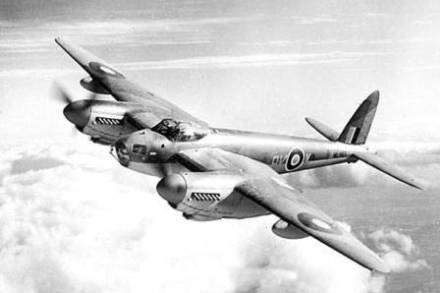
Liam Fox is anticipating the Strategic Defence Review, preparing the services for what will be extremely bad news. Britain will not engage in large scale operations in the immediate future. The Telegraph reports that officials intend to reduce the number of strike aircraft, warships and tanks. Future strategic emphasis will be on maximising firepower and range and minimising direct and associated costs. The service arms have mobilised their writers to prepare a defence. The Times have hosted a set-to between Air-Vice Marshall Tony Mason and Major General Julian Thompson. Mason’s argument is simple: warfare is determined by air superiority. He writes: ‘Since Dunkirk, British Armed Forces have usually fought beneath

Out by 2014

It remains a hope, but Hamid Karzai wants his country to control its own security by 2014. Karzai echoes the MoD’s stance – revealed at the weekend courtesy of a leaked internal communiqué. Surely this is more than coincidence? 2014 would seem to be NATO’s preferred withdrawal date. At last, the politicians have dispelled some of the indecision which has marred operations recently. With politicians beginning to agree to stay until at least 2014 and having bolstered aid budgets, the military can now concentrate on ‘stabilising’ incendiary parts of the country. Whether it will receive the resources needed to protect reconstruction and secure lasting stability remains to be seen –

The chaos of military deadlines

The leaked communiqué, obtained by the Independent on Sunday, stating that British troops will not be fighting in Afghanistan by 2014 has further confused the Afghan war at a time when clarity is necessary.  There are now two deadlines, or aspirations of a withdrawal at any rate. Liam Fox is polluting the airwaves with specious waffle about 2015 being a ‘conservative assessment’, but of course the troops will probably be home earlier, but then again they might not, but then again we don’t really know. Well, Dr Fox, if that’s the case it’s best to say nothing. Amid this disorder, Andrew Mitchell has announced that aid to Afghanistan will be