Death

Dead expensive

From our UK edition

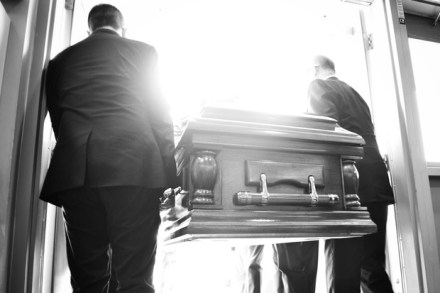
They say that death and taxes are the only two certainties in life. But there seems to be a third, linked to death and as painful as taxes. It’s the astronomical cost of organising a funeral. My partner’s father died recently, and for the honour of a bog-standard cremation in a far from fashionable part of East Anglia she was charged just over £4,000. Jo felt no shame in asking for the cheapest option (it’s what her father would have wanted — he was never a man to waste money), and so the answer came as something of a shock. When a figure has you imagining the cheeky little jaunt to the Caribbean it could fund instead, you know things have turned serious. ‘How the hell do they justify four grand?’ I asked. Jo went through the itemised list.

Long life | 7 May 2015

From our UK edition

It’s more than four months now since my 75th birthday, but I’m still waiting for a ‘cold call’ from the NHS to ask if I have ‘thought about resuscitation’. This is what the Daily Mail warned me last week that anyone over 75 might now receive. As it so happens, I do quite often think about resuscitation, though only in the sense that I would like to be somehow revived when I fall asleep at my desk. But the Mail was talking about something different: NHS guidelines by which doctors are required to ask their elderly patients if they would like to be resuscitated when they suffered a heart attack or a stroke or other such life-threatening events.

All the pomp of family life

From our UK edition

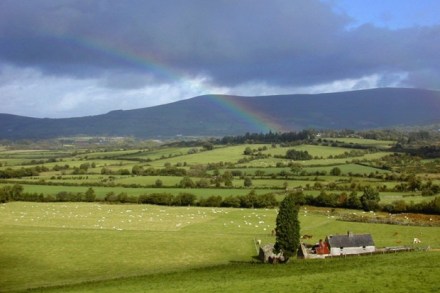
The Green Road is a novel in two parts about leaving and returning home. A big house called Ardeevin, walking distance from an unnamed town on the coastline of County Clare, is home to the Madigan family. At the centre of the family is Rosaleen Madigan, the matriarch: ‘A woman who did nothing and expected everything. She sat in this house, year after year, and she expected.’ The novel begins with the thwarting of one of Rosaleen’s expectations. She has taken to her bed in 1980 after Dan, the eldest of her four children, has announced that he is going to become a priest. Each of the first four chapters focuses on a Madigan sibling — Hanna, Dan, Constance, Emmet — and maps the escape routes they take out of rural Ireland in adult life.

Presence of mind

From our UK edition

‘It’s hard to know how to tell this story,’ she said as she began. ‘Because it’s so loaded. It’s so heavy-duty.’ Lore Wolfson was talking about the death of her husband, Paul, or rather about the onset of the illness that led him a year later to take an overdose of heroin, aged 61. He had been diagnosed with early-onset dementia, in a peculiarly aggressive form, rapidly losing his words, his memory, his capacity to work or function independently. Lore began recording her conversations with Paul very soon after they knew for sure why he was having word-finding difficulties. ‘It was the natural thing to do,’ she said, because she’s a radio producer and, for her, keeping an audio diary was more natural than writing things down.

If British democracy worked, we would have had a referendum on the death penalty

From our UK edition

Nice to know, isn’t it, that public attitudes are finally catching up with MPs’? It seems, from the Social Attitudes survey, that finally, half a century after parliament suspended the death penalty, 48 per cent of people no longer want the death penalty reintroduced. Opinion has been stubbornly in favour of it ever since 1965, and that was also true in 1998 when the Human Rights Act forbade capital punishment outright. In other words, until now, MPs have been wildly at odds with the opinion of most voters on an undeniably important issue. I’m unsure exactly where I stand on the issue myself, though I’ve always felt the guillotine would have been my own choice of method if it came to it.

Anne Tyler’s everyday passions

From our UK edition

There was nothing remarkable about the Whitshanks. None of them was famous. None of them could claim exceptional intelligence, and in looks they were no more than average….Their family firm was well thought of. But then, so were many others. But like most families, they imagined they were special. So, you know what you will get in this novel, which Anne Tyler says will be her last, and that is the stories of three generations of the Whitshanks, a straightforward, unexceptional Baltimore family. We have been here before.

You realise how little you know of anybody when they die

From our UK edition

Whether or not you believe in the afterlife, death remains an impenetrable mystery. One moment a person is making jokes and comments and observations about life; the next he is gone. What has happened to that store of wit and wisdom acquired over a lifetime, to that particular way of understanding and looking at things, to that unique muddle of thoughts and feelings that every individual has? Even if someone has gone to heaven, it is difficult to imagine that he has taken these things with him. If he did, they would hardly be compatible with eternal rest.

Here I am on Twelfth Night with nothing but benevolence to look back on

From our UK edition

For the past two and a half years my brother John has been living next door to me in the Northamptonshire countryside. We have both been most of the time alone in our separate houses, 25 yards apart, and, whenever I’ve been there, I have shared at least one meal a day with him. It was a very cosy and mutually supportive set-up. Then, on New Year’s Eve, he suddenly died. His death wasn’t exactly premature — he was 87 and increasingly debilitated by Parkinson’s disease — but it came as a shock nevertheless. On the two last evenings of his life he had come over to my house to have supper and watch his daughter Anna star with Miranda Richardson in the three-part television adaptation of E.F. Benson’s Mapp and Lucia.

All you’ll ever need to know about the history of England in one volume

From our UK edition

Here is a stupendous achievement: a narrative history of England which is both thorough and arresting. Very few writers could pull it off. Either they’d have an axe to grind, or they’d lose perspective, or they’d present a series of anecdotes, or they’d end up in a Casaubonish pursuit of other historians’ errors. In fact, to get it right, you’d ideally be a mature and accomplished author, steeped in the facts, who was nonetheless tackling English history for the first time. Which is more or less what Robert Tombs, a professor of French history at Cambridge, is. ‘A writer of history ought, in his writings, to be a foreigner, without country, living under his own law only,’ claimed Thomas Hobbes, adapting Lucian.

Life is full of little endings. We should pay them more attention

From our UK edition

The end of the year seems a good time to think about lasts. Not many of us ever do. Firsts are always landmarks: the first time you taste alcohol, drive a car, have sex. Then the first time your child talks, walks, goes to school. All are noted at the time, stored away in the mental file marked ‘life events’. But when do we ever notice, much less remember, a last? We’re doing them a disservice — in many cases they’re even more poignant than the firsts. One problem, of course, is that we often don’t know it’s a last at the time. You’ll register your last day in a job, or your last exit from a house you’ve owned. Recovering alcoholics note (though only in retrospect) the occasion of their last drink. But the last time you go to London?

We know that war is hell. But it doesn’t ever make us stop doing it

From our UK edition

There’s a plausible theory — recently rehearsed in the BBC’s excellent two-part documentary The Lion’s Last Roar? — that our war in Afghanistan was largely the creation of the Army, which sorely needed a renewed sense of military purpose after the debacle in Iraq. As a taxpayer, this appals me. As the parent of a boy approaching conscription age it horrifies me. But as an Englishman, it doesn’t half make me proud that we’ll still do anything — up to and including embroiling ourselves in a futile conflict — rather than admit we’re finished as a fighting nation.

Have scientists really found proof of life after death?

From our UK edition

When I finally reached the hospital, my grandma had already lost consciousness. As soon as I saw her, I could tell she wouldn’t wake up again. We all stood around and waited, and hoped it wouldn’t take too long. I sat on the bed and held her hand. Thankfully, it only took an hour or so. Eventually, the nurse came in and checked her pulse and told us she was dead. Except she wasn’t. Not exactly. The nurse was right – her heart had stopped – but from the way she held my hand, I could tell she was still there. I didn’t say anything. I knew she’d be gone soon enough. For a few more minutes I kept her company, stroking her hand while everyone else fussed around us. It was an extraordinary sensation, one of the oddest moments of my life.

Jeremy Vine’s diary: Zipcars, hipster milk and the word that means I’m losing an argument

From our UK edition

Last Tuesday I tried to sign up to a new life. My wife and I argued, slightly. ‘I don’t think this will work!’ she laughs, and I reply feebly: ‘But babe, it’s the future.’ (My use of the word ‘babe’ is like a label on the conversation — WARNING: HAVING ARGUMENT WHICH I AM ABOUT TO LOSE). She protests that she needs a car for ferrying kids and clearing the allotment and occasional 5.30 a.m. starts at work, and I produce a small piece of plastic and wave it, like Neville Chamberlain. This is my trump card. I have signed up to Zipcar. With this rectangle I can unlock a hire car from a nearby street and just drive. ‘It will be the end of petrol, insurance, repairs, mud and road tax!’ I say.

Clive James on his late flowering: ‘I am in the slightly embarrassing position where I write poems saying I’m about to die and then don’t’

From our UK edition

Clive James has published a new poem days before we meet. It opens, ‘Your death, near now, is of an easy sort’. It is about a Japanese maple his daughter has planted in the garden of his Cambridge home where we are sitting, and whether the poet will live to see the leaves flame red this autumn. The poem has made news. ‘At the moment,’ he says, laughing, ‘I am in the slightly embarrassing position where I write poems saying I am about to die and I don’t. My wife is very funny on that subject.’ It is part of an astonishing late body of work. This month there is a new book of writing on poetry, Poetry Notebook.

Seven things you need to know about George Osborne’s abolition of the pensions death tax

From our UK edition

The good news on pensions just keeps on coming. Today, at the Conservative Party Conference in Birmingham, George Osborne will today announce the abolition of the draconian 55 per cent pension death tax. There'll be no inheritance or income tax if funds passed on as pension. There had been expectations of this being cut, perhaps to 40 per cent, but the Chancellor has decided to abolish this altogether. I gather this wasn't due to be announced until the Autumn Statement on 3 December, but the Chancellor has brought the news forward to gather some positive headlines. A chunk of his speech has been trailed: "People who have worked and saved all their lives will be able to pass on their hard-earned pensions to their families tax free.

Why do we care about the mutts from Manchester and not the chickens from KFC?

From our UK edition

[audioplayer src="http://traffic.libsyn.com/spectator/TheViewFrom22_25_Sept_2014_v4.mp3" title="Melissa Kite, Camilla Swift (and Charlie the dog) discuss animal welfare" startat=630] Listen [/audioplayer]We love animals more than we love people. Of course we do. Following the recent fire at a Manchester dogs’ home, people donated £1 million and blocked the M6 with their cars as they arrived in their multitudes to adopt the displaced animals. It would have been heartwarming, it really would, if we hadn’t also demanded the death of the teenaged boy named on Twitter as the suspect in the arson attack. All over the internet apparently normal people, including ‘friends’ of mine on Facebook, called for a 15-year-old boy to be burned alive. I feel sick about the dogs too.

Charles Saatchi’s new book of photos makes me feel sick

From our UK edition

Charles Saatchi, the gallery owner, has created his own Chamber of Horrors in this thick, square book, ‘inspired by striking photographs’. One of the most successful of these is a black and white image of male and female figures: ‘Gruesome and gaunt, they look like extras from an early piece of zombie cinema.’ They are, it soon becomes clear, oddments saved by firemen from a blaze at Madame Tussauds in 1925. Madame Tussaud, the author reminds us, ‘would ‘tiptoe through the piles of corpses behind the guillotine to discover the most illustrious of the heads, and would promptly make casts of them, her hands bathed in their blood’.

No, I haven’t seen that beheading video. And it’s not right to share it

From our UK edition

I am sure we’re all in agreement that watching videos of adults abusing children is wrong. At least outside the halls of BBC light entertainment (historically speaking) such a consensus must exist. So how has it become not just right, but seemingly virtuous, to watch and then promote pictures of big bearded men chopping off children’s heads? The proliferation of torture and beheading porn is one of the social media horrors of our day. Every minute millions of people around the world send links to videos and photographs. And as world news gets darker, even if you don’t seek them out, such images find their way to you. Of course the boastful sadists of Isis and similar groups ‘produce’ most of this content.

Balls tries to defuse the tax bombshell

From our UK edition

Ed Balls' interview with the Telegraph today is a demonstration of what he learnt working for Gordon Brown in opposition. He is at pains to deny that he is planning any major tax rises; he doesn’t want to give the Tories the chance to claim Labour are planning a ‘tax bombshell’. He stresses that he understands that ‘People feel they are paying too much tax already’ and emphasises that he ‘would rather all tax rates were lower’. He also explicitly rules out a National Insurance increase to pay for extra spending on the NHS and a so-called ‘death tax’. Interestingly, Balls also restates his desire to limit EU immigration. He says he wants ‘fair movement not free movement’ of workers.

Labour wants you to pay more tax. But what about its tax bill?

From our UK edition

Westminster has got in a tizz overnight because Andy Burnham has been taped saying that he still favours a 'death tax' of 10-15%, on top of 40% inheritance tax, to pay for social care. Burnham concocted a similar plan before the last election, only for Gordon Brown (even dear old Gordon Brown recognised a loser) drop it. Guido has a recording of Burnham’s comments, which were made at the Fabian Society’s Summer Conference in June. Burnham was musing aimlessly, rather than articulating party policy. But, that said, one might easily draw the conclusion from this and other musings, such as Harriet Harman’s views on sports betting and football, that Labour has a rapacious attitude to your money. In view of the above one would expect Labour to be paying lots of tax.