David cameron

Cameron starts to pull the Tory campaign out of the fire

From our UK edition

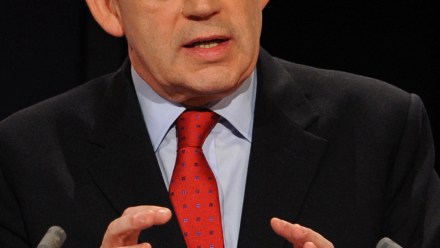
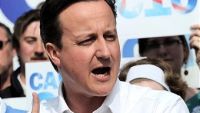
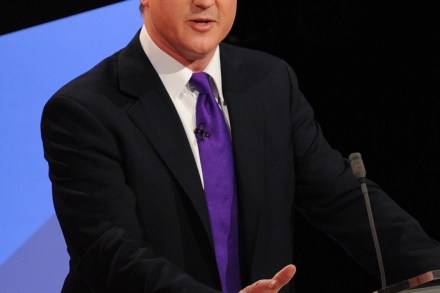
The headlines will be "score draw", but I’d say Cameron won – and comfortably. I write this as someone who could have happily have sunk a few pins into a voodoo doll of David Cameron earlier on this evening – for taking the Conservatives (and Britain) to this appalling point where he may yet lose the election. But he raised his game, substantially. At best, he spoke with passion and authenticity. This time, he looked like he was fighting for his political life, which (of course) he is. Things are looking up. Here’s my participant-by-participant verdict: Brown Brown was his normal automaton self. He does tend to mangle his words, and his attempts at simplification backfire.
Cameron is much improved – but the Lib Dem bubble hasn’t burst

From our UK edition

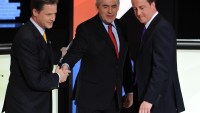
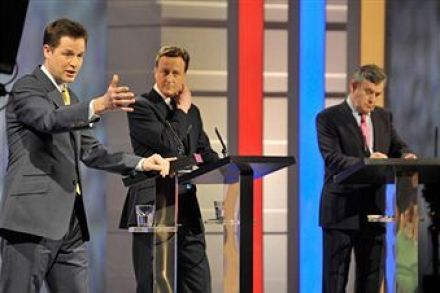
It seems that the general election of 2010 will turn on 90 minutes next Thursday. David Cameron was far better tonight than he was last week. This time he managed to bracket Brown and Clegg together and had the moment of the debate when he called Brown out on Labour’s leaflets claiming the Tories would scrap various things that pensioners currently get free. If there was a YouTube moment in the debate, it was that exchange when Brown said he didn’t authorise the leaflets making these claims. The Tory press team then delighted in pointing to a Labour party political broadcast where they had suggested the Tories would take away these things. Nick Clegg came under far more fire than he did in Manchester.

Cameron’s evening – as he and Brown fight back against the Clegg surge

From our UK edition

Well, one thing was clear: Brown and Cameron have both been at the textbooks, staying behind for extra classes, and learning the lessons of last week.  They came into this TV debate prepared.  Not just for the very fact of Nick Clegg, but with strategies and soundbites to slow his advance.  The result was a more passionate and confrontational show than I expected. Brown was the biggest surprise on the night.  Sure, you have to apply the usual caveats and parameters: he is Gordon Brown, and being disingenuous and deluded is what he does.  But, all that considered, he was uncharacteristically sprightly, I thought.

Tonight’s tactical battle

From our UK edition

If seven days ago, anyone had suggested that the first debate would propel Nick Clegg and the Lib Dems to the top of the polls we’d all have thought that their lunch had gone on rather too long. But that’s what happened. Tonight, the questions are whether Gordon Brown reprises his ‘I agree with Nick’ routine or tries to check Clegg’s momentum and whether Cameron can turn in the kind of performance that begins to turn things round for him.   Cameron shouldn’t be angry tonight. But he does need to bracket Brown and Clegg together at every opportunity.

Is Europe a Con-Lib deal-breaker?

From our UK edition

Europe is likely to play a big role in tonight’s debate. It is probably the one issue that divides the Liberal Democrats and the Tories as much as electoral reform. Nick Clegg, a former MEP and adviser to then-EU Commissioner Leon Brittan, is a euro-enthusiast who would like Britain to join the Euro, even if it takes time. David Cameron is a euro-skeptic (though not, to the chagrin of many CoffeHouse readers, obsessed about the issue).   But neither wants a confrontation with the EU and other European governments over the next four years - and the Liberal Democrats have become quieter over time about their pro-EU tendencies.

Not so squeaky clean

From our UK edition

“All my life, I’ve opposed the old politics,” says Nick Clegg ad nauseam. Not so it seems. Peter Oborne’s Mail column reports that one youthful indiscretion has been omitted from Clegg’s CV: ‘In fact, he has a background as a Westminster lobbyist with the firm GJW, where he worked as an account executive for 18 months. (Something he has omitted from his curriculum vitae on the Lib Dem website).’ So, Clegg glosses over his stint of political kerb-crawling. Hypocrisy always makes a good story but the Tories should, and probably will, shun this story. They have lost the media narrative and the last thing Cameron needs is for the campaign to focus on the leaders’ backgrounds.

The growing sense that the worst is behind the Tories

From our UK edition

These have been a grim few days for the Conservative party. But there is a sense, just a sense mind, that the worst might be behind them. Today’s ICM poll shows the Lib Dems still surging, up 3 to 30, but Tory support is only down one from Sunday’s ICM poll to 33. Labour is in third on 28, down one. Obviously, these polls numbers would have been considered pretty darn awful a week ago and no one would pretend that they are what the Tories would like to see right now. But they are not as bad as some feared they might be and as Julian Glover writes, “the Lib Dems have gained twice as much support from Labour as from the Conservatives. Meanwhile, Labour is losing support in all directions, including to the Conservatives and other smaller parties.

Can the Tories turn things from personality to policy?

From our UK edition

If the Lib Dem surge shows anything, then it's the growing power of personality politics in this country.  A few days ago, they're languishing in third place with around 20 percent of the vote.  One dose of TV razzmatazz later, and they're topping the polls on over 30 percent.  Yes, even though I admire much of what Nick Clegg has done with his party, there's little doubt that all this has been catalysed by simply putting him in front of the cameras.  Like someone with an okay singing voice reaching the X-Factor final, the Lib Dem leader triumphed in what was essentially a clash of personalities.

Overseas aid could be a Tory winner in Con-Lib fights

From our UK edition

As the Conservatives start looking at areas where the Liberal Democrats are weak, or where differences can be drawn between the parties, they are honing in on international development. In the Independent on Sunday, David Cameron and anti-poverty star Jeffrey Sachs lay out the party's plans if they win power. It includes a commitment to spending 0.7 of GDP on overseas aid, an emphasis "on greater transparency, ensuring the money reaches the people who need it most" and "action on women" as a conduit to development. The op-ed is clearly inspired by the work of Tory aid spokesman, Andrew Mitchell, who has written a piece for ConservativeHome this evening.

How Cameron can stem the Lib Dem tide

From our UK edition

If the Tories are to beat back this Lib Dem surge, there are three things they need to do. First, they need to establish Cameron as the insurgent, anti-establishment candidate. It might seem odd to urge the leader of the Conservative party to be the anti-establishment cadidate, but the establishment in this country is now essentially soft-left. Just look at how senior police chiefs are threatenting to resign over Cameron's plans for elected police commissioners who would be accountable to the public and set the priorities of the local force (another transformative Tory policy that Cameron didn't mention during the debate) Cameron needs to run against these people. He should be the tribune of the people pledging to return power to them from the unaccoountable and the unelectable.

Cameron has a policy agenda to change Britain – he should tell us about it

From our UK edition

Cameron has not, alas, broken free of the never-ending opinion poll bungee jump which is the story of his leadership of the Conservative Party. Cleggmania is a bubble – but the thing about bubbles is that one can never quite tell when they will burst. The Tories, who have lost the most votes due to this bubble, will have their needles out. But in my News of the World column today I suggest they focus on policy because they do have hard ideas that could radically change Britain. Cameron missed a trick by failing to mention his single best policy, Gove's school reform, last week.  On immigration, his plan for reducing it is the most radical promise on the market, and his linking it with welfare shows maturity and sophistication.

Mandelson contra Cameron

From our UK edition

So far as the Tories are concerned, Peter Mandelson is the political equivalent of an itch that you can't scratch: irritating, elusive and impossible to ignore.  And he's at it again today, with an article in the Independent on Sunday chiding the Tories' over their Big Society agenda.   It's not the "agenda of abandoment" attack that Mandelson made a few days ago.  But, rather, a return to the "cross-dressing" territory of last year.  As Mandelson puts it, "[Cameron's] tightly knit group of associates has simply pinched a few ideas from our campaign manual, rather than fundamentally reforming the party to make it fit for office.

Responding to the Lib Dem surge

From our UK edition

We've had the insta-polls and that eyectaching YouGov poll, and now we get the political reaction to Thursday's TV debate.  Interviewed in the Times, Alan Johnson plays up what Labour and the Lib Dems have "in common," and opens the door on a potential coalition.  While, in the Telegraph, David Cameron sets about Lib Dems policies – attacking, for instance, the "flimsy backing" to their plan for making the first £10,000 of income tax-free These different responses to the Lib Dem surge are stiking, if predictable.  Labour see Clegg as an opportunity: an opportunity to whitewash Brown's mechanical performance in the TV debate, and to keep the Tories out of government.

A gentle fightback

From our UK edition

The consensus is that David Cameron made a mess of last night’s TV debate. And whilst he wasn’t bad, he certainly wasn’t good, especially to watch. In a post over at Cappuccino Culture, I make the point that Cameron was the most static and soulless feature of a static and soulless piece of television. Undoubtedly the Tories' greatest presentational asset, his subdued performance is inexplicable. Whilst there is no cause for panic the Tories are rightly trying to regain the initiative. Gary Barlow’s appearance with Cameron at a school this morning didn’t relight Dave’s, or anyone else's, fire.

Where Did Labour’s Funniest Line Originate?

From our UK edition

I must say I had a chuckle at Alastair Campbell's tweet during the leaders' debate: "Clegg done well on style, Cameron clear winner on shallowness, GB winner on substance".  I had another chuckle when Alan Johnson used the line in the post-debate analysis and now I see David Miliband congratulating Alan Johnson for using it and  Miliband's comments being recirculated by eager Labourites. So who stole it from whom? For we socialists all property is theft and everything should be owned in common so I guess it doesn't really matter. But it is amusing to see how pleased everyone is with this one-liner.

So what’s changed?

From our UK edition

The question is: how much has really changed after last night?  And the answer is hard to pin down.  There are the plastic, surface changes, of course.  Nick Clegg may now be recognised by more that one-third of the nation.  His party will probably come under greater scrutiny from the media and his opponents.  And the leaders' debate is here to stay; a defining feature of this election which will become a standard feature of future contests. But what about deeper change?  Well, I can understand the argument – made punchily by Gideon Rachman here – that this will increase the likelihood of a hung Parliament.  That's probably true.  But there's also a chance that it might help the Tories pull clear of their opponents.

The Leaders’ Debate: Well Done Chaps

From our UK edition

Shall we stop being cynical for a moment and congratulate Brown, Cameron and Clegg for being the first political leaders in Britain to take part in a televised election debate? Indeed, we should particularly congratulate Gordon Brown for agreeing to this. He had by far the most to lose. There is absolutely no doubt that Nick Clegg won this. He faltered from time to time, but was the only one confident enough to take thoughtful (if sometimes stagey) pauses.  I thought Gordon Brown also did surprisingly well. He kept his cool and showed that he is an accomplished debater. His jokes were over-prepared and characteristically dreadful, but he warmed up through the 90 minutes and challenged Cameron very effectively on several occasions, especially over police spending.

The novelty of Clegg wins it for him

From our UK edition

“I agree with Nick”, said Brown – and, as it turned out, so did most of the people YouGov polled. Brown lived right down to expectations, Cameron lived up to them (but didn’t exceed them). Few would have had any expectations from Clegg: what we political pundits know to be his clichés will be heard for the first time in many living rooms tonight. Each used tactics we’re familiar with. Brown opened his verbal machine gun, and sought to mow down the audience (they surrendered early on). David Cameron was fluent, articulate – as anyone who has followed politics had come to expect. But dazzling? No. He was subdued, seemed to be biting his tongue at times. He didn’t attack Brown, which seemed to be deliberate.

Nick Clegg triumphs – and Cameron gains – in the first TV debate

From our UK edition

So, who won?  Well, hold your horses, dear CoffeeHouser.  First, it's worth noting that that was a good shade more compelling than I thought it would be.  There were moments of heat, drama and political tension, of course.  But there was also a sprinkling of light as well.  I suspect anyone watching that would have picked up a working sense of the differences and similarities between the parties and their leaders. So, who won?  Well, it depends what you mean by "won".  Nick Clegg certainly gained most from the evening.  He was confident, coherent and had a strong line on almost every policy area, whether you agreed with those lines or not.