David cameron

Leaders’ debate – live blog

From our UK edition

2207, PH: Well, we've just been through all that - and guess what's leading the News at Ten.  Yep, the ash cloud... 2205, PH: And that's it.  I'll be writing a verdict post shortly. 2203, PH: And Cameron has pre-empted Brown's statement well.  He says that the other two have tried to frighten the audience about the Tories - but "put hope before fear".  His key message after that is about national insurance.  A solid closer from the Tory leader. 2201, PH: Classic Brown. He points the finger at the Tories, saying that they can't match Labour's guarantees and that they'd risk the recovery. I'm not sure this negative approach will come across so well. 2200, PH: Here we go: the closing statements.
Take your seats

From our UK edition

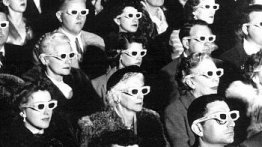
Right – the pizza has been ordered, my glass is overflowing with raspberry Ribena (New! And delicious!), and I've fired up the old cathode ray tubes. But, somehow, I'm still feeling quite ambivalent about tonight's TV debate. Maybe it's because I still suspect it will be a cautious affair – with neither side wanting to risk the kind of mistake which could define their evening. Maybe it's because of the wall-to-wall coverage of the past few days. Or maybe it's because the New York Times has a (deliciously arch) point when it writes that UK politics is finally "moving into the television age".

Advantage Cameron | 15 April 2010

From our UK edition

I’ve just been watching the feed coming out of the studio where the debate is taking place and what struck me was how much of an advantage his central position will give David Cameron. In all the shots of the studio, the middle lectern is where your eye is drawn first. The leaders, I’m told, have all had half an hour in there to familiarise themselves with the surroundings. They now appear to be white-washing parts of the studio.

What Do We Really Want from a Labour Government?

From our UK edition

After reading Seumas Milne and Timothy Garton Ash in the Guardian and then looking at the advert for the New Left Review on the back of the London Review of Books ("Good Riddance to New Labour"), I do wonder what these people want from a centre-left government. God knows I have been critical of New Labour -- I've had a pop at its record on civil liberties, education, radical Islam, prisons. I could go on. This government has lacked imagination and it has failed to be bold enough. But between 1997 and 2008 Britain became more tolerant and more confident. Hell, it has almost became a modern European nation. It is a better place to be than it was in the 1980s. David Cameron knows that and so do his closest allies in the Conservative Party.

Memo to Cameron: don’t be angry

From our UK edition

There will be no shortage advice for David Cameron as he prepares for tonight’s TV debate. Wear this tie, smile a lot, be direct but not controversial and so on. The newspapers have been full of tips and lessons from the US debates. The Tory leader is also said to have hired Squier, Knapp, Dunn Communications, a DC-based political consultancy, specifically for help with the TV debates. Allow me to add my piece of (unsolicited but free) advice: don’t be Mr Angry. People want to like you; they want to feel that you can be trusted. They know they don’t like Labour. They know that the country needs change. But they are not yet sure you represent a benign form of change.

Brown’s signature parade

From our UK edition

Only 58? Labour's last letter attacking Tory spending cuts this year had 60 economists' signatures attached to it. Their latest, released today, has only 58. Number 10's signature-marshalling skills are clearly on the wane. I sincerely hope that the Tories don't marshal some economists of their own. The last time that happened, back in February, we witnessed the low point of the fiscal debate – with both sides using a bunch of academics as a substitute for a proper conversation with the public. And, lest we forget, Guido's handy graph reminds us just what those economists were and are quibbling over anyway. This is a phoney war, so it's little surprise that Brown has resorted to it once again. Thankfully, signs are that Tories won't pay heed to the bait.

Follow the money | 14 April 2010

From our UK edition

Looking at the papers this morning and watching the news last night, you realise what a benefit in the image stakes the Tory cash advantage gives them. The Tories can afford to hire out better venues than the other two parties. So while Labour launched their manifesto in hospital and the Lib Dems theirs at Bloomberg, the Tories used Battersea Power Station which provided them with much better visuals. We saw the same dynamic on the day the election was called: Labour’s event was in Downing Street, the Lib Dem one in an office and the Tory one on the terrace of County Hall looking over to Parliament The Mirror’s front page today accuses Cameron of using his photo-ops to benefit the firms that are backing his position on National Insurance.

Labour’s response to the Tory manifesto

From our UK edition

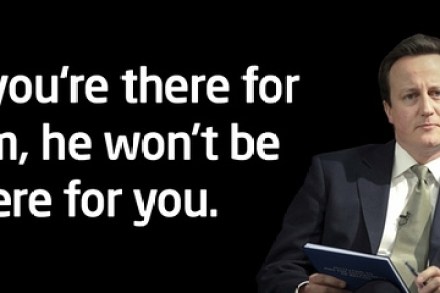
Anyone else think that Labour's latest poster is like a negative of the Tories' "Vote For Me" effort?  White text on a black background, instead of black text on a white background.  A picture of Cameron, instead of Brown.  I mean, the only thing that isn't swapped over is the tone: both go on the attack, rather than presenting a positive vision. Labour's message here is that the Tories' Big Society manifesto washes its hands of the people.  Which echoes the caricatures - "an agenda for abandonment" - that Peter Mandelson wheeled out yesterday, and which you can expect to hear again and again between now and polling day.  The question is whether this attack will connect at a time when people trust politicians - and their capabilities - less than ever.

Voting blues

From our UK edition

One of the key questions in any election is turnout: whose voters will turn up and whose won’t. People are clearly disappointed in the political class - on a scale from 0 to 10, trust in politicians and parties is hovering around 3 points - but does it mean that they will stay at home, spoil their ballots or opt for fringe parties and single-issue candidates? What about the talk of a hung parliament ? Will it make voters believe that their vote counts - and so bring them to the polling stations -- or make them stay at home, giving up on the idea that any change is possible? In the last three elections turnout was low, relatively speaking: 59 percent of the electorate voted in 2001 and 61 percent went to the polls in 2005.

The Big Idea Competition

From our UK edition

Whatever your political leanings, it is hard to deny that the Tories won the Big Idea Competition. The Labour Party offered a series of unconnected (if occasionally innovative) initiatives. But they lacked coherence. Their manifesto had what Peter Mandelson called “Blair Plus”, but also what could be referred to as “Prescott Squared”. “What's The Big Idea?” asked Sky’s Niall Paterson. The Tories on the other hand have a Big Idea – decentralisation. Giving power to citizens in a number of different ways. It is a concept that gives shape to the Tory manifesto, providing a ready stock of sound-bites.   But why do we need Big Ideas, as opposed to just Good Ideas?

The Tories’ great manifesto launch

From our UK edition

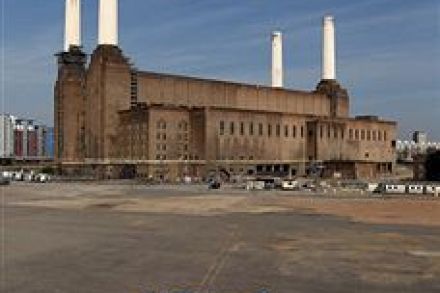
Battersea Power Station is chosen as an allegory for Britain – “a building in need of rejuvenation in a country in need of rejuvenation” says David Cameron. As for Cameron’s speech – great stuff. He delivered the ‘empowerment’ message and gave hard examples, and wrapped it up into a greatest hits of his best soundbites (none the worse for that). It was so up our street that, at times, I thought he was working his way through the leader in the current edition of The Spectator. I’ll save my full verdict on Cameron’s speech and positioning for the magazine this week.  But here’s the rest of the launch. The Tories went for an ensemble, with each of the Shadow Cabinet taking turns to read out the lines.

Tory manifesto launch – live blog

From our UK edition

Stay tuned for live coverage from 1100. 1238: And that's it. Phew - quite a marathon.  A strong central message, I think, but it could have been said in fewer words.  Thanks for tuning in. 1235: The Guardian's Nick Watt asks why the Tories aren't talking more about the extent, and the consequences, of spending cuts.  Cameron's response is that he has "always been frank" with the public. 1233: Key question on whether withdrawing the state will mean worse public services for folk.  Cameron says that he not looking to pull the rug from under people, but just to introduce choice and competition to counter the "dead, dull hand of the state.

Don’t mention ze Europe

From our UK edition

The Conservative Party’s departure from the European People's Party came down to a choice of expediency over principle. If you are inclined to accept that Britain will stay in the EU and that membership helps this country - even if it requires some compromises - you will likely find the move unfortunate. If you are more concerned about the principles at stake – and feel that Britain’s loss of sovereignty has gone too far – and do not care about the loss of influence on the legislative process, you are likely to be in favor of the Tory move.   David Cameron is keen to keep the issue of Europe away from the campaign - and he is likely to succeed.

Where’s the surprise?

From our UK edition

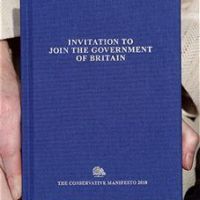
Am I the only one who'd care for a bit more uncertainty and surprise when it comes to the election campaign?  I mean, yesterday, Labour released a manifesto which had been heavily trailed for weeks, even months, in advance.  And, today, it looks as though the Conservatives are going to do likewise – with the political barometer saying that their Invitation to Join the Government of Britain won't contain anything substantially new.  Its cover was even published last night.  And, if you want an sense of what Cameron will say today, then just read his article in this morning's Times. Of course, it's the job of a well-oiled campaign machine to build anticipation in advance, and to keep feeding the media beast along the way.

The Tories invite you to join government

From our UK edition

Battersea Power Station was the site of one of the Tories' most effective publicity stunts of recent months – and it will be the venue for their manifesto launch tomorrow.  Details are already emerging about the document (ConHome has a good summary here), which sounds as though it won't contain much, if anything, that we haven't heard before.  As with Labour earlier, this approach risks an indifferent response from the media and the public.  But at least the Tories have clearer flagship policies to broadcast – the national insurance cut among them. While the manifesto may not contain any new policy, it sounds as though the Tories have gone to town on it presentationally.

Come out, come out wherever you are

From our UK edition

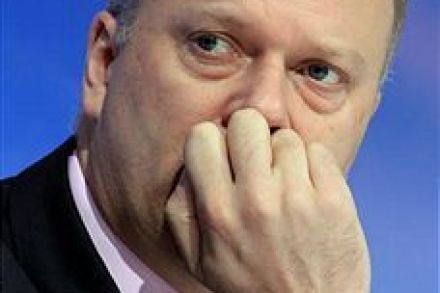
Chris Grayling, the Shadow Home Secretary and former attack dog, seems to have been cast into outer darkness. As with Oliver Letwin’s disappearing act in the 2001, Labour is toasting this unofficial scalp. Denis MacShane has been adding poison to the potion this morning. The Tories are paying a heavy price for Grayling’s B&B gaffe, but it’s self-inflicted. Grayling’s comments were cackhanded and I think he is wrong, but they were nowhere near as controversial as was claimed – he was seeking a clarification of the law, not calling for Sandi Toksvig to be lynched. I doubt Grayling will be Home Secretary but such a senior Shadow minister can’t hide away for ever.

What would you ask Cameron?

From our UK edition

David Cameron takes a few journalists with him on each of his one-day tours, and it's my turn tomorrow: 6am start. I should be able to get  half an hour or so with him, to do an interview for The Spectator. As is customary, I'll try and ask him some questions on behalf of CoffeeHousers - so please add any thoughts as a comment below.